Huntingdon County Head Start and Pre-k Advocates Urge Lawmakers to Resolve Budget Impasse as Classrooms Face Uncertain Future
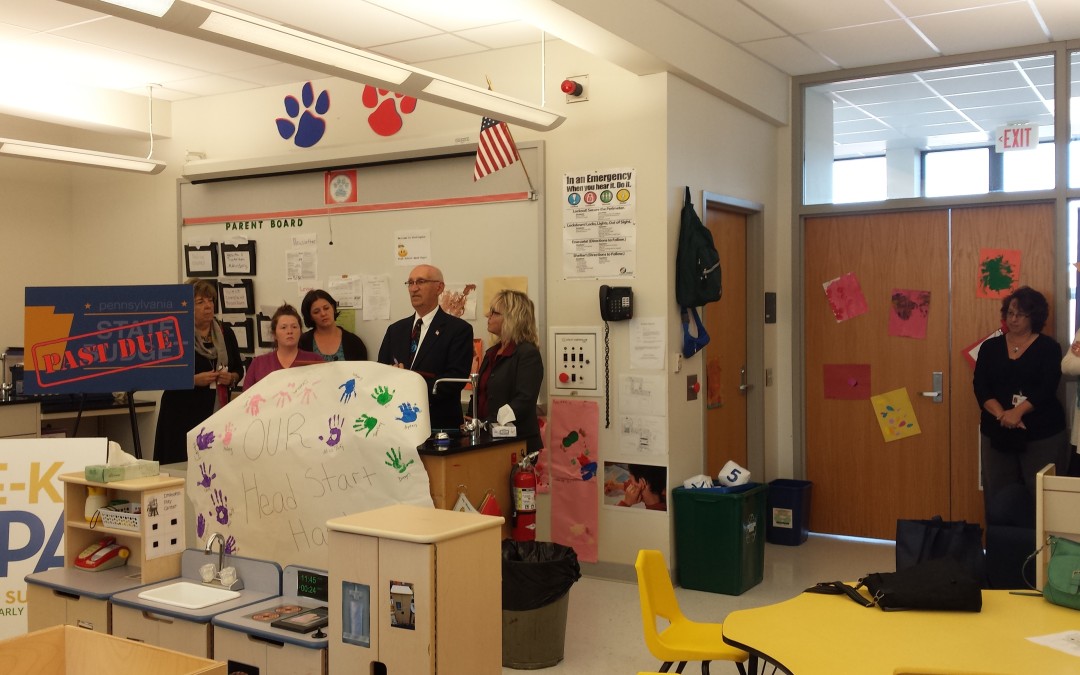
Education Officials, Human Services Providers, Parents & pre-k advocates gather to urge Gov. and Legislature to Act Swiftly on Budget with Increased Investment in Pre-k
HUNTINGDON COUNTY (October 15, 2015)– As the budget impasse continues in Harrisburg, the Huntingdon County Child and Adult Development Corporation, which currently enrolls 120 pre-k kids in seven classrooms across the county, says it ability to keep the doors open depends on the approval of yet another bridge loan. If approved, the loan will keep HCCADC’s 7 state funded Pre-K Counts and Head Start classrooms open until roughly Thanksgiving.
“It is extremely difficult to operate ‘state-funded’ early learning classrooms with no state funding,” said Louise Ketner, Executive Director of Huntingdon County Child and Adult Development Corporation. “Due to the impasse, we have already had to close our adult education and family literacy programs. Now we are trying to secure our third loan to keep our pre-k kids enrolled and our 17 teachers employed.”
As the budget impasse stretches on to its 106th day, Pre-K Counts and Head Start Supplemental grants have not gone out to pre-k providers across the Commonwealth – forcing them to operate off of reserves, lines of credit, bridge loans, or ultimately consider closures and layoffs.
“We had actually hoped to open an additional classroom this school year to help off-set the high demand for pre-k in Huntingdon County,” continued Ketner. “This all speaks to the fact that our state legislators and Governor Wolf must get to work and pass a budget that keeps pre-k kids in class and takes a step towards reducing the unmet need for these services in our community.”
Stephanie Mock of the Pre-K for PA Campaign stressed the importance of pre-k. “High-quality pre-k is a critical investment in the future of our children. Higher graduation rates, lower criminal activity, greater lifetime earnings, lower rates of special education are all connected by research to quality pre-k programs,” said Mock.
“As a parent, you see the important progress that your child makes in that year of Head Start,” said Danica Coulter, a parent of an enrolled student. “I would really hate to have my child miss out on a full year of pre-k because of this state budget impasse.”
The Pre-K for PA Campaign continues to encourage Governor Wolf and legislative leaders to return to the negotiating table and pass a budget with a significant investment in pre-k that gets us on the path to serving more of the 200,000 thee and four-year olds without access in the Commonwealth.
According to data from the campaign, each year (under FY 2014-15 funding levels) more than 70% of three- and four-year-olds in Huntingdon County do not have access to high quality pre-k.
“These 200,000 kids don’t get a “do-over” if they miss out on high-quality pre- k,” continued Mock. “For them, this budget negotiation must include $120 million of new state funding so that programs like this one can expand to serve more of the kids without access right here in Huntingdon County.”
The Pre-K for PA campaign believes that high-quality pre-k should be available to all children – beginning with those most in need. Advocates say that to accomplish this Pennsylvania needs to aggressively ramp up its investments over the next four years.
“This will take about $400 million in additional state investments over the coming years,” said Mock. “The greater the funding increase for Pre-K in this budget – the closer we get to that goal.”
Pre-K for PA was launched in 2014 with the vision that every 3- and 4-year-old in Pennsylvania will have access to high-quality pre-k. This statewide coalition includes: Delaware Valley Association for the Education of Young Children; Economy League of Greater Philadelphia; Fight Crime: Invest in Kids; Mission: Readiness; Pennsylvania Association for the Education of Young Children; Pennsylvania Head Start Association; Pennsylvania Partnerships for Children; Pittsburgh Association for the Education of Young Children; Public Citizens for Children and Youth; and United Way of Greater Philadelphia and Southern New Jersey. www.prekforpa.org
###

Uncertainty Grows in Pre-K Classrooms Across PA
Providers Acquire Bridge Loans; Classrooms Sit Empty and Threat of Closure Remains as a Result of Harrisburg Budget Impasse
ROYERSFORD (August 28, 2015)– The budget impasse in Harrisburg has left many Pre-K Counts and Head Start providers seeking bridge loans to keep their doors open or pondering closure of state funded classrooms, while potential new expansion classrooms sit empty awaiting a resolution to ongoing budget negotiations.
Pre-K providers were joined by superintendents from Pottstown and Spring-Ford school districts at Play and Learn in Royersford, in a newly constructed pre-k expansion classroom, which will remain empty until the level of pre-k funding is resolved with the overall state budget.
Without a state budget in place, Pre-K Counts and Head Start Supplemental grants did not go out to pre-k providers across the Commonwealth, forcing them to make the hard decision to either solicit private bridge financing and pay the interest associated with that or close state funded classrooms.
Delaware County based Today’s Child Learning Centers took out a $130,000 bridge loan this week, which will enable them to operate state funded classrooms for about a month. “This loan helped us ensure that our doors remained opened to the 138 children and families that we serve in state programs,” said Erinn Rinn, Community Relations Coordinator, Today’s Child Learning Centers. “But even this is only a short term solution. Bridge financing will run out in October. In a real sense, the clock is ticking.”
Christine Fox of Warwick Child Care Centers in Chester County added that Warwick has also taken the risk of opening its approved Pre-K Counts classrooms to 56 children without any state funds, absorbing the salaries for 9 teaching staff and maxing out their line of credit and even their credit cards. “We hope that our story will help Harrisburg and our legislators realize the detrimental impact the budget impasse is having on thousands of children across the state, putting an irreversible strain on childcare employers and employees. Our ability to continue providing high-quality early childhood education to our PA Pre-K Counts children and families, as well as all of the additional families in our centers, is in danger if the budget is not passed. The clock is ticking for all of us,” continued Fox, adding that Warwick would like to provide an additional 14 seats if the program is expanded.
In Pottstown, a school-community collaboration is serving 360 children but still leaves out 278. “Our data shows that the PA Pre-K Counts students enter kindergarten better prepared than the district average. And, the Pre-K Counts students maintain that advantage throughout elementary school, with no evidence of fadeout,” said Dr. Jeffrey Sparagana, superintendent of the Pottstown School District. “We need more Pre-K Counts classes in Pottstown and across the Commonwealth to build strong, stable children and families.”
“Each year (under FY 2014-15 funding levels) more than 30,000 three- and four-year-olds in Montgomery, Delaware and Chester Counties are missing out on this once-in-a-lifetime learning opportunity. These kids don’t get a “do-over” if they miss out on high-quality pre- k. For them, this negotiation must also be about increased funding,” stated Shawn Towey of the Pre-K for PA campaign.
In Montgomery County 32 % of kids under five years old are living in families under 300% of the federal poverty guidelines, making them eligible for state funded pre-k programs. Only 6 percent of Montgomery County 3- and 4-year-olds have access to publicly funded pre-k. Play and Learn sits on additional empty classroom space awaiting much-needed state expansion funds so it can hire new teachers.
“We have this beautiful new classroom to educate our children, but without additional state funding, it will sit empty,” said Melanie Godhania, Program Operations Director for Play and Learn. “It is the reason why Pennsylvania needs a state budget now that further invests in pre-k.”
Kristine Helman, whose daughter is enrolled in Pre-K Counts at Play and Learn’s Blue Bell Center, joined the conversation on Friday. “For every spot in my daughter’s class, there are a dozen more families that need this program and couldn’t enroll their child. I am so lucky she had such an enriching early learning program. I can see how excited it makes her to learn new things every day. I worry that the budget delay is trimming valuable days off of the coming school year. Every day of lost learning, is one day less to ensure our kids are ready for kindergarten. I know that our elected leaders are supporters of pre-k, but they must recognize the impact that this will have on families.”
“High-quality pre-k is a critical investment in the future of our children,” said Towey. “Higher graduation rates, lower criminal activity, greater lifetime earnings, lower rates of special education – research has shown that all of these are results of quality pre-k programs.”
The Pre-K for PA campaign is calling on Governor Wolf and legislative leaders to return to the negotiating table and pass a budget with a significant investment in pre-k that gets us on the path to serving more of the 200,000 three and four-year olds without access.
Towey praised the bi-partisan support in Harrisburg for pre-k. She referenced that both the Republican proposed budget and Governor Wolf’s proposed budget grew funding for pre-k by $30 million and $120 million respectively. “We urge the legislature and Governor Wolf to not just pass a budget swiftly, but pass a budget with a major new investment in early learning.”
The Pre-K for PA campaign believes that high-quality pre-k should be available to all children – beginning with those most in need. Advocates say that to accomplish this Pennsylvania needs to aggressively ramp up its investments over the next four years.
“This will take at least $400 million in additional state investments over the coming years,” said Towey. “The greater the funding increase for pre-k in this budget, the sooner we get to the goal of making quality early learning accessible for every family.”
Pre-K for PA was launched in 2014 with the vision that every 3- and 4-year-old in Pennsylvania will have access to high-quality pre-k. This statewide coalition includes: Delaware Valley Association for the Education of Young Children; Economy League of Greater Philadelphia; Fight Crime: Invest in Kids; Mission: Readiness; Pennsylvania Association for the Education of Young Children; Pennsylvania Head Start Association; Pennsylvania Partnerships for Children; Pittsburgh Association for the Education of Young Children; Public Citizens for Children and Youth; and United Way of Greater Philadelphia and Southern New Jersey. www.prekforpa.org
Former Governor Schweiker Calls for Investment in Pre-k, Encourages Supporters to Stay Energized
Panelists Discuss Power and Politics of Pre-k
ERIE (August 14, 2015)– Former Governor Mark Schweiker opened the 2015 Kiwanis Early Education Summit, as part of the Pennsylvania District of Kiwanis International Annual convention at the Erie County Convention Center today with a continued call for significant investment in early learning and a repeated call to action to pre-k supporters.
“Stay energized, be intelligently persistent and we will be successful,” exclaimed former Governor Mark Schweiker to a crowd of about 300 Kiwanians and Pre-K for PA supporters. “There is a great impasse in Harrisburg, but I’m optimistic—I’m bullish about this. $120 million is a good start, which means 14,000 kids have a shot to get into a high-quality classroom. The intellectual and human and social development and opportunities for these kids is immense.”
The six-weeklong state budget impasse has left Pre-K Counts recipients without state funding, and a $120 million new pre-k investment hangs in the balance.
“We have a growing bipartisan coalition behind this,” said former Governor Schweiker. “This isn’t some off to the side political pursuit or a break the bank pursuit. We think it’s an affordable commitment. We’re talking $120 million in a general fund budget north of $29 billion. It’s not going to break the bank. I would argue in the out years that it’s going to save dollars.”
Schweiker continued: “If we do this right, and the idea is a steady march, in four or five years we are close to 170,000 kids. It’s not going to happen overnight, but we will get there. We have to go in the right direction, because as you know, the academic and human development payoff is tremendous.”
Co-Chairs of the NW PA Pre-K for PA campaign, Ron DiNicola and Nick Scott, Jr., moderated two panels following Gov. Schweiker’s keynote address.
PANEL: The Case for Early Learning
Moderator: Nick Scott, Jr.
Dr. Karen Tyler, ED.D, Head of School, Erie Day School
Mr. Michael Palzony, Sr. Vice-President, Erie Family Life Division & Member, Pennsylvania Early Learning Investment Commission
Dr. Joyce Miller, PH.D, CEO, Northwest Institute of Research
Ms. Betsy Bort, Sr. Vice-President, Erie Bank & Member, Pennsylvania Early Learning Investment Commission
PANEL: Funding Education: The Politics of Early Learning
Moderator: Ron DiNicola
Mr. Mark Longetti, Pennsylvania State Representative
Dr. Jay Badams, Superintendent of Schools, Erie City School District
Ms. Donna Cooper, Executive Director, Public Citizens for Children and Youth; Former PA Secretary for Policy and Planning
Kiwanis International is a global organization of members dedicated to serving the children of the world. Each community’s needs are different—so each Kiwanis club is different. By working together, members achieve what one person cannot accomplish alone. Kiwanians believe that when you give a child the chance to learn, experience, dream, grow, succeed, and thrive – great things happen.
Pre-K for PA was launched in 2014 with the vision that every 3- and 4-year-old in Pennsylvania will have access to high-quality pre-k. This statewide coalition includes: Delaware Valley Association for the Education of Young Children; Economy League of Greater Philadelphia; Fight Crime: Invest in Kids; Mission: Readiness; Pennsylvania Association for the Education of Young Children; Pennsylvania Head Start Association; Pennsylvania Partnerships for Children; Pittsburgh Association for the Education of Young Children; Public Citizens for Children and Youth; and United Way of Greater Philadelphia and Southern New Jersey. www.prekforpa.org
###
Pre-K for PA Urges Leaders in Harrisburg to Negotiate a Budget that Boosts Early Learning
Harrisburg, PA (July 1)—The Pre-K for PA campaign, along with the Early Learning PA coalition, today called on leaders in Harrisburg to continue negotiating a budget that builds on the increased investment in early childhood education.
The coalition partners called the budget passed by the House and Senate on Tuesday, which included a $30 million increase, a good first step. That increase would serve about 3,500 more 3- and 4-year-olds who can benefit from high-quality pre-k programs. The campaign urged more significant investments so more children can benefit in the coming school year.
Nearly 70 percent of Pennsylvania’s 3- and 4-year-olds – more than 200,000 children in all – don’t have access to high-quality pre-k. The campaign supports an investment of an additional $120 million in fiscal 2015-16, which would allow another 14,000 children to benefit.
The principal partners of the Pre-K for PA campaign (listed below) issued the following statement:
“Our coalition leaders understand that negotiations can be difficult, particularly when it comes to expanding investments, but we know that high-quality pre-k works and the failure to invest at a higher level will have negative impacts on many children. An investment of $120 million this coming fiscal year and in the subsequent three state budgets will set us on a path that will allow every child born today who is at-risk of school failure and some middle class kids access to high-quality pre-k.
“Our coalition members have spoken to dozens of lawmakers who have enthusiastically voiced their support for investing more in our state’s youngest learners, far too many of whom are left out of this budget. Gov. Wolf’s original budget proposal only increases access to 1 in 4 of our 3- and 4-year-olds, which is why our commitment to high-quality pre-k investments needs to be a long-term one that goes beyond a single budget year.
“We urge lawmakers and Gov. Wolf to keep in mind those children who will start kindergarten behind their peers because they missed out on the benefits high-quality pre-k provides. There are no do-overs for these children.
“We encourage Gov. Wolf and all legislative leaders to advance negotiations on behalf of each kid who would gain access to high-quality pre-k and craft a budget that adequately invests in this proven learning resource.”
Pre-K for PA is an issue campaign supported by individuals and organizations across Pennsylvania who believe that investing in our children is the right choice and an urgent necessity. Our vision is that every 3- and 4-year-old in Pennsylvania will have access to high-quality pre-k. We will not endorse nor oppose candidates, but rather we will advocate on behalf of this vision for Pennsylvania’s children, schools and communities. For more information www.prekforpa.org.
# # #
The Budget passed by the House last week was passed in the Senate today. Unfortunately, the level of pre-k funding it includes for fiscal 2015-16 does not go far enough to expand access to high-quality pre-k urgently needed for Pennsylvania’s families.
While we at the Pre-K for PA campaign are very heartened that House and Senate leaders boosted pre-k funding considerably and we recognize the actions are the first step in the budget process, the budget falls short of the enormity of the need to make sure children start school ready to learn.
With fewer than 20 percent of Pennsylvania’s 3- and 4-year-olds able to access publicly funded, high-quality pre-k programs, the pace of expansion must be hastened. At a minimum, the fiscal 2015-16 investment should be $120 million.
Your continued support is so valuable as we reach out to the governor and all legislators to work with them toward reaching a final budget agreement that makes the level of investment in pre-k that we all know is needed.
This weekend the PA House of Representatives is expected to pass a 2015-2016 state budget that authorizes no new taxes yet grows funding for high-quality pre-k by $30 million, which would provide access to approximately 3,500 more children. The $30 million investment is significantly less than the $120 million proposed by the Administration that would serve approximately 14,000 additional children.
The Pennsylvania Senate will vote on this measure early next week and send it to the Governor’s desk where a veto is expected. This will set up a budget standoff for early July where your voice will be critical in advocacy efforts to help ensure greater funding for high-quality pre-k access in a final state budget.
The Pre-K for PA campaign and its partners are leading the charge in Harrisburg on behalf of the Commonwealth’s youngest learners. Please check for emails from Pre-K for PA and visit the website next week for the most up-to-date information on how you can lend support.