CHOP Pediatrician: Pre-K Prevents and Heals
Dr. Nate Blum joins Rep. Todd Stephens, Rep. Madeleine Dean at regional legislative breakfast focused on the case for expanding pre-k quickly to thousands of at-risk kids in Delaware, Philadelphia Counties
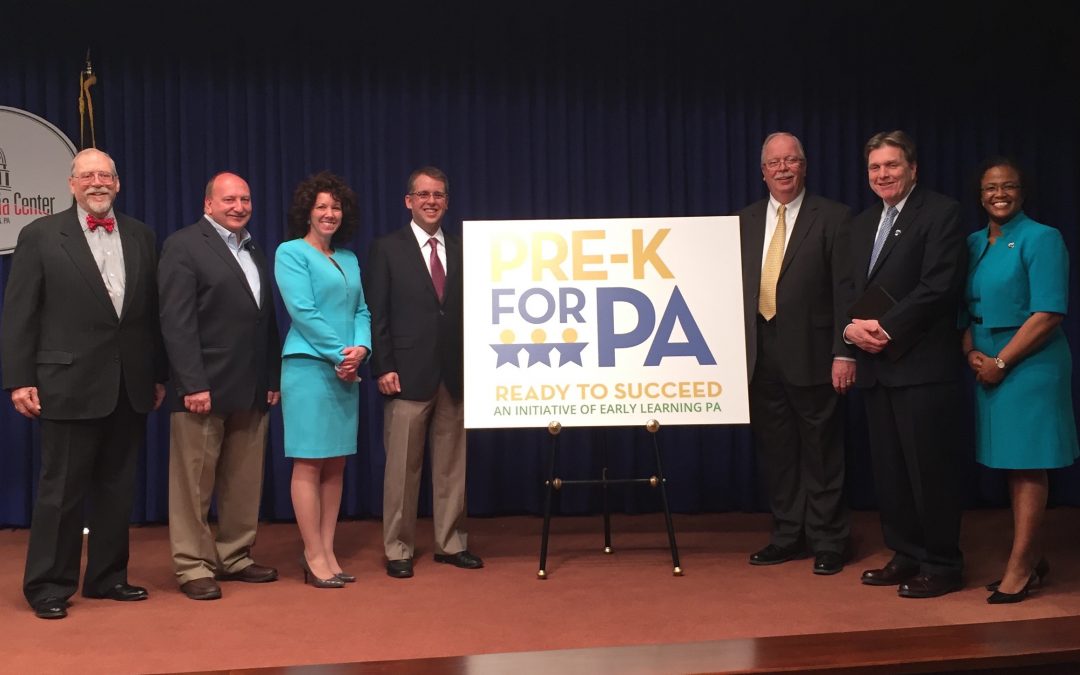
Wayne, PA (May 4, 2016) –Chief of the Division of Developmental and Behavioral Pediatrics at The Children’s Hospital of Philadelphia, Nate Blum, MD joined local business leaders and education advocates as part of a regional Pre-K for PA legislative breakfast today with PA State Representatives Todd Stephens and Madeleine Dean to call for a serious investment in pre-k as leaders in Harrisburg launch budget negotiations.
The group participated in a panel discussion that focused on the need to increase state funding and research documenting the impact of high-quality early childhood programs on educational and life outcomes for at-risk children and specifically how it can affect a child’s health and development.
Dr. Blum outlined findings in a Pennsylvania Chapter of American Association of Pediatrics policy statement released earlier this year, “Poverty and Child Health in the United States” that noted early childhood interventions such as high-quality pre-k programs have a high return on investment in both human and financial terms, in part because of their power to mitigate the negative impacts of toxic stress. He also previewed findings of a PA AAP report to be released May 16th at the state Capitol in Harrisburg.
“Much of the work we do in pediatric medicine is focused on prevention,” said Dr. Blum. “Another key area of our work is mitigating the health impacts of things we cannot prevent. Finding ways to heal and help children recover from harm that has come to them.
“Pre-k programs are, in essence, a form of both prevention and healing. High-quality pre-k programs can help prevent the loss of opportunity by preparing children academically and socially for success once they enter kindergarten. And these programs can help heal by mitigating the impact of toxic stress and other negative forces that can undermine a child’s success. If you look at it in that context, I think it becomes clear why pediatricians are so strongly supportive of giving all of our children access to high-quality pre-k.”
The 2016-17 budget proposal includes $120 million in additional funding over two years for high-quality pre-k, which includes the $30 million in new funding already enacted for the second half of the current school year. If realized, Pennsylvania’s investment will rise to $197.284 million in Pre-K Counts and $59.178 million in the Head Start Supplemental Assistance Program in FY 2016-17.
“All students should have access to early learning opportunities setting them on a path to success while reducing future government costs,” said State Representative Todd Stephens. “Pre-k can change a child’s path from one that leads to poverty or prison to one that develops into a life-sustaining career. Pre-k is great for both children and taxpayers.”
Across Pennsylvania, there are more than 175,000 3- and 4-year-olds who are at-risk because they are in lower income households—70 percent of these at-risk young learners – more than 120,000 children statewide – had no access to publicly funded pre-k last year.
“Research shows the value of quality pre-k education,” said State Representative Madeleine Dean. “The money invested in early education more than pays for itself over time in decreased special education, public welfare, unemployment, and prison costs.”
In his remarks, Jim Cawley President & CEO of Greater Philadelphia and Southern New Jersey, outlined the enormous need for investment, particularly when it comes to the high percentage of at-risk kids with no access to pre-k. Cawley outlined troubling statistics regarding the lack of availability of high-quality pre-k for children at greatest risk of academic failure due to conditions or circumstances beyond their control.
“Even with a $90 million increase in state pre-k funding for fiscal 2016-17, Pennsylvania would still have more than 107,000 – or about 61 percent – of at-risk preschool children without access to high-quality pre-k,” said Cawley. “This is why continued and consistent investment in pre-k is so critical. Every child deserves the opportunity to succeed in their educational experience and ultimately to succeed in life.”
Philadelphia County has more than 29,900 at-risk 3- and 4-year-olds, and a staggering 59 percent of them – about 17,600 children – lacked access to high-quality pre-k last year. Delaware County has more than 14,850 at-risk 3- and 4-year-olds, and about three-fourths of them – 5,284 children – also lacked access to publicly funded, high-quality pre-k last year.
By the time at-risk children get to kindergarten, reports show many are already behind in vocabulary development and pre-literacy and pre-math skills. They can also have problems with behavior and impulse control – which makes it hard to get along with other kids and teachers.
Pre-K for PA is an issue campaign supported by individuals and organizations across Pennsylvania who believe that investing in our children is the right choice and an urgent necessity. Its vision is that every 3- and 4-year-old in Pennsylvania will have access to high-quality pre-k. Pre-K for PA does not endorse or oppose candidates, but rather advocates on behalf of this vision for Pennsylvania’s children, schools and communities. For more information visit www.prekforpa.org.
# # #
PA Mayors Call for Continued Investment in Publicly Funded Pre-K; Pre-K Helps Develop Vibrant Communities
HARRISBURG (April 11, 2016)— As Mayors from Pennsylvania’s largest population centers continue to advocate for major pre-k initiatives in Philadelphia and Pittsburgh, Mayors and other leaders from mid-sized cities and communities across Pennsylvania gathered in Harrisburg today to encourage Governor Wolf and legislators to continue investing in publicly funded pre-k. The Mayor’s said pre-k is a vital element in the development of municipalities, citing lower crime, improved education outcomes, and greater workforce readiness as the key reasons to invest.
Lancaster Mayor J. Richard Gray, President of the Pennsylvania Municipal League joined forces with leaders from Cranberry to Lebanon in a chorus of support for expanded access to pre-k, “I support expanded access to pre-k as a cost-effective strategy to make our communities safer, and grow new jobs and businesses. A growing body of research shows that early childhood education in a pre-kindergarten setting provides a proven pathway towards achieving these goals.”
Governor Wolf’s 2016-17 proposed budget includes another $60 million in new funding for high quality pre-k. That investment would build on this year’s expansion and allow more than 14,000 young children to access pre-k over the two-year time period.
Research shows that expanded access to high quality pre-k can also reduce crime rates and make communities safer. Hundreds of Pennsylvania police chiefs, sheriffs and district attorneys have lined up behind efforts to invest in pre-k.
“Less crime means less money spent fighting crime,” said Pennsylvania Municipal League 1st Vice President and City of York Mayor C. Kim Bracey. “Imagine what we could do to improve our city or lower our taxes if we didn’t have to devote so much of our local budget to dealing with crime on the back-end.”
Bracey cited the Chicago Child-Parent Center (CPC) preschool study, one of the nation’s most extensive studies that tracked child outcomes over 28 years, that found that children without access to a good pre-k program were 70 percent more likely to be arrested by the time they were 18 compared to children who had the benefits of pre-k.
In Pennsylvania, Department of Correction Secretary John Wetzel has touted research that shows a $120 million state funding increase for early childhood education will eventually lead to $350 million in Corrections and other cost savings for the Commonwealth every year.
Expanded access to high quality pre-k enjoys bi-partisan support in communities throughout the state. Lebanon Mayor Sherry Capello noted that mayors regardless of political affiliation see pre-k as an important part of their communities’ future. “Better education is an important part of any communities’ economic development plan and I believe that better education starts early. I think this is an issue that we all can agree on.” Capello went on to urge state policymakers to work in a bi-partisan fashion to invest in pre-k.
By stimulating economic growth and reducing public safety costs, over time cities and communities are likely to see that expanded pre-k can take some pressure off the local tax base. In the short term, pre-k reduces special education costs so school districts see immediate returns.
Research from Pennsylvania and across the country indicates that where children start school with two years of high quality pre-k under their belts, the districts are seeing the number of children enrolled in special education services drop by as much as 50 percent by 2nd grade.
“In school districts across Pennsylvania, rising special education costs are a leading reason for regular property tax increases,” Dick Hadley, Supervisor, Cranberry Township. “A smart upfront investment in our children can curb that trend in short order. When combined with the savings on the public safety side of the ledger, pre-k makes sense for our kids and our local budgets.”
The mission of the Pennsylvania Municipal League (PML) is to strengthen, empower and advocate for effective local government. PML is a nonprofit, nonpartisan organization established in 1900 as an advocate for Pennsylvania’s 3rd class cities. Today, PML represents Pennsylvania’s cities, townships, town, boroughs, and home rule communities that all share the League’s municipal policy interests. The Board of Directors oversees the administration of a wide array of municipal services including legislative advocacy (on both the state and federal level), publications designed to educate and inform, inquiry and research, education and training certification programs, consulting-based programs, and group insurance trusts. For more information www.pamunicipalleague.org.
Pre-K for PA is an issue campaign supported by individuals and organizations across Pennsylvania who believe that investing in our children is the right choice and an urgent necessity. Our vision is that every 3- and 4-year-old in Pennsylvania will have access to high-quality pre-k. We will not endorse nor oppose candidates, but rather we will advocate on behalf of this vision for Pennsylvania’s children, schools and communities. For more information www.prekforpa.org.
Early Learning Advocates Urge Bi-partisan Support of 2016-17 Investment Proposal
HARRISBURG (Feb. 9, 2016)— The Pre-K for PA campaign, along with the Early Learning PA (ELPA) coalition, lauded Gov. Tom Wolf’s continued commitment to expanding access to pre-k in Pennsylvania after he announced a $120 million multi-year investment in his 2016-17 budget address today, which includes the new $30 million, six-month appropriation enacted last December.
The principal partners of the Pre-K for PA and Early Learning PA issued the following statement regarding this budget proposal:
“Given the dire state of the commonwealth’s finances, it’s especially important to note that Gov. Wolf remains committed to make high-quality child care, home visiting and pre-k available to more kids. It’s clear that he and many legislators understand that we must play the long game and invest in kids while addressing the short game by balancing the state budget.”
“Support for expanded access to pre-k and other early learning investments such as Child Care Works and evidence-based home visiting has become a bipartisan priority that has generated enormous energy among a diverse collection of stakeholders across the commonwealth. ELPA and Pre-K for PA urge the governor and legislature to kick off this next round of budget discussions by coming together behind a budget agreement that generates enough revenue to balance the budget and makes continued progress on substantial investments in child care, home visiting and pre-k that ensure our kids will enter school ready to learn. These public investments reap strong returns that strengthen our commonwealth.”
Governor Wolf’s budget proposal included:
- $120 million in additional funding over two years for high-quality pre-k, which includes the $30 million in new funding already enacted for the second half of the current school year. If realized, Pennsylvania’s investment will rise to $197.284 million in Pre-K Counts and $59.178 million in the Head Start Supplemental Assistance Program in FY 2016-17.
- An additional $10 million investment in evidence-based home visiting programs that would support 1,900 higher risk, low-income children and their parents.
- Investing $12 million more in child care subsidy funding making it possible for up to 2,247 kids currently on state waiting lists to enroll in a child care program.
The groups expressed their disappointment that the governor’s early childhood education proposal did not include an effort to improve the rate structure for programs serving children in Child Care Works. The current rate structure fails to provide necessary support to deliver high-quality child care to our children.
“Pennsylvania’s early childhood education system is based on a commitment to improve the quality, access and availability of early learning for children at-risk of school failure. High-quality early childhood education is a vital component to closing the achievement gap, producing qualified workers and providing short- and long-term economic returns to Pennsylvania taxpayers. The commonwealth must increase its reimbursement rates to better reflect the true cost of quality child care service in order to achieve its goal of high-quality child care for all kids.”
Pre-K for PA was launched in 2014 with the vision that every 3- and 4-year-old in Pennsylvania will have access to high-quality pre-k and has 13,000 members. This statewide coalition’s leadership group includes: Delaware Valley Association for the Education of Young Children; Economy League of Greater Philadelphia; Fight Crime: Invest in Kids; Mission: Readiness; Pennsylvania Association for the Education of Young Children; Pennsylvania Head Start Association; Pennsylvania Partnerships for Children; Pittsburgh Association for the Education of Young Children; Public Citizens for Children and Youth; and United Way of Greater Philadelphia and Southern New Jersey.www.prekforpa.org
Early Learning PA also was launched in 2014 with the vision that, by 2020, all Pennsylvania children will have access to high-quality early learning opportunities. Its founding members include: the Delaware Valley Association for the Education of Young Children; Fight Crime: Invest in Kids; Mission: Readiness; Pennsylvania Association for the Education of Young Children; Pennsylvania Child Care Association; Pennsylvania Head Start Association; Pennsylvania Partnerships for Children; Pittsburgh Association for the Education of Young Children; and Public Citizens for Children and Youth.
###
HARRISBURG (February 4, 2016)—The Pre-K for PA campaign lauded Governor Tom Wolf’s continued commitment to expanding access to pre-k in Pennsylvania after he announced his plans today to propose a $120 million multi-year investment in his 2016-17 budget address on February 9. The plan calls for $60 million total investment in 2015-16 budget and additional $60 million in the 2016-17 budget.
The principal partners of the two-year-long campaign to increase funding for high-quality pre-k issued the following statement regarding this budget proposal:
“We are pleased that Gov. Wolf remains committed to make high-quality pre-k available to more kids. This proposed multi-year commitment capitalizes on the significant new $30 million investment in pre-k already adopted by the legislature in the budget passed at the end of December making it possible for over 6,000 children to enroll in pre-k for the remainder of this school year.
“Support for expanded access to pre-k has become a bi-partisan priority that has generated enormous energy among a diverse collection of stakeholders across the commonwealth. Our coalition, representing ten organizations and more than 13,000 supporters, urges the Governor and Legislature to kick off this next round of budget discussions by coming together behind a pre-k funding agreement that keeps us on track to serve all at-risk kids by 2019.
“A bipartisan agreement generated by a push for something as important as access to pre-k has the potential to significantly boost public confidence in our political process. It’s time to get behind pre-k because it speaks to Pennsylvanians and unites the many proud constituencies of our state who know our future is dependent on all kids entering school ready to learn.”
Pre-K for PA was launched in 2014 with the vision that every 3- and 4-year-old in Pennsylvania will have access to high-quality pre-k. This statewide coalition includes: Delaware Valley Association for the Education of Young Children; Economy League of Greater Philadelphia; Fight Crime: Invest in Kids; Mission: Readiness; Pennsylvania Association for the Education of Young Children; Pennsylvania Head Start Association; Pennsylvania Partnerships for Children; Pittsburgh Association for the Education of Young Children; Public Citizens for Children and Youth; and United Way of Greater Philadelphia and Southern New Jersey. www.prekforpa.org
###
New Report Details How Pennsylvania Can Step Up Investments in High-Quality Pre-k
United Way of Erie Co., Other Philanthropies Stress Need to Reach More At-Risk Children
ERIE, PA (Jan. 13) – Pre-k advocates, including United Way officials, today called on Pennsylvania to increase its commitment to making high-quality pre-k more accessible to the commonwealth’s young learners, particularly those at greatest risk of academic failure due to economic disadvantages.
The push to increase pre-k access is bolstered by a new report – “The Case for Pre-k in PA: Smart Investment in Kids, Communities and the Commonwealth” – that outlines a multi-year investment strategy Pennsylvania can implement to provide high-quality pre-k to most at-risk children, as well as some middle-income children.
“High-quality pre-k has broad benefits for students, schools and communities, ranging from improving school readiness and graduation rates to reducing the need for special education services and criminal justice costs,” said Joan Benso, president and CEO of Pennsylvania Partnerships for Children, which produced the report. “Yet too few young learners are benefiting from this once-in-a-lifetime learning opportunity, and many of those missing out are at-risk kids.”
The report finds that if Pennsylvania were to increase state funding for high-quality pre-k gradually over this fiscal year and the following three years, we could make high-quality pre-k available to more than 40 percent of the commonwealth’s 3- and 4-year-olds, compared to fewer than 20 percent who benefited in 2013.
United Way of Erie County President Bill Jackson noted only about 30 percent of Erie County’s 3- and 4-year-olds – 2,125 out of 6,864 children – were in publicly funded, high-quality pre-k last year. More than 2,400 of the county children who missed out on pre-k are in lower income households, a factor that puts them at risk of academic failure.
“We know from research that high-quality pre-k can have the greatest benefits for these at-risk children in terms of preparing them for kindergarten and putting them on the solid road to success in school and beyond,” Jackson said.
United Way of Pennsylvania President Kristen Rotz noted many United Way affiliates across the commonwealth have made school readiness a priority issue, and high-quality pre-k is “among the best and most cost-effective initiatives for preparing children for success in school and beyond.”
“United Ways and other community-based philanthropic organizations have made great efforts over the years to promote high-quality pre-k as a critical part of developing well-educated children and strong communities,” Rotz said. “But as with so many efforts to strengthen communities, it takes a collaboration. In this case, we need the commonwealth to bolster its efforts to fund high-quality pre-k programs to reach those children who are missing out.”
The “Case for Pre-k in PA” report was prepared by Pennsylvania Partnerships for Children (PPC), a founding partner of the statewide, nonpartisan Pre-K for PA campaign. The report and supporting information, including county-level data on pre-k access, can be found at www.papartnerships.org or www.prekforpa.org.
###
Pre-K for PA Says Pre-Kindergarten Funding is a Good Start; Urges Legislature to Return to Work
Coalition says funding does not go far enough to address the more than 200,000 PA kids missing out on high-quality pre-k
HARRISBURG (December 29, 2015)—The Pre-K for PA campaign recognized today that the increased funding for high-quality pre-k programs that resulted from the adopted partial-year 2015-16 budget agreement is a good start, but urged the legislature to return to Harrisburg and deliver a full budget that adequately funds pre-k. The partial-year budget currently invests $25 million in new Pre-K Counts funding and $5 million in new funding for Head Start.
The principal partners of the nearly two-year-long campaign to increase funding for high-quality pre-k issued the following statement regarding this budget agreement:
“The release of funds and expansion will allow pre-k classrooms to remain open, reopen and serve some additional children for the remainder of the 2015-16 school year, but leaves too many kids behind during a crucial stage of their development. This represents a step in the right direction, but we remain hopeful that continued budget negotiations will yield additional funding in this school year to expand access to high-quality pre-k to more of the roughly 200,000 three- and four-year-olds in Pennsylvania without access.
“With such a broad and strong commitment by so many legislators and the Governor, our campaign remains cautiously optimistic that leaders in Harrisburg will continue to work together, both in this year and beyond, toward the goal of access to high-quality pre-k for all Pennsylvania three-and four-year-olds by 2019—ensuring that every child born today could benefit from at least one year of high-quality pre-k before he or she heads off to kindergarten. The Pre-K for PA campaign believes that high-quality pre-k should be accessible by all children with priority given to those most at-risk.”
Pre-K for PA was launched in 2014 with the vision that every 3- and 4-year-old in Pennsylvania will have access to high-quality pre-k. This statewide coalition includes: Delaware Valley Association for the Education of Young Children; Economy League of Greater Philadelphia; Fight Crime: Invest in Kids; Mission: Readiness; Pennsylvania Association for the Education of Young Children; Pennsylvania Head Start Association; Pennsylvania Partnerships for Children; Pittsburgh Association for the Education of Young Children; Public Citizens for Children and Youth; and United Way of Greater Philadelphia and Southern New Jersey. www.prekforpa.org
###