Schweiker, Rendell Join Leaders from Across PA; Call on Legislature to Fund Pre-K
Letter to the Legislature calls for $90 million investment to expand Pre-K to thousands of at-risk kids across PA
Harrisburg, PA (May 24, 2016) – Former Governors Edward G. Rendell and Mark S. Schweiker led a group of influential business, civic, military and law enforcement leaders from across the state today in support of continued investment in pre-k, urging the Pennsylvania legislature and the governor to expand access to thousands of at-risk kids in the final 2016-17 budget.
In a letter to leadership offices of the Pennsylvania legislature, the signers urged leaders in Harrisburg to cement bi-partisan consensus around a multi-year goal for growing access to high-quality pre-k for all of the income eligible children and begin looking at pre-k affordability issues regarding middle class families. Specifically, they called for $90 million in additional funding (as proposed by Governor Tom Wolf) as part of the 2016-17 final state budget.
This proposal builds on the $30 million in new funding already enacted for the second half of the current school year. If realized, $120 million in additional funding over two years for high-quality pre-k will serve an additional 14,000 three- and four-year-olds.
Across Pennsylvania, there are more than 175,000 three- and four-year-olds who are at-risk because they are in lower income households—70 percent of these at-risk young learners – more than 120,000 children statewide – had no access to publicly funded pre-k last year.
EDITOR’S NOTE: Below is the full text of the letter and signatories.
You have heard from many of us on the life altering benefits that high quality pre-kindergarten can provide to our commonwealth’s youngest learners. You have also heard of the limited availability of such programs serving only one out of every six preschool age children in Pennsylvania.
The 2015-16 state budget included $30 million in additional funding for PA Pre-K Counts and Head Start Supplemental Assistance programs – expanding access to more than 6,000 at-risk children. While this investment was a positive step, the fact remains that more than 120,000 income eligible three- and four-year-olds do not have access each year due to insufficient funding.
We encourage you to work with your colleagues to cement bi-partisan consensus around a multi-year goal for growing access to high quality pre-k for all of the income eligible children and begin looking at pre-k affordability issues regarding middle class families.
Specifically, we ask your support of $90 million in additional funding as part of the 2016-17 final state budget as yet another incremental step towards the above-mentioned goal.
Such an investment will set us on a path to reduce educational, public welfare and incarceration costs and have the most important added benefit of ensuring brighter futures for more of the commonwealth’s children.
Thank you very much for taking the time to consider this correspondence.
Respectfully submitted,
Mark Schweiker, 44th Governor, Commonwealth of Pennsylvania
Ed Rendell, 45th Governor, Commonwealth of Pennsylvania
Mary Stengel Austen, President & CEO, Tierney Communications
Joe Bard, Executive Director, PA Association of Rural and Small Schools
Bruce Bartels, Former President, WellSpan Health
Dennis Benchoff, Lieutenant General (Ret.), United States Army
Don Bernhard, Former Director, Community Affairs, PP&L
Betsy Bort, Vice-President, Commercial Lending, Erie Bank
Steven Bradley, Chairman, African-American Chamber of Commerce
Jim Buckheit, Executive Director, PA Association of School Administrators
Anthony Campisi, President & CEO, Glatfelter Insurance Group
Robert Celeski, Chairman, Employees Community Service Fund of GE
Denise Cesare, Former President & CEO, Blue Cross of Northeastern Pennsylvania
David Cohen, Senior Executive Vice-President, Comcast Corporation
Pete Danchak, President – Northeast PA, PNC Bank
Phil Devorris, President & CEO, Blair Companies
Ron DiNicola, Partner, DiNicola Law Offices
Stephanie Doliveira, Vice-President, Human Resources, Sheetz Inc.
Bob Esch, Vice-President External Affairs, American Refining Group
Tim Fallon, Chief Executive Officer, PBS-39
Varsovia Fernandez, Senior Vice-President, Phila. Market Leader, Customers Bank
Frank Ford, CEO – Allentown Campus, St. Luke’s University Health Network
Sara Furlong, Executive Communications Coordinator, American Refining Group
Robert Fyock, Sheriff, Indiana County Sheriff’s Office
Jeff Gayman, Senior Vice-President, Retail Banking & Consumer Lending, Orrstown Bank
Thomas Gluck, Executive Director, PA Association of Intermediate Units
Brad Gosser, Executive Director and Vice-President, Greenville-Reynolds Dev. Corporation
Michael Hanes, President & CEO, Whitaker Center for Science and the Arts
Bill Hankowsky, Chairman, President & CEO, Liberty Property Trust
Dave Hawk, Chairman of the Board, Gertrude Hawk Chocolates
Paul Healey, Executive Director, PA Association of Elementary and Secondary School Principals
Fritz Heinemann, President & CEO, EconomicsPennsylvania
Tara Hemmer, Area Vice-President, Waste Management of Greater Mid-Atlantic
Tom Hogan, District Attorney, Chester County District Attorney’s Office
Dan Hoover, President & CEO, Roaring Spring Blank Book Company
Joe Hurd, President & CEO, Blair County Chamber of Commerce
Renee Cardwell Hughes, Chief Executive Officer, American Red Cross SE PA Chapter
Bill Isler, President & CEO, Fred Rogers Company
Kathy Killian, Vice-President of Human Resources & Customer Services, Philadelphia Phillies
Tom King, Chief of Police, State College Police Department
James Kinneer, Vice-President, Indiana Regional Medical Center
Robert Krasne, Chief Executive Officer, Steinman Communications
Jay Kshatri, Chairman of the Board, Community Services for Children, Inc.
Allen Kukovich, Attorney At Law
Keith Leaphart, President & CEO, Replica Creative Inc.
Alice Lindenauer, Managing Director, Global Human Resources, Hamilton Lane
Jerry Maginnis, Office Managing Partner (Ret.), Phila. Office, KPMG LLP
Nathan Mains, Executive Director, PA School Boards Association
Ed Martin, Chief Executive Officer, Goodx.com
Dwight Mathis, Market Executive, Merril Lynch
Rob McNeill, Managing Partner, Deloitte, LLP – Greater Philadelphia Region
Paula McWilliams, President & CEO, Heritage Community Initiatives
Phyllis Mundy, State Representative (Ret.), 120th Legislative District
Dennis Noonan, Vice-President, Sales & Marketing, Ford Business Machines
Jerry Oleksiak, President, Pennsylvania State Education Association
Dave Patti, President & CEO, Pennsylvania Business Council
Kathleen Pavelko, President & CEO, WITF Public Media
Joseph Peluso, Management Consultant
Phil Peterson, Deputy-Director, ReadyNation
Norm Rich, Former President & CEO, Weis Markets Inc.
Kristen Rotz, President, United Way of Pennsylvania
Brian Schreiber, Executive Director, Jewish Community Center
Nick Scott, Jr., Vice-President, Scott Enterprises
Judith von Seldeneck, Founder, Chairman & CEO, Diversified Search
Sandra Strauss, Director of Public Advocacy, PA Council of Churches
Sam Talarico, President, Northwestern Region – PSEA
Stephen Tang, President & CEO, University City Science Center
Vincentina Taylor, President, Waveline Direct, LLC
Art Thomas, Vice-President, Meck-Tech, Inc.
Kevin Thomas, Executive Director, PA District Kiwanis International
John Touey, Principal, Salveson Stetson Group
James Waddington, Director Strategic Marketing Solutions, Lockheed-Martin
Seth Williams, District Attorney, Philadelphia District Attorney’s Office
Andrew Williford, Vice-President, Volvo Construction Equipment Operations
Tom Wilson, Rear Admiral (Ret.), United States Navy
Colby Windholz, Vice-President of Business Banking, First National Bank
Jake Witherell, Chief Operating Officer, Schell Games
Todd Wolynn, President & CEO, Kids Plus Pediatrics
Suzanne Yunghans, Executive Director, PA Chapter American Academy of Pediatrics
Pre-K for PA is an issue campaign supported by individuals and organizations across Pennsylvania who believe that investing in our children is the right choice and an urgent necessity. For more information visit www.prekforpa.org.
The Pennsylvania Early Learning Investment Commission is a network of business leaders that work to secure public investment in early learning by focusing on practices that are educationally, economically, and scientifically sound by increasing business, civic, and public awareness of the importance of early childhood education.
# # #
PA Chapter of American Academy of Pediatrics Calls for Stronger State Investments in Pre-k
Pediatric Residents Visit Lawmakers, Rally for Early Learning
HARRISBURG (May 16) – Pediatric residents from across Pennsylvania today called on Gov. Tom Wolf and state lawmakers to increase investments in high-quality pre-kindergarten programs to help more children grow up healthy and succeed in school and beyond.
The residents visited the Capitol on behalf of the Pennsylvania Chapter of the American Academy of Pediatrics (PA AAP), which today released a new report – Making a Healthy Investment in Child Development: The Benefits of High-Quality Pre-K – detailing how quality pre-k programs can help promote healthy cognitive, social and emotional development.
“One of the most significant periods for a child’s physical, mental, social and emotional growth is before they even enter kindergarten,” said PA AAP President Susan Kressly, M.D., FAAP. “These earliest years are a relatively brief window of opportunity that can make a huge difference in determining whether a child has a solid foundation for a lifetime of success – and high-quality pre-k helps build that foundation.”
The PA AAP is supporting the Pre-K for PA campaign’s call for a $90 million increase in the state’s pre-k investments for fiscal 2016-17 so an additional 7,400 Pennsylvania 3- and 4-year-olds can benefit from this once-in-a-lifetime learning opportunity. Even with the proposed increase, more than 107,000 at-risk preschoolers will miss out on high-quality pre-k next year, so additional increases must be made in the years ahead.
Dr. Elaine Donoghue, M.D., FAAP, emphasized the role quality pre-k can have in mitigating the negative consequences of “toxic stress” – the extreme, frequent and long-lasting stress that often affects children who must endure poverty and other adverse conditions beyond their control.
“Toxic stress can actually alter the architecture of a young child’s brain, bringing with it long-lasting negative impacts that can undermine the ability to learn, think, react and interact with others,” Dr. Donoghue said. “Research shows toxic stress can be mitigated by the type of caring, stable and supportive environments found in high-quality pre-k programs. That’s why pediatricians support quality early learning as a critical tool to aid healthy development.”
High quality pre-k programs not only prepare children for success in school and in life, but these programs also have been shown to promote good health in childhood and into adulthood. The PA AAP’s report notes participants in high-quality pre-k programs tend to have more positive health and safety habits, better diet and exercise routines as adults, and lower rates of smoking, substance abuse, diabetes, stroke and heart disease over the course of their lifetimes.
Despite these many benefits to individuals and society, most of Pennsylvania’s 3- and 4-year-olds lack access to publicly funded, high-quality pre-k, and many of those missing out are at risk of academic failure. The most recent data shows that, among the approximately 175,000 Pennsylvania 3- and 4-year-olds at greatest risk of academic failure due to living in lower-income households, nearly 70 percent – or about 120,000 children – lack access to publicly funded, high-quality pre-k.
The PA AAP is a state-level organization of approximately 2,200 pediatricians who are dedicated to promoting the health and well-being of children and the value of pediatric practice. The Pennsylvania chapter supports the national AAP agenda for children and work on children’s initiatives that are specific to Pennsylvania. For more information, visit www.paaap.org.
Pre-K for PA is an issue campaign supported by individuals and organizations across Pennsylvania who believe that investing in our children is the right choice and an urgent necessity. Our vision is that every 3- and 4-year-old in Pennsylvania will have access to high-quality pre-k. We will not endorse nor oppose candidates, but rather we will advocate on behalf of this vision for Pennsylvania’s children, schools and communities. For more information, visit prekforpa.org.
Lancaster County Prosecutor: Pay Now for Pre-K or Pay Later for Crime
DA joins Sen. Judy Schwank, Rep. Bryan Cutler at regional legislative breakfast focused on the case for expanding Pre-k quickly to thousands of at-risk kids in Berks, Lancaster Counties
Lancaster, PA (May 4, 2016) – Lancaster County District Attorney Craig Stedman joined local United Way leaders and education advocates as part of a regional Pre-K for PA legislative breakfast today with Senator Judy Schwank and Representative Bryan Cutler to call for a serious investment in pre-k as leaders in Harrisburg launch budget negotiations.
The discussion focused on the need to increase state funding and research documenting the impact of high-quality early childhood programs on educational and life outcomes for at-risk children and specifically the resulting crime reduction. District Attorney Stedman documented how a state funding increase for high-quality pre-kindergarten programs could boost high school graduation rates, reduce the number of people who are incarcerated in Pennsylvania and lead to more than $350 million annually in Corrections and other cost savings to society over the lifetimes of the children served. Currently, Pennsylvania spends more than $2 billion annually¾about seven percent of the state budget¾to house about 50,000 inmates.
“The issue here boils down to dollars and sense – as in common sense. Incarceration costs our state $2.2 billion dollars a year – about 7 percent of our entire state budget – and is about 11 times more than we spend on pre-k,” said District Attorney Stedman, a member of Fight Crime: Invest in Kids. “And that doesn’t count what we’re spending for the Lancaster County or the rest of the local jails across the state. While we’re never going to eliminate the need for law enforcement and corrections, we have to take every step we can to reduce crime. Starting early is a common sense way to accomplish this goal.”
The 2016-17 budget proposal includes $120 million in additional funding over two years for high-quality pre-k, which includes the $30 million in new funding already enacted for the second half of the current school year. If realized, Pennsylvania’s investment will rise to $197.284 million in Pre-K Counts and $59.178 million in the Head Start Supplemental Assistance Program in FY 2016-17.
“In an atmosphere where a lot of people don’t agree with each other, the one thing that we all agree on is the importance of pre-k,” said Senator Judith Schwank, D-Berks. “It’s an investment that can make a world of difference. When the Secretary of Corrections says, ‘Give us more money for pre-k and you’ll cut my costs,’ I think that’s a message we should not ignore.”
Across Pennsylvania, there are more than 175,000 3- and 4-year-olds who are at-risk because they are in lower income households—70 percent of these at-risk young learners – more than 120,000 children statewide – had no access to publicly funded pre-k last year.
“Far too many of Central PA’s youngest learners don’t yet have access to high-quality pre-k education,” said State Representative Bryan Cutler, R-Lancaster. “We need to ensure that all of our children are able to begin kindergarten on the right foot. We need to reduce that learning gap that we so often see in our schools. We owe it to our children to offer them the best chances at success, for our future as well as theirs.”
Pennsylvania Partnerships for Children President and CEO, Joan Benso outlined the enormous need for investment, particularly when it comes to the high percentage of at-risk kids with no access to pre-k. Benso outlined troubling statistics regarding the lack of availability of high-quality pre-k for children at greatest risk of academic failure due to conditions or circumstances beyond their control.
“Even with a $90 million increase in state pre-k funding for fiscal 2016-17, Pennsylvania would still have more than 107,000 – or about 61 percent – of at-risk preschool children without access to high-quality pre-k,” said Benso. “This is why Pennsylvania needs to step up its funding for pre-k not just in the coming year, but over the next several fiscal years. Every year we fail to step up is another year of missed opportunities for far too many children.”
Lancaster County has more than 9,200 at-risk 3- and 4-year-olds, and a staggering 83 percent of them – about 7,700 children – lacked access to publicly funded, high-quality pre-k last year. Berks County has more than 6,300 at-risk 3- and 4-year-olds, and about three-fourths of them – 4,800 children – also lacked access to publicly funded, high-quality pre-k last year.
Pre-K for PA is an issue campaign supported by individuals and organizations across Pennsylvania who believe that investing in our children is the right choice and an urgent necessity. Its vision is that every 3- and 4-year-old in Pennsylvania will have access to high-quality pre-k. Pre-K for PA does not endorse or oppose candidates, but rather advocates on behalf of this vision for Pennsylvania’s children, schools and communities. For more information visit www.prekforpa.org.
# # #
CHOP Pediatrician: Pre-K Prevents and Heals
Dr. Nate Blum joins Rep. Todd Stephens, Rep. Madeleine Dean at regional legislative breakfast focused on the case for expanding pre-k quickly to thousands of at-risk kids in Delaware, Philadelphia Counties
Wayne, PA (May 4, 2016) –Chief of the Division of Developmental and Behavioral Pediatrics at The Children’s Hospital of Philadelphia, Nate Blum, MD joined local business leaders and education advocates as part of a regional Pre-K for PA legislative breakfast today with PA State Representatives Todd Stephens and Madeleine Dean to call for a serious investment in pre-k as leaders in Harrisburg launch budget negotiations.
The group participated in a panel discussion that focused on the need to increase state funding and research documenting the impact of high-quality early childhood programs on educational and life outcomes for at-risk children and specifically how it can affect a child’s health and development.
Dr. Blum outlined findings in a Pennsylvania Chapter of American Association of Pediatrics policy statement released earlier this year, “Poverty and Child Health in the United States” that noted early childhood interventions such as high-quality pre-k programs have a high return on investment in both human and financial terms, in part because of their power to mitigate the negative impacts of toxic stress. He also previewed findings of a PA AAP report to be released May 16th at the state Capitol in Harrisburg.
“Much of the work we do in pediatric medicine is focused on prevention,” said Dr. Blum. “Another key area of our work is mitigating the health impacts of things we cannot prevent. Finding ways to heal and help children recover from harm that has come to them.
“Pre-k programs are, in essence, a form of both prevention and healing. High-quality pre-k programs can help prevent the loss of opportunity by preparing children academically and socially for success once they enter kindergarten. And these programs can help heal by mitigating the impact of toxic stress and other negative forces that can undermine a child’s success. If you look at it in that context, I think it becomes clear why pediatricians are so strongly supportive of giving all of our children access to high-quality pre-k.”
The 2016-17 budget proposal includes $120 million in additional funding over two years for high-quality pre-k, which includes the $30 million in new funding already enacted for the second half of the current school year. If realized, Pennsylvania’s investment will rise to $197.284 million in Pre-K Counts and $59.178 million in the Head Start Supplemental Assistance Program in FY 2016-17.
“All students should have access to early learning opportunities setting them on a path to success while reducing future government costs,” said State Representative Todd Stephens. “Pre-k can change a child’s path from one that leads to poverty or prison to one that develops into a life-sustaining career. Pre-k is great for both children and taxpayers.”
Across Pennsylvania, there are more than 175,000 3- and 4-year-olds who are at-risk because they are in lower income households—70 percent of these at-risk young learners – more than 120,000 children statewide – had no access to publicly funded pre-k last year.
“Research shows the value of quality pre-k education,” said State Representative Madeleine Dean. “The money invested in early education more than pays for itself over time in decreased special education, public welfare, unemployment, and prison costs.”
In his remarks, Jim Cawley President & CEO of Greater Philadelphia and Southern New Jersey, outlined the enormous need for investment, particularly when it comes to the high percentage of at-risk kids with no access to pre-k. Cawley outlined troubling statistics regarding the lack of availability of high-quality pre-k for children at greatest risk of academic failure due to conditions or circumstances beyond their control.
“Even with a $90 million increase in state pre-k funding for fiscal 2016-17, Pennsylvania would still have more than 107,000 – or about 61 percent – of at-risk preschool children without access to high-quality pre-k,” said Cawley. “This is why continued and consistent investment in pre-k is so critical. Every child deserves the opportunity to succeed in their educational experience and ultimately to succeed in life.”
Philadelphia County has more than 29,900 at-risk 3- and 4-year-olds, and a staggering 59 percent of them – about 17,600 children – lacked access to high-quality pre-k last year. Delaware County has more than 14,850 at-risk 3- and 4-year-olds, and about three-fourths of them – 5,284 children – also lacked access to publicly funded, high-quality pre-k last year.
By the time at-risk children get to kindergarten, reports show many are already behind in vocabulary development and pre-literacy and pre-math skills. They can also have problems with behavior and impulse control – which makes it hard to get along with other kids and teachers.
Pre-K for PA is an issue campaign supported by individuals and organizations across Pennsylvania who believe that investing in our children is the right choice and an urgent necessity. Its vision is that every 3- and 4-year-old in Pennsylvania will have access to high-quality pre-k. Pre-K for PA does not endorse or oppose candidates, but rather advocates on behalf of this vision for Pennsylvania’s children, schools and communities. For more information visit www.prekforpa.org.
# # #
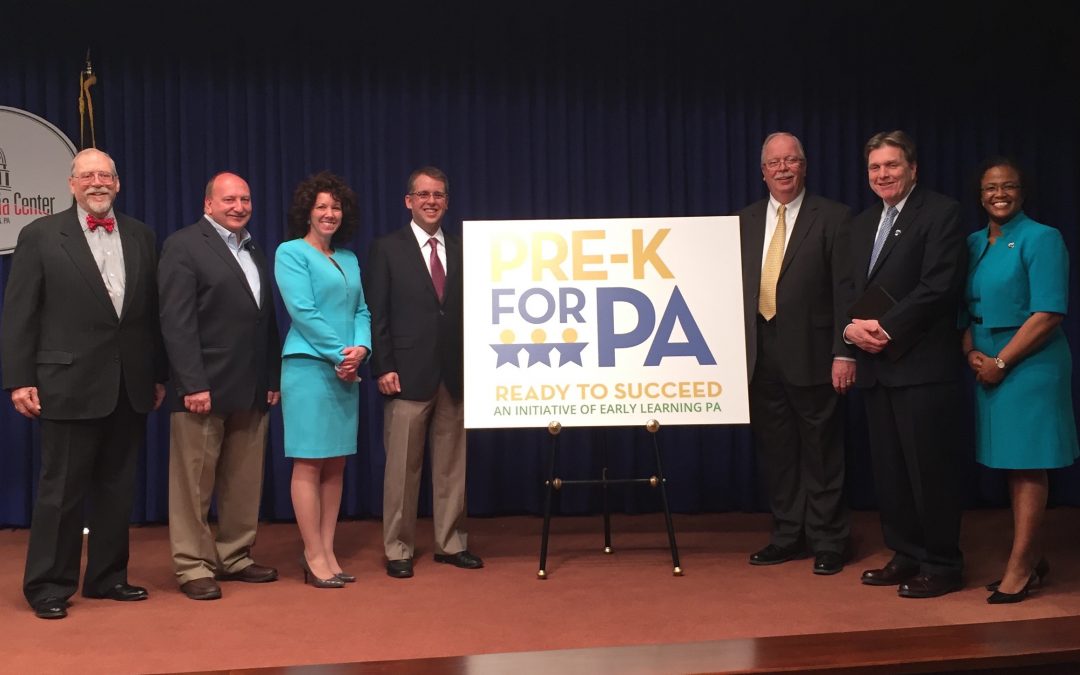
PA Mayors Call for Continued Investment in Publicly Funded Pre-K; Pre-K Helps Develop Vibrant Communities
HARRISBURG (April 11, 2016)— As Mayors from Pennsylvania’s largest population centers continue to advocate for major pre-k initiatives in Philadelphia and Pittsburgh, Mayors and other leaders from mid-sized cities and communities across Pennsylvania gathered in Harrisburg today to encourage Governor Wolf and legislators to continue investing in publicly funded pre-k. The Mayor’s said pre-k is a vital element in the development of municipalities, citing lower crime, improved education outcomes, and greater workforce readiness as the key reasons to invest.
Lancaster Mayor J. Richard Gray, President of the Pennsylvania Municipal League joined forces with leaders from Cranberry to Lebanon in a chorus of support for expanded access to pre-k, “I support expanded access to pre-k as a cost-effective strategy to make our communities safer, and grow new jobs and businesses. A growing body of research shows that early childhood education in a pre-kindergarten setting provides a proven pathway towards achieving these goals.”
Governor Wolf’s 2016-17 proposed budget includes another $60 million in new funding for high quality pre-k. That investment would build on this year’s expansion and allow more than 14,000 young children to access pre-k over the two-year time period.
Research shows that expanded access to high quality pre-k can also reduce crime rates and make communities safer. Hundreds of Pennsylvania police chiefs, sheriffs and district attorneys have lined up behind efforts to invest in pre-k.
“Less crime means less money spent fighting crime,” said Pennsylvania Municipal League 1st Vice President and City of York Mayor C. Kim Bracey. “Imagine what we could do to improve our city or lower our taxes if we didn’t have to devote so much of our local budget to dealing with crime on the back-end.”
Bracey cited the Chicago Child-Parent Center (CPC) preschool study, one of the nation’s most extensive studies that tracked child outcomes over 28 years, that found that children without access to a good pre-k program were 70 percent more likely to be arrested by the time they were 18 compared to children who had the benefits of pre-k.
In Pennsylvania, Department of Correction Secretary John Wetzel has touted research that shows a $120 million state funding increase for early childhood education will eventually lead to $350 million in Corrections and other cost savings for the Commonwealth every year.
Expanded access to high quality pre-k enjoys bi-partisan support in communities throughout the state. Lebanon Mayor Sherry Capello noted that mayors regardless of political affiliation see pre-k as an important part of their communities’ future. “Better education is an important part of any communities’ economic development plan and I believe that better education starts early. I think this is an issue that we all can agree on.” Capello went on to urge state policymakers to work in a bi-partisan fashion to invest in pre-k.
By stimulating economic growth and reducing public safety costs, over time cities and communities are likely to see that expanded pre-k can take some pressure off the local tax base. In the short term, pre-k reduces special education costs so school districts see immediate returns.
Research from Pennsylvania and across the country indicates that where children start school with two years of high quality pre-k under their belts, the districts are seeing the number of children enrolled in special education services drop by as much as 50 percent by 2nd grade.
“In school districts across Pennsylvania, rising special education costs are a leading reason for regular property tax increases,” Dick Hadley, Supervisor, Cranberry Township. “A smart upfront investment in our children can curb that trend in short order. When combined with the savings on the public safety side of the ledger, pre-k makes sense for our kids and our local budgets.”
The mission of the Pennsylvania Municipal League (PML) is to strengthen, empower and advocate for effective local government. PML is a nonprofit, nonpartisan organization established in 1900 as an advocate for Pennsylvania’s 3rd class cities. Today, PML represents Pennsylvania’s cities, townships, town, boroughs, and home rule communities that all share the League’s municipal policy interests. The Board of Directors oversees the administration of a wide array of municipal services including legislative advocacy (on both the state and federal level), publications designed to educate and inform, inquiry and research, education and training certification programs, consulting-based programs, and group insurance trusts. For more information www.pamunicipalleague.org.
Pre-K for PA is an issue campaign supported by individuals and organizations across Pennsylvania who believe that investing in our children is the right choice and an urgent necessity. Our vision is that every 3- and 4-year-old in Pennsylvania will have access to high-quality pre-k. We will not endorse nor oppose candidates, but rather we will advocate on behalf of this vision for Pennsylvania’s children, schools and communities. For more information www.prekforpa.org.