75 Percent of Pennsylvania Voters Favor Increasing Pre-K Funding
Strong Consensus: 94% Say Early Childhood Education Important for PA
Harrisburg, PA (June 7, 2018) – As Pennsylvania state legislators return to Harrisburg to negotiate a final state budget, a new poll commissioned by the Pre-K for PA Campaign and conducted by Harrisburg-based Harper Polling shows 75 percent of likely voters support increasing funding to expand access to high-quality, publicly funded pre-kindergarten.The numbers have grown since a 2013 Pre-K for PA commissioned poll conducted by Lake Research Partners/Bellwether Research and Consulting had 63% of likely voters indicating that they favored increasing funding to ensure access to pre-k for all Pennsylvania kids.
“There is strong consensus among Pennsylvania voters [94 percent] that think early childhood education is important for the children of the commonwealth,” said Brock McCleary, President, Harper Polling. “Furthermore, a strong plurality of support for expanded funding is realized across all demographics, regions and registration.”
Nearly two-thirds of likely Pennsylvaniaoters polled by Harper from May 22-23lso said that they would support a tax increase to expand pre-k access. Sixty-four percent of Pennsylvanians said they would pay an extra $50 in taxes to fund pre-k, which would equal a .01 increase in PIT (personal income tax) for the average Pennsylvania taxpayer.This number has also grown since the 2013 poll, when only 56 percent of voters polled said they were willing to pay higher taxes to support pre-k investments.
“Pennsylvanians value pre-k education for its proven benefits to each child fortunate enough to attend a high-quality pre-k, and they’re willing to dig a little deeper into their own pockets to support expanded access for kids across the commonwealth,”said Joan Benso, President and CEO of Pennsylvania Partnerships for Children, a founding partner of Pre-K for PA. “Pennsylvania prospers when children succeed and pre-k is a key element in each child’s success.”
According to the new Harper poll results,every single voting demographic in the state favors expanded access to pre-k by at least a two-to-one margin. Seniors favor it by more than a three-to-one margin. Conservatives are for expanded access at a rate of two-to-one. More than 65 percent of likely voters in Southcentral PA, a conservative part of the state, are willing to pay $50 more per year to support state pre-k expansion.
“No child should be missing out when nearly all residents agree,” said Jodi Askins, Executive Director, Pennsylvania Association for the Education of Young Children (PennAEYC). “When it comes to the benefits of high-quality pre-k, 94 percent of Pennsylvanians agree that it is necessary for children to learn the appropriate behaviors and social skills to succeed in school. It’s time to fully fund pre-k.”
The additional $40 million in the 2018-19 budget proposal, if fully funded, will expand access to publicly funded pre-k to more than 4,400 new students. Currently more than 106,000 eligible children do not have access to high-quality, publicly funded pre-k due to limited state funding.
Since the inception of the Pre-K for PA Campaign, the commonwealth’s investment in publicly funded pre-k has increased by $100 million, but lags far behind many neighboring states. Today, Pennsylvania ranks 18th of the 30 states investing in high-quality, publicly funded pre-k. New Jersey is spending five times more per capita than PA and even West Virginia is leaps ahead of PA—it has had universal access for pre-k aged kids since 2012.
For more poll results, please visit www.prekforpa.com/poll.
Former Governors, Military, Business & Civic Leaders from Across PA Call on Legislature to Fund Pre-K
Rendell, Schweiker call for $40 million investment to expand pre-k to thousands of at-risk kids across PA
Harrisburg, PA (May 23, 2018)– Former Governors Edward G. Rendell and Mark S. Schweiker led a group of influential business, civic, and law enforcement leaders from across the state today in support of continued investment in pre-k, urging the Pennsylvania legislature and the governor to expand access to thousands of at-risk kids in the final 2018-19 budget.
Generals, admirals and other senior military leaders who are members of Mission: Readiness echoed the call for targeted investments that will help young Americans grow up to be educated, healthy and fit to do the work of our nation either as a soldier or a civilian.
In multiple letters to leadership offices of the Pennsylvania legislature, the signers urged leaders in Harrisburg to position the commonwealth to provide access to Pennsylvania Pre-K Counts and Head Start Supplemental Assistance for all eligible children and begin to address middle-class pre-k affordability concerns by 2022. Specifically, they called for the legislature to fully fund $40 million in additional funding, proposed by Governor Tom Wolf, as part of the 2018-19 final state budget.
If realized, $40 million in additional funding for high-quality pre-k will serve an additional 4,400 three- and four-year-olds across the commonwealth. Currently, there are more than 106,200 or 61% of eligible children throughout Pennsylvania who qualify for high-quality, publicly funded pre-k but remain unserved.
EDITOR’S NOTE: Below is the full text of both letters. For a list of signatories, please visit www.XXXXXXX:
As members of the Pre-K for PA Leadership Council, we thank you for your commitment to growing access to high-quality pre-k. Over the last three years, more than 10,000 eligible children have gained access to high-quality programs like Pennsylvania Pre-K Counts and Head Start State Supplemental Assistance. Despite these historic gains, 61 percent of eligible three- and four-year-olds (more than 106,000 children) lack access to publicly funded, high-quality pre-k in the commonwealth.
As such, Pennsylvania is losing ground as compared to other states providing high-quality pre-k. Currently, the commonwealth ranks 18thin per capita pre-k investments when compared to 30 other states who have comparable programs.
Looking ahead to the 2018-19 state budget, we again urge you to position Pennsylvania to provide access to Pennsylvania Pre-K Counts and Head Start State Supplemental Assistance for all eligible children and begin to address middle-class pre-k affordability concerns by 2022.
Specifically, we ask you to expand state-funded pre-k opportunities to an additional 4,400 eligible children by supporting the proposed $40 million increase in the final 2018-19 state budget. Additionally, we ask you to also prioritize funding for other early learning initiatives like expanding the reach of high-quality child care and evidence-based home visiting programs.
Research is clear that continued investments in high-quality pre-k will set us on a path to reduce educational, public welfare and incarceration costs and have the most important added benefit of ensuring that all children are ready to succeed.
Thank you very much for taking the time to consider this correspondence.
Respectfully submitted,
Mark Schweiker, 44thGovernor, Commonwealth of Pennsylvania
Ed Rendell, 45thGovernor, Commonwealth of Pennsylvania
Dear Legislator,
The generals, admirals and other senior military leaders who are members of Mission: Readiness support targeted investments that will help young Americans grow up to be educated, healthy, and fit to do the work of our nation either as a soldier or a civilian.
Unfortunately, the pool of qualified men and women capable of military service today is diminishing. In Pennsylvania, 71 percent of Pennsylvania youth ages 17 to 24 are ineligible for military service due to problems with obesity, education, drug abuse, or crime, according to the Department of Defense.
Pennsylvania employers are also concerned about workforce readiness. According to a recent Pennsylvania Chamber of Business and Industry survey, more than half – 52 percent — say they have great difficulty recruiting qualified job candidates. Moreover, 56 percent believe it will get harder by 2021. Only 21 percent – one in five – rate the readiness of our current labor force for their jobs as excellent or good.
The skills employers need are all built on a foundation of solid academics, but too few Pennsylvania children are achieving in school.
- 61 percent of Pennsylvania eighth graders are NOT proficient in reading, 64 percent are NOT proficient in math, and 67 percent are NOT proficient in science, according to the National Assessment of Education Progress. For the many children in economically disadvantaged families, average math scores are 32 points lower than their better-off peers.
- Only 45 percent of Pennsylvania public school students meet all predictors of college success.
- More than 15 percent of Pennsylvania’s high school freshmen fail to graduate within four years. Among economically disadvantaged students, it’s nearly one quarter.
Fortunately, a solution exists in greater access to early childhood education. Decades of research have shown that high-quality pre-k and other early childhood education programs can help better prepare our children by boosting educational achievement and high school graduation rates, deterring youth from crime, and reducing obesity rates, all while providing a significant return on investment.
We thank you for the progress Pennsylvania has made progress in recent years by expanding funding for high-quality early learning programs like Pre-K Counts and Head Start Supplemental Assistance, however access to these high-quality early learning programs remains very limited. Approximately 106,000 eligible Pennsylvania three- and four-year-olds do not have access to these publicly funded pre-k programs due to insufficient funding.
In the interest of fostering the human capital that ensures future military and economic readiness, we respectfully ask that Pennsylvania’s policy makers continue to boost access to high-quality pre-k. Specifically, we ask you to grow state funding for the PA Pre-K Counts and Head Start Supplemental Assistance line items by a combined $40 million.
High-quality pre-kindergarten plays a critical role in ensuring that our next generation is academically fit and citizen ready.
Pennsylvania Gubernatorial Candidates Assert Positions on High-Quality Pre-k Access
Harrisburg, PA (April 16, 2018) – As part of a gubernatorial candidate survey conducted by Pre-K for PA partner organization United Way of Pennsylvania, PA candidates asserted their positions on access to high-quality pre-k and child care.
The candidate survey offers Pennsylvanians the opportunity to learn where gubernatorial candidates stand on a variety of issues related to education, health, financial stability and the nonprofit sector. United Way of Pennsylvania is a statewide nonpartisan organization representing 43 member local United Ways and three United Funds in Pennsylvania.
Pre-K for PA is a non-partisan issue-oriented community of 16,000 supporters, 600 organizations, 130 Leadership Council members and 20,500 social media followers who all believe that greater access to high-quality, publicly funded pre-k must be a priority for the commonwealth.
“United Way hopes Pennsylvanians will use this information to learn more about the candidates as they prepare to head to the polls for the May primary,” stated Kristen Rotz, President of United Way of Pennsylvania, Pre-K for PA Principal Partner. “There are many factors that voters should consider as they evaluate the candidates. Among these are the issues United Way considers to be foundational to the vibrancy of our local communities and opportunity for all: education, health, financial stability, and the viability of the nonprofit sector.
“It is important to remember that only a registered voter’s voice will be heard on Election Day. Today is the last day to register to vote in the May primary. We encourage all voters to register, review each candidate’s positions on vital issues facing the health and well-being of the commonwealth, including pre-k access, and to make an informed vote on May 15.”
The full survey results are available on the UWP public website at www.uwp.org under the “Advocacy” menu by clicking on the link for “2018 Gubernatorial Candidates on the Issues”. The full set of responses has been posted for each candidate. The responses are available in two formats: sorted by issue area, or sorted by candidate.
The United Way of Pennsylvania is a 501(c)(3) organization, which does not engage in partisan political activity. The UWP will not endorse a candidate for governor. The purpose of this survey is to educate voters impartially on a nonpartisan basis. All candidates were given equal opportunity to respond to the survey, and three out of four gubernatorial candidates participated. The candidates who responded to this survey are Laura Ellsworth, Scott Wagner and Tom Wolf.
View the survey results here.
Pre-K for PA is an issue campaign supported by individuals and organizations across Pennsylvania who believe that investing in our children is the right choice and an urgent necessity. Its vision is that every 3- and 4-year-old in Pennsylvania will have access to high-quality pre-k. For more information visit www.prekforpa.org.
# # #
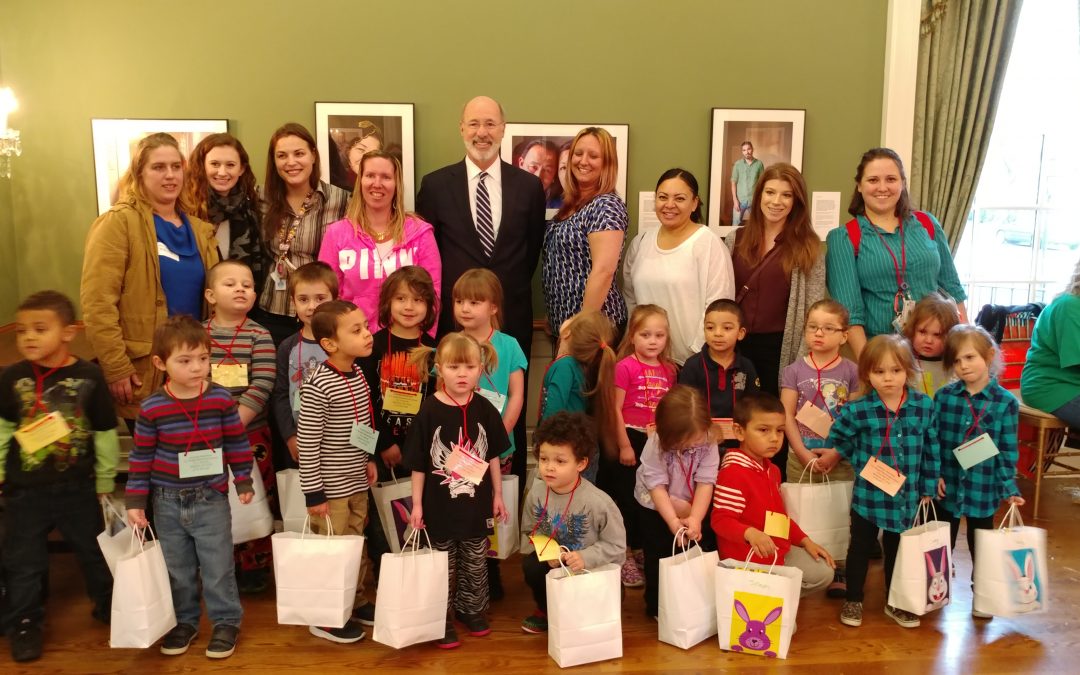
Governor and First Lady Host Annual Easter Egg Event to Highlight Importance of Pre-k Investment
Harrisburg, PA (April 3, 2018) – Governor Tom Wolf and First Lady Frances Wolf today hosted pre-school classes from across the commonwealth at the annual Easter Egg Event at the Governor’s Residence. The event was co-sponsored by Pre-K for PA, a non-partisan advocacy group that supports the expansion of publicly funded pre-k.
“Frances and I are proud that Pennsylvania delivers high-quality, publicly-funded pre-k to many children, but over 106,000 kids remain unserved and a serious investment must be made to continue toward the goal of providing access to all at-risk kids,” Governor Wolf said. “Pre-k doesn’t just benefit the children fortunate enough to access a high-quality program, it benefits the entire commonwealth. We must get serious about investing in early childhood education to make sure all of Pennsylvania’s children enter kindergarten ready to learn.”
In his 2018-19 budget, Governor Wolf proposed an additional $40 million to support high-quality pre-k programs in the commonwealth. This expansion would mean access to publicly funded, high-quality pre-k for 4,400 more kids.
“Today, only 39 percent of eligible children in Pennsylvania benefit from the once-in-a-lifetime opportunity to attend high-quality publicly funded pre-k,” said Jodi Askins, founding partner of Pre-K for PA. “With Governor Wolf’s proposal to invest $40 million in this year’s budget, 4,400 more children will be able to access high-quality pre-kindergarten, a fundamental building block of our state’s education system that helps ensure children have the strong foundation necessary to enter kindergarten ready to learn.”
Studies show that children who participate in high-quality pre-kindergarten perform better in school, graduate at higher rates, and earn more throughout their working lives compared to peers who do not have access to early learning programs. Additionally, children who were previously enrolled in Pre-K Counts outperform their economically disadvantaged peers in third grade math and reading.
Governor Wolf’s 2018-19 budget proposal contains education investments at all levels, including:
* $100 million increase in Basic Education;
* $40 million increase in Pre-K Counts and Head Start;
* $20 million increase for Special Education;
* $15 million increase for the State System of Higher Education; and
* $10 million increase for Career and Technical Education
Pre-K for PA is an issue campaign supported by individuals and organizations across Pennsylvania who believe that investing in our children is the right choice and an urgent necessity. Its vision is that every 3- and 4-year-old in Pennsylvania will have access to high-quality pre-k. For more information visit www.prekforpa.org
# # #
Pottstown Officials Celebrate Pre-K Expansion
New data shows 72 percent of eligible kids in Montgomery County lack access to pre-k; Leaders urge continued state investment to further reduce unmet need
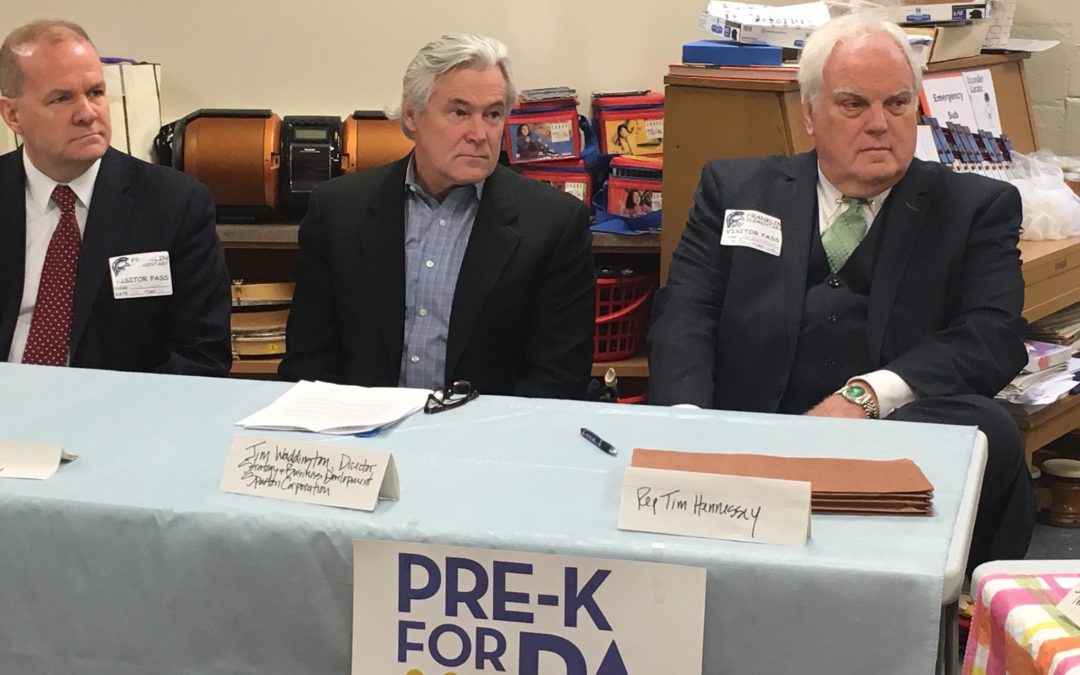
Pottstown, PA – Pennsylvania House members Tom Quigley and Tim Hennessey, joined Pottstown area leaders for a mid-year pre-k visit at Franklin Elementary. Officials took the opportunity to visit with pre-k students in a new state-funded Pre-K Counts classroom that was made possible by additional investments included in the 2017-18 state budget.
“Greater access to high-quality pre-k is an essential investment in our community,” said Tim Phelps of the PA Early Learning Investment Commission. Phelps continued, “Pre-k programs are backed by decades of research showing that children who attend have a more positive trajectory in life. This means more kids finishing high school, getting a job, less reliance on social services and less crime in our community.”
The expansion classroom at Franklin Elementary was made possible by the infusion of an additional $25 million in funding for Pennsylvania Pre-K Counts and $5 million for the Head Start Supplemental Assistance Program as part of the state’s 2017-2018 budget. Montgomery County early learning providers received new funding for 159 expansion seats. Pre-K Counts and the Head Start State Supplemental are the primary state funding sources for high-quality pre-k in Pennsylvania.
Pottstown School District Superintendent Stephen Rodriguez noted that the added capacity to high-quality pre-k is welcome news as only 28 percent of income eligible 3- and 4-year-olds in Montgomery County have access to publicly funded high-quality pre-k according to new data from the Pre-K for PA Campaign.
“While I join you to celebrate this new classroom, I must be clear that we still have a lot of work to do,” said Rodriguez. “More than 4,700 income eligible three- and four-year-olds in Montgomery County still lack access to this once-in-a-lifetime learning opportunity.”
More than 106,000 eligible children, or 61 percent of all three- and four-year-olds, across the commonwealth lack access to publicly funded, high-quality pre-k each year.
Jim Waddington of Sparton Corporation noted that Pennsylvania is experiencing a shortage of qualified workers and pre-k is the place to start to stem that tide.
“A recent survey from the statewide chamber of business and industry showed that more than half of the 400+ Pennsylvania employers that were surveyed reported trouble finding people with adequate skills, training, or education. This was especially true of technical and skilled job openings,” said Waddington. “It is particularly troubling considering the proven benefits of pre-k and lack of access to pre-k statewide.”
A large body of research shows children who benefit from high-quality pre-k:
-
- Enter kindergarten with stronger literacy, language, math and social/emotional skills;
- Are less likely to need special education services, less likely to repeat grades, and more likely to graduate and enroll in college.
- Over a lifetime, these young learners will see stronger employment opportunities and increased earning potential, and they are less likely to commit juvenile and adult crimes.
Participants thanked Representatives Quigley and Hennessey for supporting increased pre-k funding in the 2017-18 state budget, and encouraged all state policy makers alike to make increasing access to high-quality pre-k a top priority for current 2018-19 state budget negotiations in Harrisburg. Governor Tom Wolf has included $40 million in new state pre-k funding as part of his 2018-19 budget proposal.
Also participating in the event were Valerie Jackson, PEAK Coordinator; Karen Kile, Pre-K Counts Coordinator; Donna Cooper, Executive Director, Public Citizens for Children and Youth; Laurie Kolka, Director of Curriculum & Professional Development, Pottstown SD; Leslie Spilling, Family Engagement Coordinator, PEAK; Diana Gonzalez, Bilingual Parent Outreach Specialist; Tyrone Scott, Director of External Affairs, DVAEYC; Shirlee Howe, Montgomery County Coordinator, Public Citizens for Children and Youth.
Governor Wolf’s 2018-19 Budget Proposal, Ambitious Steps Forward for Early Learning in PA
Pre-K for PA, Early Learning PA Salutes Gov. Wolf’s Commitment to High-Quality Pre-k, Child Care Access, and Evidence-Based Home Visiting
HARRISBURG (Feb. 6, 2018)— The Pre-K for PA campaign, an initiative of the Early Learning PA (ELPA) coalition, saluted Governor Tom Wolf’s continued commitment to expanding access to early learning from birth to age five in Pennsylvania after he announced a $40 million expansion to high quality pre-k; a $6.5 million expansion to evidence-based home visiting programs; and a $23 million expansion to the state’s child care system, which will expand access to subsidized child care and increase funding for high quality programs as part of his 2018-19 budget address today.
The principal partners of Pre-K for PA and Early Learning PA issued the following statement regarding the 2018-19 budget proposal:
“Governor Wolf’s 2018-19 budget proposal once again shows the Governor’s commitment to making wise use of public funds by proposing significant expansions in access to high-quality pre-k. We know that investing in pre-K also has widespread support in the legislature and for that reason we urge the legislature to fully fund the $40 million proposal in order to serve 4,400 more children next year.
“In states across the country we are seeing impressive investments in pre-k, which we hope will serve as an incentive to fully fund this proposal and inspire Pennsylvania to ramp up its investment in the coming years. New Jersey is spending five times more per capita for pre-k than Pennsylvania. West Virginia, which launched its pre-k program in 1983 and made it universal for all four-year-olds six years ago, is investing at three times the rate per-capita than Pennsylvania. In fact, Pennsylvania ranks 18th of the 30 states investing in high-quality, publicly funded pre-k.
“Today only 39 percent of eligible children in Pennsylvania benefit from the once-in-a-lifetime opportunity to attend high quality publicly funded pre-k. Pennsylvania can serve the 106,200 eligible children by 2022, if Pennsylvania lawmakers fully fund Gov. Wolf’s $40 million proposed new investment and the state grows its investment with an additional $270 million over the next three years. If our neighboring states can prioritize pre-k, why not PA?
“Governor Wolf’s proposal also recognizes the importance of child care as a vital workforce support for young Pennsylvania families and a delivery system for high quality pre-k. In fact, 48 percent of children enrolled in Pre-K Counts are served by STAR 3 and 4 child care providers. We applaud efforts to again reduce the state’s waiting list for Child Care Works and increase tiered reimbursement rates for Keystone STAR two, three, and four programs. We are also excited that in addition to child care and pre-k, the proposal also grows funding for evidence-based home visiting programs.”
Governor Wolf’s budget proposal included:
- $30 million in additional funding for the state’s Pre-K Counts program and an additional $10 million for the Head Start Supplemental Assistance Program. This $40 million expansion would serve 4,400 additional young children. Currently more than 106,000 eligible three- and four-year-olds do not have access to high-quality publicly funded pre-k programs.
- An additional $6.5 million investment in evidence-based home visiting programs expands home visiting for 800 eligible families and includes a cost of living adjustment for the two long standing home visiting models (Nurse Family Partnership and Family Centers – Parents as Teachers) who haven’t had a rate increase in nearly a decade.
- Investing $10 million more to expand access to 1,600 additional families waiting for access to the child care subsidy.
- $10 million in state funding coupled with $5 million in federal funding for increased tiered reimbursement rates for Keystone STAR two, three, and four child care providers.
- $3 million for a pilot program serving infants and toddlers in high quality child care.