Pennsylvania’s Working Families Need Greater Investment in Early Learning Services
2020-21 State budget proposal: modest growth for pre-k; fails to expand critical child care and evidence-based home visiting services
HARRISBURG, PA (February 4, 2020) –The principal partners of Early Learning Pennsylvania (ELPA), a statewide coalition of advocates focused on supporting young Pennsylvanians from birth to age five, are calling on the General Assembly to go beyond Governor Wolf’s budget proposal and prioritize greater state investments in high-quality pre-k, child care and evidence-based home visiting services to help Pennsylvania’s working families. ELPA operates three issue-based advocacy campaigns: Pre-K for PA, Start Strong PA, and Childhood Begins at Home. Reaction statements from these respective campaigns regarding Governor Tom Wolf’s 2020-21 budget proposal follow.
PRE-K
“Governor Wolf deserves to be acknowledged for his continuous support of expanded access to publicly-funded, high-quality pre-k in PA. If approved, his proposed $30 million in new state funding as part of the 2020-21 Executive Budget will provide the once-in-a-lifetime opportunity of high-quality pre-k to more than 3,200 young learners.
“Research shows that high-quality pre-k benefits children’s cognitive, social and emotional development. This is why, according to recent polling, an overwhelming majority of Pennsylvania voters support investing additional state dollars to expand access to pre-k for children in every corner of the commonwealth.
“Unfortunately, only 44 percent of eligible children in Pennsylvania are currently enrolled in publicly-funded, high-quality pre-k, according to the most recent data available (FY 2018-19). That means 56 percent of eligible children do not have access to this vital early education opportunity due to limited state funding. We must do better, faster, if we are to move the needle on these dismal statistics. PA is being outranked by states like Georgia, Alabama and West Virginia when it comes to expanding access to publicly-funded, high-quality pre-k. PA ranks 19th –- a drop from the 2018 study — among the 28 states that also publicly fund high-quality pre-kindergarten programs with similar quality standards.
“Pre-K for PA, representing tens of thousands of Pennsylvania families, appreciates that policymakers in Harrisburg understand the irrefutable value of investing in high-quality pre-k. We strongly urge the General Assembly to make a bold move and boost funding for both access and quality to Governor Wolf’s proposed pre-k investment. By investing now, Pennsylvania can serve more eligible children and take steps to adjust quality pre-k provider rates for inflation.”
CHILD CARE
“Start Strong PA agrees with Governor Wolf that the critical shortage of affordable, high-quality child care is a major barrier to workforce participation for many Pennsylvania families.Given that 70 percent of Pennsylvania children under the age of five have all adults in their household in the labor force, high-quality child care is an essential workforce support. This finding was a focal point of the January 2020 Keystone Economic and Workforce Command Center reports — which included input from Pennsylvania business leaders — and recommended greater access to affordable high-quality child care.
“Start Stong PA is disappointed that the Governor’s budget proposal commits no new state funding to help Pennsylvania’s working families find and afford high-quality child care.
“Although the Governor’s budget proposal utilizes $15.3 million in federal funding toward child care subsidy base rates, this proposal will have no impact in addressing the list of children waiting to gain access to subsidized care or improve the quality of that care.
“Less than half of certified child care capacity in Pennsylvania currently meets high-quality standards. And only 34 percent of infants and toddlers that receive subsidized care attend programs that have met high-quality standards.
“Start Strong PA urges the Pennsylvania General Assembly to invest in our youngest children, their families and our workforce by allocating additional state funding for more children to gain access to high-quality child care.”
EVIDENCE-BASED HOME VISITING
“The Childhood Begins at Home campaign has credited the Wolf administration over the past three state budgets for making the state a national leader for delivering voluntary, evidence-based home visiting programs that ultimately improve maternal health, child well-being and family self-sufficiency.
“Unfortunately, the proposed $2.4 million included in the 2020-21 state budget is disappointing, because it does not build upon the steady progress of investing in evidence-based programs to expand services to additional children and families.
“We understand state funds will preserve federal slots through the Maternal, Infant, and Early Childhood Home Visiting program (MIECHV) and support Medicaid managed care organizations offering short-term, in-home services for first-time mothers. However, the proposal is a missed opportunity as only 5 percent of the pregnant women, children and families who would benefit the most from evidence-based home visiting programs currently receive services.
“While we’re not losing ground, we’re not gaining it either, and building successful families by providing healthy and safe home environments through consistently demonstrated, evidence-based home visiting programs takes a greater commitment than maintaining the status quo.”
“From birth to age 5 early learning is happening, and our coalition of advocates is committed to ensuring that families can access it in high-quality, developmentally appropriate settings. The lack of state resources for early learning creates deep inequity among families at a very early age.We, and our tens of thousands of supporters, urge lawmakers to boldly invest in early learning in 2020 – it is an urgent necessity.”
###
Pennsylvania’s Ranking Stagnant Among States Investing in High-Quality Pre-K
New report shows states with similar political landscapes outpacing
PA in per capita pre-k investments
Pennsylvania Partnerships for Children (PPC), in its role as a principal partner of the Pre-K for PA Campaign, today released the Campaign’s third report comparing Pennsylvania’s per-capita investments in pre-k. The report shows states with similar political compositions and quality standards are making stronger per capita investments, putting their early learners on the road to success in school and in life at a faster pace than Pennsylvania.
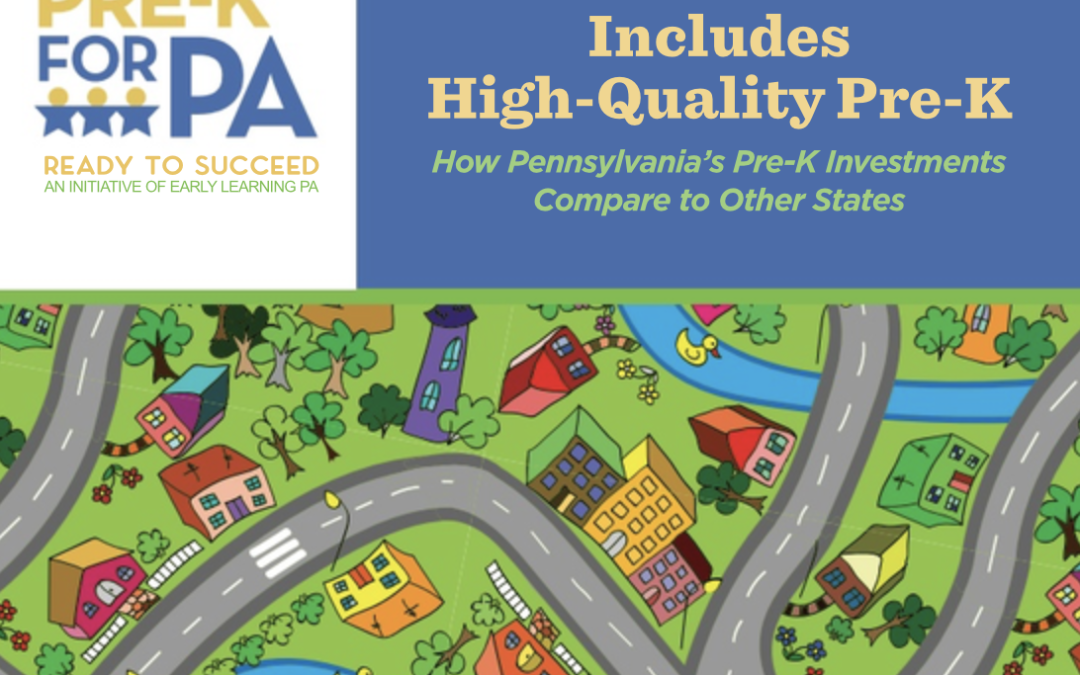
According to The Road to Success Includes High-Quality Pre-K, Pennsylvania ranks 19th out of the 28 states that also publicly fund high-quality pre-kindergarten programs with similar quality standards, remaining nearly stagnant since the first state comparison report was released in 2017.
“Giving all eligible preschoolers a chance to attend high-quality pre-k should be a top priority for all of our state policymakers, regardless of political party affiliation,” said PPC President and CEO Kari King. “If we want to pave the way to success in adulthood for our early learners, we need to increase our investments in high-quality, publicly funded pre-k, because 56 percent of eligible children do not have access to this vital education.
When the Pre-K for PA Campaign released its first report comparing per capita pre-k investments in 2017, Pennsylvania ranked 20th out of 28 states and the District of Columbia that were analyzed. Another state-by-state comparison was done the following year in 2018, ranking Pennsylvania at 18th out of 30 states when looking at per capita investments in high-quality pre-k.
King noted the body of academic research supporting the benefits of high-quality pre-k goes back decades, revealing improved outcomes for enrolled children that are difficult to dispute: the programs prepare students for kindergarten and beyond by supporting the development of the whole child, provide an early chance at proactively impacting the development of Pennsylvania’s future workforce, and are particularly beneficial for low-income children, who are more likely to have road blocks along the way than their peers.
Michigan – where the political landscape is like Pennsylvania – has invested at a higher per capita rate than the Commonwealth and ranks 4th. Its General Assembly is controlled by Republicans and the governor is a Democrat.
During a media webinar PPC hosted as part of the report’s release, King was joined by: former Michigan Senate and House Majority Leader Ken Sikkema, a Republican who served in the state legislature for 20 years and was a champion for pre-k during his tenure; and Republican State Rep. Corley Ellis of Alabama, who advocates for pre-k funding as a member of the House Republican Caucus Agenda Committee and oversees education spending on the House Ways and Means Committee.
“I was not convinced we could move the needle for pre-k funding in Michigan until I read a study showing the longitudinal benefits. At the time, both the executive and legislative branches in Michigan were very conservative, but no one could argue that high-quality pre-k delivers results. That was in the 1990s and early 2000s, and Michigan has been a leader for its pre-k investments ever since,” said Sikkema.
“Alabama has a long history of Republican-led legislative and executive branches and we’re viewed as a pre-k model nationally. I’m proud that we’re ranked 5thin this report because it shows that it doesn’t matter if you are a Republican or a Democrat in state office, prioritizing high-quality pre-k is just good policy.”
In Pennsylvania, an increase of $243 million in high-quality pre-k (Pre-K Counts and the Head Start Supplemental Assistance Program) by the 2022-23 fiscal year will put the state on par with others that deliver similar high-quality programs.
The Road to Success Includes High-Quality Pre-K can be found here.
###
Pre-K for PA Lauds Continued Investment in High-Quality Pre-K
Harrisburg, PA (June 27, 2019) – In the final FY 2019-20 budget agreement, the Commonwealth of Pennsylvania continued to make progress on behalf of its youngest learners by prioritizing expanded access to high-quality pre-k.
The principal partners of Pre-K for PA issued the following statement regarding the increased investment:
“The Pre-K for PA campaign, representing tens of thousands of Pennsylvania families, appreciate that lawmakers in Harrisburg understand the irrefutable value of investing in high-quality pre-k. We applaud Governor Wolf and the legislature for maintaining the political will to continue to invest in greater access to high-quality pre-k for yet another year.
“Research shows that high-quality, publicly funded pre-k benefits children’s cognitive, social, and emotional development. From birth to age five is the most rapid period of brain development in a child’s life and the nurturing interactions that children experience in high-quality early learning programs are key to their future success. This is why in every corner of the commonwealth, across all demographics, an overwhelming majority of Pennsylvanians support investing additional state dollars to expand access to high quality pre-k.
“We all know that there is more work to be done, but today represents another milestone as we chip away at the number of children who are missing out on this once-in-a-lifetime learning opportunity.”
The goal of the non-partisan Pre-K for PA campaign is that by 2022 every at-risk child will have access to a high-quality pre-kindergarten program and that middle-income families will more easily afford these services for their children. High-quality pre-k is delivered in Pennsylvania in a variety of settings: school districts, Head Start centers, licensed private academic nursery schools, home-based care, and roughly half in STAR-3 and -4 Child Care centers.
Pre-K for PA is an issue campaign supported by individuals and organizations across Pennsylvania who believe that investing in our children is the right choice and an urgent necessity. Its vision is that every 3- and 4-year-old in Pennsylvania will have access to high-quality pre-k. For more information visit www.prekforpa.org.
###
Pre-K for PA Lauds Continued Investment in High-Quality Pre-K
Harrisburg, PA (June 27, 2019)–In the final FY 2019-20 budget agreement, the Commonwealth of Pennsylvania continued to make progress on behalf of its youngest learners by prioritizing expanded access to high-quality pre-k.
The principal partners of Pre-K for PA issued the following statement regarding the increased investment:
“The Pre-K for PA campaign, representing tens of thousands of Pennsylvania families, appreciate that lawmakers in Harrisburg understand the irrefutable value of investing in high-quality pre-k. We applaud Governor Wolf and the legislature for maintaining the political will to continue to invest in greater access to high-quality pre-k for yet another year.
“Research shows that high-quality, publicly funded pre-k benefits children’s cognitive, social, and emotional development. From birth to age five is the most rapid period of brain development in a child’s life and the nurturing interactions that children experience in high-quality early learning programs are key to their future success. This is why in every corner of the commonwealth, across all demographics, an overwhelming majority of Pennsylvanians support investing additional state dollars to expand access to high quality pre-k.
“We all know that there is more work to be done, but today represents another milestone as we chip away at the number of children who are missing out on this once-in-a-lifetime learning opportunity.”
The goal of the non-partisan Pre-K for PA campaign is that by 2022 every at-risk child will have access to a high-quality pre-kindergarten program and that middle-income families will more easily afford these services for their children. High-quality pre-k is delivered in Pennsylvania in a variety of settings: school districts, Head Start centers, licensed private academic nursery schools, home-based care, and roughly half in STAR-3 and -4 Child Care centers.
Pre-K for PA is an issue campaign supported by individuals and organizations across Pennsylvania who believe that investing in our children is the right choice and an urgent necessity. Its vision is that every 3- and 4-year-old in Pennsylvania will have access to high-quality pre-k. For more information visit www.prekforpa.org.
Kindergarten Teachers Survey Backs Research Showing Social-Emotional Benefits of High-Quality Pre-K
Report Highlights Unmet Need and Makes Case for Funding Increases for
High-Quality Pre-K in the 2019-20 State Budget
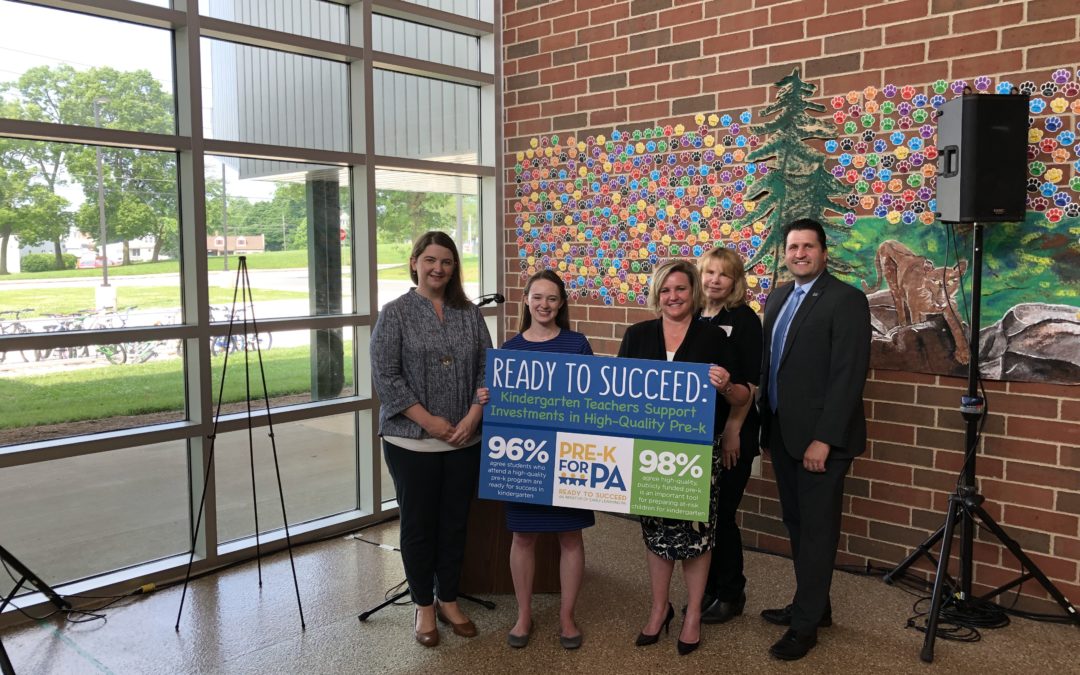
Harrisburg, PA (May 28, 2019)—The Pre-K for PA Campaign today released Ready to Succeed: Kindergarten Teachers Support Investments in High-Quality Pre-k, a report based on findings of a survey conducted with campaign partner the Pennsylvania State Education Association (PSEA), seeking the perceptions of kindergarten members about the role that access to high-quality, publicly funded pre-k plays in school readiness.
PSEA Treasurer Jeff Ney says the results show resounding support for high-quality pre-k among those surveyed, with 96 percent of elementary school teachers agreeing that students who attend a high-quality pre-k program are ready for success in kindergarten, and 98 percent agreeing that high-quality, publicly funded pre-k is an important tool for preparing at-risk children for kindergarten.
“Phrasing quality pre-k as ‘an important tool’ was intentional in this survey,” Ney said. “Kindergarten teachers know and understand that a quality pre-k experience provides each child entering kindergarten with a growth mindset and a readiness to succeed. Their personal experiences mirror what researchers have uncovered – that children who attend high-quality pre-k have a solid foundation for learning, which promotes increased student growth and achievement.”
Research shows that access to high-quality, publicly funded pre-k benefits children socially and emotionally, helps cognitive development through physical activity, promotes healthy brain development through positive interactions and helps them develop early literacy skills.
Responses from the kindergarten teachers surveyed support this research. The top three skills kindergarten teachers found to be most important for early learning programs to focus on to ensure incoming students are ready for a successful kindergarten year were physical well-being and motor development, emotional development and social development.
Miranda Clash, a kindergarten teacher at Hamilton Elementary School in the Carlisle Area School District in Cumberland County who took the survey, said, “Students who attend high-quality pre-k programs come into kindergarten ready to succeed. They have already practiced essential learning behaviors, know how to regulate their emotions, interact appropriately with peers, and have a solid foundation of language and background knowledge onto which they can add new learning. For students who have had a high-quality pre-k experience, I don’t have to spend as much time teaching these prerequisites to academic learning.”
Kari King, President and CEO of Pennsylvania Partnerships for Children, a founding member of the Pre-K for PA Campaign, said that while it’s no surprise that kindergarten teachers support programs that help students succeed in their classrooms, their collective voice is important.
“Almost immediately, kindergarten teachers can determine the ‘haves’ and ‘have nots’ in their classrooms – or those children who have had access to high-quality pre-k and those who have not,” she said. “Investments in high-quality pre-k have a significant return on investment for our children, schools and communities. However, the state is not investing enough to ensure access for the children who need it the most.”
More than 97,000 – or 56 percent – of eligible 3- and 4-year-olds do not have access. The Pre-K for PA Campaign is calling for a $50 million increase in the 2019-20 state budget; $40 million for Pre-K Counts and $10 million for the Head Start Supplemental Assistance Program (HSSAP). This investment will provide access to an additional 5,500 children.
The report notes that the Commonwealth still ranks 18th of the 30 states investing in high-quality pre-k, and aggressive steps must be taken to put Pennsylvania children on a level playing field with their peers in those states.
Ready to Succeed: Kindergarten Teachers Support Investments in High-Quality Pre-k is available at http://www.prekforpa.org/wp-content/uploads/2019/05/PPC-Pre-K-Report-Online.pdf.
Pre-K for PA is an issue campaign supported by individuals and organizations across Pennsylvania who believe that investing in our children is the right choice and an urgent necessity. Our vision is that every 3- and 4-year-old in Pennsylvania will have access to high-quality pre-k. We will not endorse nor oppose candidates, but rather we will advocate on behalf of this vision for Pennsylvania’s children, schools and communities. For more information www.prekforpa.org.
###
Governor and First Lady Host Annual Easter Egg Event to Highlight Importance of Pre-K Investment
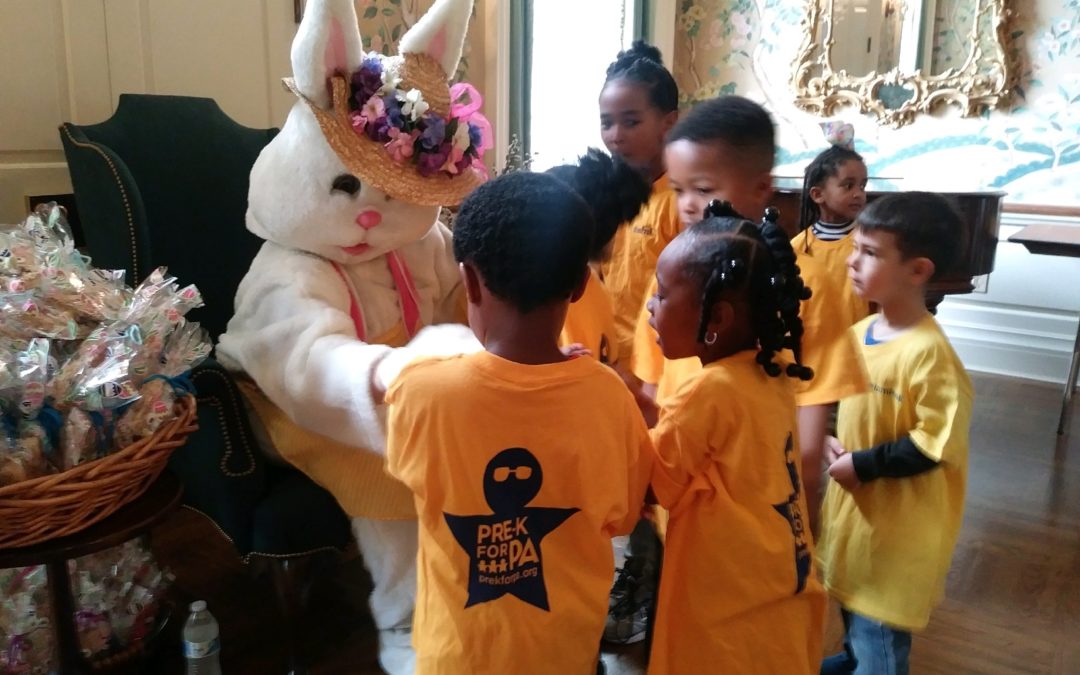
Harrisburg, PA (April 15, 2019) – Governor Tom Wolf and First Lady Frances Wolf today hosted pre-school classes from across the commonwealth at the annual Easter Egg Event at the Governor’s Residence. The event was co-sponsored by Pre-K for PA, a non-partisan advocacy group that supports the expansion of publicly funded pre-k. Over 100 pre-school aged children participated.
“The long-term benefits of high-quality early childhood programs are tremendous – it reduces costs to our schools, enables stronger earning potential in our workforce, and leads to increased tax revenues to support a robust economy,” Governor Wolf said. “Frances and I are very proud that Pennsylvania delivers high-quality, publicly funded pre-k to many at-risk children, but a serious investment must be made to continue toward the goal of providing access to all at-risk kids.”
In his 2019-20 budget, Governor Wolf proposed an additional $50 million to support high-quality pre-k programs in the commonwealth. With $115 million in funding increases secured over the past four years, this additional investment will more than double the funding for Pre-K Counts programs since 2014-15 and increase funding for Head Start Supplemental Assistance by 77 percent.
“Today, Pennsylvania ranks 18th of the 30 states investing in high-quality pre-k with nearly 100,000 eligible children still lacking access,” said Jodi Askins, founding partner of Pre-K for PA. “With Governor Wolf’s proposal to invest $50 million in this year’s budget, 5,500 more children will be able to access high-quality pre-kindergarten, a fundamental building block of our state’s education system that helps ensure children have the strong foundation necessary to enter kindergarten ready to learn.”
Studies show that children who participate in high-quality pre-kindergarten perform better in school, graduate at higher rates, and earn more throughout their working lives compared to peers who do not have access to early learning programs. Additionally, children who were previously enrolled in Pre-K Counts outperform their economically disadvantaged peers in third grade math and reading.
Governor Wolf’s budget also leverages $15 million in federal funding to expand high-quality childcare programs to nearly 1,000 Pennsylvania infants and toddlers. It also includes a $5 million investment for evidence-based home visiting programs, to serve an additional 800 vulnerable families.