Centre Daily Times: Sen. Jake Corman and County Officials Celebrate New Pre-k Classroom
By Jeremy Hartley 4/25/16
An additional $30 million in funding has brought the opportunity for prekindergarten learning to more children in Centre County.
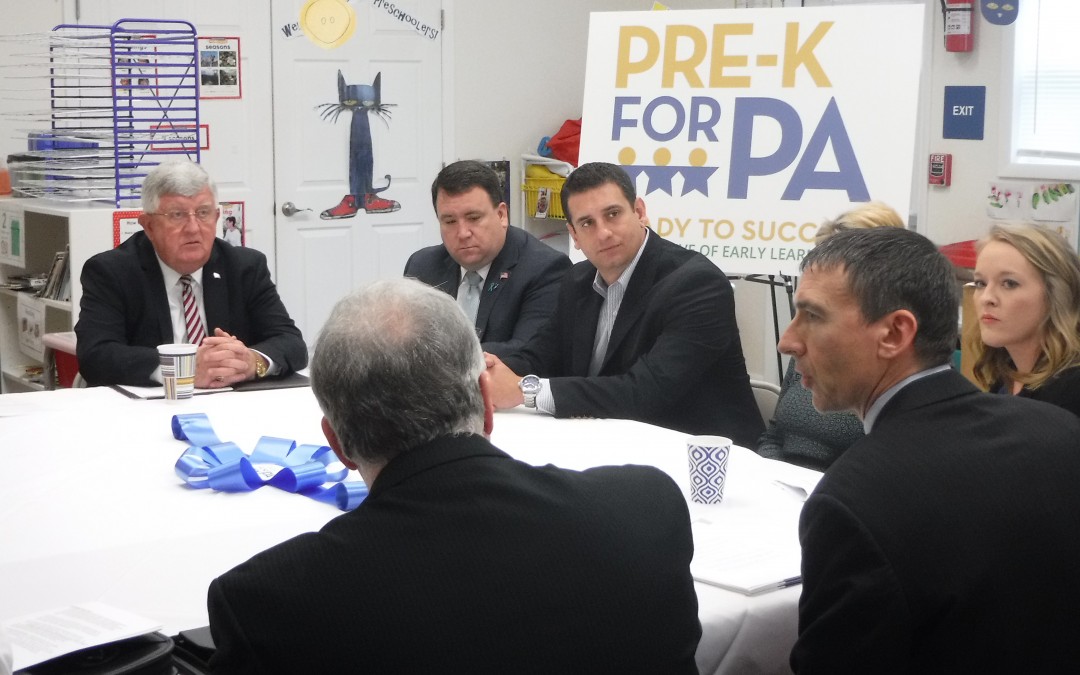
State Senate Majority Leader Jake Corman, R-Benner Township, met with educators and law enforcement officials at St. Paul’s Christian Preschool and Childcare in downtown State College on Monday to discuss the infusion of funds and recognize the school’s new pre-K classroom and students.
The funding came as part of the state’s 2015-16 budget, said a joint news release from Fight Crime: Invest in Kids in Pennsylvania and Pre-K for Pa. Pennsylvania Pre-K Counts received $25 million while the Head Start Supplemental Assistance program received $5 million.
This new funding for the remainder of the school year has allowed the county to serve an additional 47 children with pre-K education, the release said.
“A review of Pennsylvania’s state inmate population reveals that more than 50 percent of inmates have not graduated high school,” State College police Chief Tom King said in the release. “This revealing statistic is more reason for the imperative that law enforcement leaders place on educational success, which is best achieved by children getting a strong early education.”
Funding for pre-K is one of the few areas in the state where the funds are increasing, Corman said Monday, adding that while there has been a significant increase over the past two years, the demand continues to grow.
“We need to be able to show as a government that we are having a positive impact in these investments of state dollars,” Corman said.
After the meeting, Corman, King, county Commissioner Michael Pipe and educators visited the new pre-K classroom, which, according to school Director Joan Stroemel, opened at the end of Feburary. Fourteen 3- and 4-year-olds helped Corman cut a long, blue ribbon marking the inauguration of the new class.
Read the full article here.

York Daily Record: One Class Could Make Big Difference in York City
By Angie Mason 4/14/16
Students in Nicole Reed’s pre-kindergarten class sat “criss cross applesauce” while she began reading them a story about a chick that imitates other barnyard animals.
“This little chick from over the way went to play with the pigs one day,” she began. Students chimed in on a line that repeated throughout the book. “And what do you think they heard him say?”
Reed asked questions as she paged through the story. What sound does a chick make? What letter does “ribbit” start with? What do you think the chick is going to say?
While Reed guided students through the book, co-teacher Ciara Sweeney sat on the floor with them, jotting down notes about which ones seemed to be picking up the various skills.
Pre-kindergarten class looks like fun. There’s singing, dancing and playing. But there’s a learning goal behind most every activity, and York City school officials believe it pays off — and they’re hoping to see evidence of that in third grade classrooms in a few years. That’s one of the key measurements the district will use to see if its efforts to improve students’ education, laid out in its recovery plan, are working.
What’s the district doing
The York City School District has been pushing to expand pre-kindergarten, with a goal of one day providing the program for all York City children. The district expanded its offerings to have 12 classrooms this year, serving about half of children who will head to kindergarten, and the district hopes to add another classroom next year. Some of the district’s classrooms are funded by state Pre-K Counts grants, and some are paid for with district funds.
The pre-k expansion relates to one of the academic goals laid out in the district’s new recovery plan: improving third-grade literacy.
Before third grade, students are learning to read. Starting in third grade, they begin using their reading skills to learn.
“If we don’t build these literacy skills early … then those students will be at a disadvantage,” said York City School District Supt. Eric Holmes.
In 2018-19, this year’s pre-kindergarten students will be in third grade. By June 2019, the district aims to close the gap between its third-grade reading scores and the state average. That gap stands at about 42 percentage points now.
Third grade is the first year students take mandated state reading and math tests, and in urban environments around the country, it’s also where schools start to see student achievement begin to fall, Holmes said.
Offering the children pre-kindergarten would give the district one more year to catch them up and get them on track by third grade.
Like everything, expanding pre-kindergarten takes money. A pre-k classroom for 19 students costs about $161,500.
Holmes said the district supports Gov. Tom Wolf’s efforts to increase early education funding. Pre-kindergarten is usually considered to have bipartisan support, but how much more the state should spend there is debated. Wolf had initially sought an increase of $120 million for Pre-K Counts and Head Start programs for 2015-16, but the partial budget adopted in December included a $30 million increase for those items.
The school district is committed to expanding pre-kindergarten either way, Holmes said, and will use general funds if necessary. But if the state put more toward pre-k, that would allow the district to use its general fund dollars for other student-centered programs, he said.
Getting ready to read
In a third-grade classroom at Hannah Penn K-8 School, Ella Alsentzer asked her students if they remembered what an adverb is.
“It describes a verb,” a student called out.
“Perfect!” Alsentzer answered. Students began going through sentences, looking for adverbs and discussing their meaning as they went.
Soon they turned to their textbooks, where they learned the word “voyage” — is a trip to Target a voyage? How about to California? — and took turns reading paragraphs.
Third grade is when students begin putting together their skills to start to comprehend what they’re reading, Alsentzer said. They’re no longer just learning to sound out words, but rather putting those words together to understand meaning. They need to be able to answer context questions about what the’re reading.
Getting the students there starts early.
In Reed’s pre-kindergarten class at Devers, students took turns sitting at a desk and writing the letters of their first names on a piece of paper, while their classmates danced and sang with Sweeney.
“Stay on those tracers,” Reed guided one child, while classmates pretended to play guitar along with a song.
In pre-kindergarten, Reed works to get students used to seeing words and letters. They focus on a “letter of the week” and a list of vocabulary words. They learn “snap words” like “a” and “the.”
Kindergarten will move fast. While pre-k focuses on a letter of the week, kindergarten does several each week, Reed said.
Julie Fabie, the district’s pre-kindergarten coordinator, said literacy is a big focus. The teachers work on introducing students to vocabulary they might not have heard otherwise, building up students’ “word bank” in preparation for kindergarten.
And while there’s a learning standard being met through every activity, Fabie said, students in pre-k are certainly getting time to play.
“It’s what’s developmentally appropriate,” she said.
Fabie told the school board that this year, the pre-kindergarten classes started a developmental screening questionnaire with students, to help identify any possible developmental delays. Then the classes work closely with the Lincoln Intermediate Unit for any interventions needed.
Pre-k can save on special education costs, said Joan Benso, president and CEO of Pennsylvania Partnerships for Children. Often a child might have an IEP — an individualized plan for a student with special needs — in pre-k that might be unnecessary by kindergarten or first grade.
“I think the issue is … sometimes those delays are very focused on language acquisition,” Benso said. “If that child is in a rich, literacy promoting pre-k program, those language acquisition skills … are all taken care of before that kids go to kindergarten.”
Benso’s organization is part of Pre-K for PA, a campaign pushing for all 3- and 4-year-olds to have access to high quality pre-kindergarten by 2018. The campaign cites a host of benefits from pre-k, pulled from various studies.
Early literacy skills are one of the most important outcomes of pre-k, she said, but it also gives students early numeracy and social skills. It can mean fewer disruptions in the classroom later, which is better for everyone to learn.
For children from lower socioeconomic backgrounds, pre-k means they are more likely to enter kindergarten similarly prepared to a student from a more affluent background, she said.
Benso said it isn’t a silver bullet — the quality of education after pre-k matters, too. A child who has the opportunity to attend a high school with the latest technology in the science lab and advanced courses is likely to be better prepared for college than a child who doesn’t.
“That does’t mean pre-k failed, that means we failed on a K-12 side,” she said.
Read the full article here.
CBS21: PA mayors call for continued investment in publicly funded pre-k
April 11, 2016
HARRISBURG, Pa. — As Mayors from Pennsylvania’s largest population centers continue to advocate for major pre-k initiatives in Philadelphia and Pittsburgh, Mayors and other leaders from mid-sized cities and communities across Pennsylvania gathered in Harrisburg today to encourage Governor Wolf and legislators to continue investing in publicly funded pre-k. The Mayor’s said pre-k is a vital element in the development of municipalities, citing lower crime, improved education outcomes, and greater workforce readiness as the key reasons to invest.
Lancaster Mayor J. Richard Gray, President of the Pennsylvania Municipal League joined forces with leaders from Cranberry to Lebanon in a chorus of support for expanded access to pre-k, “I support expanded access to pre-k as a cost-effective strategy to make our communities safer, and grow new jobs and businesses. A growing body of research shows that early childhood education in a pre-kindergarten setting provides a proven pathway towards achieving these goals.”
Governor Wolf’s 2016-17 proposed budget includes another $60 million in new funding for high quality pre-k. That investment would build on this year’s expansion and allow more than 14,000 young children to access pre-k over the two-year time period.
Research shows that expanded access to high quality pre-k can also reduce crime rates and make communities safer. Hundreds of Pennsylvania police chiefs, sheriffs and district attorneys have lined up behind efforts to invest in pre-k.
“Less crime means less money spent fighting crime,” Pennsylvania Municipal League 1st Vice President and City of York Mayor C. Kim Bracey said. “Imagine what we could do to improve our city or lower our taxes if we didn’t have to devote so much of our local budget to dealing with crime on the back-end.”
Bracey cited the Chicago Child-Parent Center (CPC) preschool study, one of the nation’s most extensive studies that tracked child outcomes over 28 years, that found that children without access to a good pre-k program were 70 percent more likely to be arrested by the time they were 18 compared to children who had the benefits of pre-k.
In Pennsylvania, Department of Correction Secretary John Wetzel has touted research that shows a $120 million state funding increase for early childhood education will eventually lead to $350 million in Corrections and other cost savings for the Commonwealth every year.
Expanded access to high quality pre-k enjoys bi-partisan support in communities throughout the state. Lebanon Mayor Sherry Capello noted that mayors regardless of political affiliation see pre-k as an important part of their communities’ future. “Better education is an important part of any communities’ economic development plan and I believe that better education starts early. I think this is an issue that we all can agree on.” Capello went on to urge state policymakers to work in a bi-partisan fashion to invest in pre-k.
Read the full article here.
Indiana Gazette: Pre-k Expansions to Benefit At-Risk Children in County
By Sean Yoder 4/2/2016
BLAIRSVILLE — Great Expectations Child Care and Early Learning Center in Blairsville is one of the latest education centers to expand its number of subsidized pre-kindergarten slots.
On March 1, Great Expectations learned it would gain another 17 Pre-K Counts-funded slots, on top of the existing 17, according to Madeline Savage, director.
Several local elected officials and law enforcement gathered Friday to celebrate the expansion and talk about the benefits of early childhood education, especially for at-risk children from low-income families.
Savage told them that about 60 to 70 percent of the children do receive subsidies and qualify for the reduced meal program, which shows that many come from low-income families, she said. The grant expansion has allowed more of the 110 children at the center to receive subsidized pre-K and add some new children or those whose parents may have pulled them out for financial reasons.
Great Expectations expanded a year and a half ago and has been in Blairsville since 2009.
Advocates say that students who attend pre-K need fewer special needs through school and aren’t as likely to be held back, are healthier and aren’t years behind their peers when kindergarten starts.
Sarah Byrnes-House, representing the Pittsburgh Association for the Education of Young Children, said 58 percent of children below the poverty line in Indiana County don’t have access to high-quality pre-K. The percentage is the same in Allegheny County. In Washington County it’s 69 percent and it’s 71 percent in Westmoreland County. She said the U.S. lags behind other countries and ranks 24th out of 29 in spending for early learning.
The latest state budget called for $25 million more funding to Pre-K Counts and $5 million more for the Head Start Supplemental Assistance Program. Early childhood education centers and school districts across the state had been waiting for months on word about their Pre-K Counts applications due to the budget stalemate in Harrisburg.
Nationally, state funding increased by $672 million to a total of $6.3 billion for 2014-15.
In Indiana County:
• ARIN IU 28 received $70,500 in Pre-K Counts grant money for 2015-16. That equates to 20 full slots per day.
• The Indiana County Child Development Center was awarded $7,050, or two slots.
• Indiana County Head Start received $51,649 in Head Start funding, or 13 slots.
State Rep. Dave Reed said the discussion among lawmakers has changed a lot in the past decade.
“Folks in Harrisburg are much more open to investing in early childhood learning programs,” he said “There are still a few folks out there that look at it as a glorified day care program and I don’t think they quite understand it. And it’s a generational issue, absolutely.”
“You’ve got kids showing up to kindergarten ready to read, doing addition, subtraction, looking at multiplication and competing against kids who don’t know the difference between a circle and a square. That child is already left behind.”
Reed said pre-kindergarten could also help cut down on expenses for remediation later in a student’s career.
“This truly is the opportunity to balance the scale for those children who are living in atmospheres that are not ideal. They didn’t choose to be born into those atmospheres. They are products of a situation that is beyond their control.”
Also in attendance were Sheriff Bob Fyock, District Attorney Patrick Dougherty and Blairsville Police Chief Michael Allman.
Bruce Clash from Fight Crime: Invest in Kids has been helping to organize support for pre-kindergarten across the state from a law enforcement standpoint. The organization’s contention is that at-risk children who don’t attend a pre-kindergarten program can be more likely to be arrested for violent crimes and end up in prison later in life.
Half of inmates in Pennsylvania don’t have a high school diploma, said Dougherty. He said that education is cheaper than incarceration and that it was a no-brainer to invest in the front end to keep people out of the corrections system.
Fyock said in his years in law enforcement he’s seen generations of families follow the same patterns of crime. He said it was important to reach children when they’re young and be proactive.
“It’s going to be very valuable on down the road,” Fyock said. “If we can prevent them from getting into crime to start with it’s going to be very good.”
Mission: Readiness is an organization comprised of former service members who hope to prepare children for success in order to qualify for military service, or keep from being disqualified. Steve Doster, Pennsylvania director, said about 72 percent of 17- to 24-year-olds are not eligible for service. It can be due to inadequate education, lack of skills to pass the entrance exams or lack of physicality. Drug offenses also preclude people from serving.
Rod Ruddock, a retired U.S. Army Reserve major general and current county commissioner, said that young adults who are fit for military service are also more likely to be employable in the general workforce.
Read the full article here.
Indiana Gazette: Pre-k Expansions to Benefit At-risk Children in County
4/2/16 By Sean Yoder
BLAIRSVILLE — Great Expectations Child Care and Early Learning Center in Blairsville is one of the latest education centers to expand its number of subsidized pre-kindergarten slots.
On March 1, Great Expectations learned it would gain another 17 Pre-K Counts-funded slots, on top of the existing 17, according to Madeline Savage, director.
Several local elected officials and law enforcement gathered Friday to celebrate the expansion and talk about the benefits of early childhood education, especially for at-risk children from low-income families.
Savage told them that about 60 to 70 percent of the children do receive subsidies and qualify for the reduced meal program, which shows that many come from low-income families, she said. The grant expansion has allowed more of the 110 children at the center to receive subsidized pre-K and add some new children or those whose parents may have pulled them out for financial reasons.
Great Expectations expanded a year and a half ago and has been in Blairsville since 2009.
Advocates say that students who attend pre-K need fewer special needs through school and aren’t as likely to be held back, are healthier and aren’t years behind their peers when kindergarten starts.
Sarah Byrnes-House, representing the Pittsburgh Association for the Education of Young Children, said 58 percent of children below the poverty line in Indiana County don’t have access to high-quality pre-K. The percentage is the same in Allegheny County. In Washington County it’s 69 percent and it’s 71 percent in Westmoreland County. She said the U.S. lags behind other countries and ranks 24th out of 29 in spending for early learning.
The latest state budget called for $25 million more funding to Pre-K Counts and $5 million more for the Head Start Supplemental Assistance Program. Early childhood education centers and school districts across the state had been waiting for months on word about their Pre-K Counts applications due to the budget stalemate in Harrisburg.
Nationally, state funding increased by $672 million to a total of $6.3 billion for 2014-15.
In Indiana County:
• ARIN IU 28 received $70,500 in Pre-K Counts grant money for 2015-16. That equates to 20 full slots per day.
• The Indiana County Child Development Center was awarded $7,050, or two slots.
• Indiana County Head Start received $51,649 in Head Start funding, or 13 slots.
State Rep. Dave Reed said the discussion among lawmakers has changed a lot in the past decade.
“Folks in Harrisburg are much more open to investing in early childhood learning programs,” he said “There are still a few folks out there that look at it as a glorified day care program and I don’t think they quite understand it. And it’s a generational issue, absolutely.”
“You’ve got kids showing up to kindergarten ready to read, doing addition, subtraction, looking at multiplication and competing against kids who don’t know the difference between a circle and a square. That child is already left behind.”
Reed said pre-kindergarten could also help cut down on expenses for remediation later in a student’s career.
“This truly is the opportunity to balance the scale for those children who are living in atmospheres that are not ideal. They didn’t choose to be born into those atmospheres. They are products of a situation that is beyond their control.”
Also in attendance were Sheriff Bob Fyock, District Attorney Patrick Dougherty and Blairsville Police Chief Michael Allman.
Bruce Clash from Fight Crime: Invest in Kids has been helping to organize support for pre-kindergarten across the state from a law enforcement standpoint. The organization’s contention is that at-risk children who don’t attend a pre-kindergarten program can be more likely to be arrested for violent crimes and end up in prison later in life.
Half of inmates in Pennsylvania don’t have a high school diploma, said Dougherty. He said that education is cheaper than incarceration and that it was a no-brainer to invest in the front end to keep people out of the corrections system.
Fyock said in his years in law enforcement he’s seen generations of families follow the same patterns of crime. He said it was important to reach children when they’re young and be proactive.
“It’s going to be very valuable on down the road,” Fyock said. “If we can prevent them from getting into crime to start with it’s going to be very good.”
Read the full article here.
Scranton Times: Ceremony held for new Mid Valley Head Start classroom
March 30, 2016
THROOP — State, county and local officials stressed the importance of pre-kindergarten education and celebrated the opening of a second pre-k classroom in the Mid Valley Elementary Center during a roundtable Tuesday.
“Only 50 percent of 3- and 4-year-olds in Lackawanna County have access to publicly funded high-quality pre-k,” said Ann Lynady, Head Start project director.
The roundtable at the Mid Valley Elementary Center, spearheaded by Bruce Clash, state director of the Harrisburg-based Fight Crime: Invest in Kids Pennsylvania, celebrated another 17 students now enrolled in a second pre-k classroom at Mid Valley. Roundtable participants included Ms. Lynady; Sam Ceccacci, executive director of the Scranton-Lackawanna Human Development Agency; Lackawanna County District Attorney Shane Scanlon; Gary Drapek, president of United Way of Lackawanna and Wayne Counties; state Sen. John Blake, D-22, Archbald; state Rep. Frank Farina, D-112, Jessup; and Mid Valley District representatives. They discussed facts and figures on how the new early education classrooms will benefit local students. Mr. Clash’s organization campaigns for “Pre-K for PA” to help reduce crime rates.
When Governor Tom Wolf released a partial state budget in December, $25 million went to pre-k Counts programs and $5 million to Head Start programs across the state. From that funding, the Scranton-Lackawanna Human Development Agency received $356,280 to educate 60 children under the state Department of Education-funded Head Start Supplementary Assistance Program, which targets low-income families. The agency also received $168,075 for 63 children — in both full- and part-day programs — under the department’s pre-k Counts program. Families earning up to 300 percent of the poverty guidelines are eligible for Pre-K Counts.
Besides Mid Valley, new pre-k classrooms also are open in North Pocono, Carbondale Area and Wallenpaupack Area school districts.
“This area is traditionally saturated with income eligible Head Start children. We always have a lengthy wait list,” said Ms. Lynady, who worked with Mid Valley School Board Director Donna Dixon to move the classrooms into the school.
“It’s a nicer marriage when the children are able to transition right into the school district,” Ms. Lynady said.
Read the full article here.