PennLive.com (Harrisburg): Want a smart investment for kids? Try high-quality pre-k: Joan Benso
by Joan Benso
Despite the many benefits, the amount of public funds available for pre-k in Pennsylvania is only enough to help about 1 in 6 of the commonwealth’s 3- and 4-year-olds access high-quality programs. That leaves more than quarter of a million children statewide missing out on its once-in-a-lifetime benefits, including more than 5,000 children in Dauphin County alone.
Click here to read the full article online.
Pew: Rising cost of child care may help explain recent increase in stay-at-home moms
“A greater share of mothers are not working outside the home than at any time in the past two decades, according to a new Pew Research Center report. After declining for several decades — bottoming out at 23% around the turn of the century — the share of stay-at-home mothers has risen in fits and starts over the past decade and a half, to 29% in 2012, according to the Pew Research analysis of census data.
While there are many reasons driving this trend, one likely reason is the rising cost of child care. ”
Read the full Pew Research Center report
YDR.com : Want a smart investment for York County? Try high-quality pre-k
by Joan Benso
If we could invest tax dollars in a way that reduces public school costs, increases graduation rates, lowers spending on crime and social services and helps build a more competitive workforce with stronger earning power, would you get behind it? Such an investment opportunity already exists in York County in the form of high-quality pre-kindergarten. Unfortunately, we aren’t doing enough to take full advantage of it here or across Pennsylvania, and that means lost savings for taxpayers and missed opportunities for kids.
Click here to read the full article online.
By Rhian Evans Allvin, Executive Director of The National Association for the Education of Young Children (NAEYC)
As the mother of three young children, I was fortunate enough to have people around me that supported my desire to give them the best start possible. Among them were family, friends, our pediatrician and their early childhood educators. With that support network coaching, guiding and building my confidence, Austin, Eli and Isabel were afforded the opportunity to walk into kindergarten the first day of school ready to learn and face the expectations of classroom learning that awaited them. If all parents and children were supported in the same way with high-quality early learning experiences, our outlook would be much different.
That is why it is with great pleasure that, as the Executive Director of The National Association for the Education of Young Children (NAEYC), I’m proud to share with you the launch of NAEYC’s 2014 Week of the Young Child™ (April 6-12, 2014). This year, with our theme “Early Years are the Learning Years,” we draw attention to how a high-quality early childhood experience and the professionals that help to create that experience set a child’s path for success in school and beyond.
We will spend this week in partnership with our 300 affiliates around the country and the world reinforcing how critical the early years are to building the skills to get along with others, and succeed in school and life – and the important role early childhood professionals play in that process. Some of those partners are in Pennsylvania and are active supporter of Pre-K for PA: PennAYEC, the Delaware Valley Association for the Education of Young Children (DVAEYC), and the Pittsburgh Association for the Education of Young Children (PAEYC). Pre-K for PA is an important effort to ensure all 3-and 4-year-old children in Pennsylvania have access to high-quality early education opportunities.
So please join us in this celebration by learning more about our special events in your community via our interactive event map HERE or our special music event for teachers, parents and children HERE or share these helpful tips that outline the hallmarks of an NAEYC accredited center for parents and caregivers who might be navigating the decision making process of choosing an early childhood program. Please join us during NAEYC’s 2014 Week of the Young Child™ to celebrate our children, families, educators and staff for the wonderful work they do each and every day.
To see Pre-K for PA’s Week of the Young Child “One Action A Day” campaign, click here.
By Bruce Clash, Pennsylvania State Director, Fight Crime: Invest in Kids
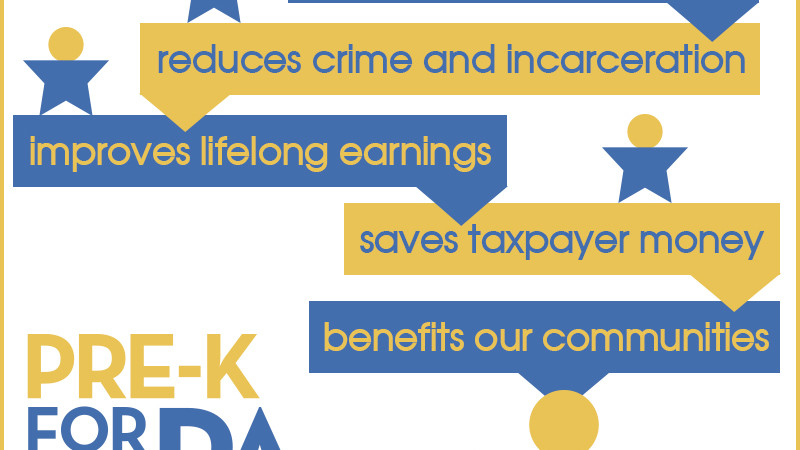
There is no doubt that high-quality pre-kindergarten programs prepare young children for school and contribute to their social and emotional development. But investment in high-quality pre-k pays dividends far beyond readiness for a kindergarten classroom. High-quality early learning programs can return as much as $17 in savings for every $1 invested over the long term.
Pennsylvania’s police chiefs, sheriffs and district attorneys know from experience and from research that at-risk kids who get the right start in life with high-quality pre-k are less likely to commit crime, drop out of high school or be a drain on taxpayers later on.
Law enforcement leaders know we can’t just arrest and imprison our way out of the crime problem. We have to prevent kids from ever becoming criminals in the first place. One of the most effective ways to reduce crime in our communities begins with investment in our youngest citizens. Nearly 70 percent of America’s state prison inmates fail to receive a high school diploma – roughly equal to the percentage of 3- and 4-year-olds in Pennsylvania who do not have access to the critical high-quality pre-k programs that will help them be better prepared for school and reinforce socially acceptable behaviors. Research shows that high-quality pre-k jump starts the learning process for children, ensuring they enter school ready to learn, have a much better chance of completing high school, and go on to become productive members of society.
Unfortunately, public funding for access to high-quality pre-k in Pennsylvania only provides this critical opportunity to fewer than 20 percent of all 3- and 4-year-olds. Law enforcement leaders view this inadequate access as a crime prevention gap that compromises the futures of at-risk children and leaves every Pennsylvanian at needless risk of becoming a victim of crime. We can pay now to provide at-risk kids a solid chance to succeed, or pay a whole lot more for failure later on.
Pennsylvania needs to be as willing to guarantee every child access to high-quality pre-k programs as we are willing to guarantee every criminal room and board in a jail cell.