
The Patriot-News: Preschool investment creates jobs and generates new spending, study finds
The Patriot-News: Preschool investment creates jobs and generates new spending, study finds
By Jan Murphy, April 25, 2014
“Investing in preschool not only helps young children’s school readiness, it reaps benefits for the economy as well in terms of creating jobs and helping local businesses, according to a study released today by a national business leaders’ group.”
“A new study about the economic impact of investing in preschool says every dollar invested in early education yields $1.79 in new spending in Pennsylvania.”
“The organization, ReadyNation/America’s Edge, estimates that every dollar invested in pre-kindergarten programs generates $1.79 in new spending in Pennsylvania.”
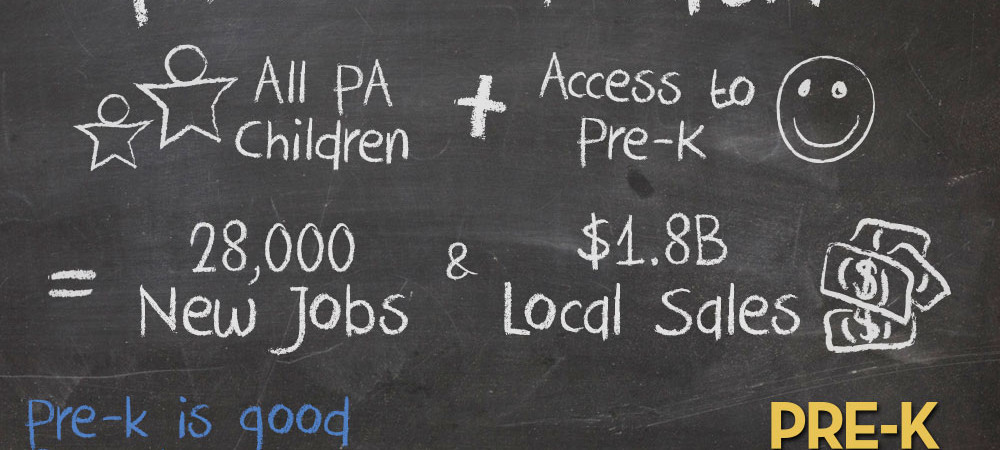
“Based on that, if quality preschool was available to all 3- and 4-year-olds, it would inject $800 million into the economy and create nearly 28,000 jobs, according to the report Strengthening Pennsylvania Businesses through Investments in Pre-Kindergarten.”
Read the full story at: http://www.pennlive.com/midstate/index.ssf/2014/04/preschool_investment_produces.html
Report: Economic Impact of Pre-K in PA
On April 24, Pre-K for PA released a report, Strengthening Pennsylvania Businesses through Investments in Pre-Kindergarten, issued by ReadyNation/ America’s Edge on its behalf. The report examines the economic benefits of pre-k investments in eight regions across the commonwealth and concludes “few investments make as much sense for Pennsylvania businesses’ balance sheets as do investments in high-quality early education.”
Every dollar Pennsylvania invests in quality pre-kindergarten programs generates $1.79 in new spending in the commonwealth, helping local businesses and creating jobs, according to a new economic impact study from a national business leaders’ organization.
ReadyNation/America’s Edge estimates that if Pennsylvania funded pre-k for all 3- and 4-year olds, that investment would generate $800 million in additional goods and services and create nearly 28,000 jobs statewide. At the same time, high-quality pre-k helps build the future workforce and foster long-term economic security.
Download the full report (PDF):  |
Download the regional briefs: |
NPR: What exactly is ‘High-Quality’ Preschool?
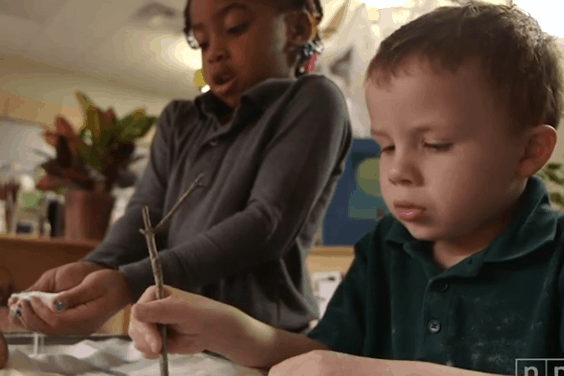
Part of a weeklong series, NPR’s Caudio Sanchez explores what ‘high-quality’ pre-kindergarten is.
Read the article here: http://www.npr.org/2014/04/22/304563233/what-exactly-is-high-quality-preschool

Where do PA voters stand on pre-k?
By Celinda Lake and Christine Matthews
It’s election season in Pennsylvania. And unless you haven’t turned on the television or radio, picked up a paper or logged on to almost any website, you’ve been hearing candidates talk a lot about jobs and education.
What they say about early childhood education, however, might seem pretty vague. Given what we see in the polling we’ve done in Pennsylvania, and the prominent attention pre-k has gotten in other high-profile races around the country, that shouldn’t be the case.
It was a central issue in the recent New York City mayor’s race, and it’s a simmering one in the hotly contested race for governor in Texas. Why now? And why in such very different political environments?
Pennsylvania voters believe pre-k can improve a child’s social skills, which helps them through grade school. They see the long-term benefits in terms of better test scores, graduation rates, and lifetime earnings and employment.
And voters are right: The proven benefits of pre-k, both short and long-term – for kids, for schools and for the economic benefits – are indisputable. The results in the many states that have implemented universal pre-k stand as a significant piece of evidence, as does decades of research by experts in early childhood education.
The political consensus around high-quality pre-k nationally may also reflect what our research in Pennsylvania tells us: there is broad bi-partisan support for pre-k. In all, 83 percent of Democrats, 61 percent of Independents and 56 percent of Republicans favor ensuring every 3- and 4-year-old in Pennsylvania has access to voluntary, high-quality pre-k programs.
In fact, a majority of Pennsylvania likely voters (59 percent) see the benefit as so clear that they support increased state funding for such programs. Pennsylvania voters, like those in many other states, recognize the results justify the investment.
In an important election year, something else stood out in our research: Pennsylvania voters say they are more likely to vote for candidates for elected office if they favored increasing funding for pre-k programs, and less likely to vote for those who opposed increasing funding.
Right now, only 1 in 6 of Pennsylvania’s 3- and 4-year-olds has access to high-quality pre-k. Candidates for governor and other offices on the ballot in this election cycle might benefit from recognizing an issue with clear, broad public support that is bolstered by scientific research and the experience of other states. If they don’t follow the lead of states that are succeeding in this approach, perhaps they might follow the will of the voters in Pennsylvania.
More information about the Lake/Bellwether survey can be found by clicking here. Celinda Lake is president of Lake Research Partners and Christine Matthews is president of Bellwether Research and Consulting.
Cohen in Inquirer: “PA needs quality pre-k”
Pa. needs quality pre-K
The Philadelphia Inquirer: guest column by David L. Cohen
“It’s not always the case that the business and education sectors are in full agreement on what’s needed to improve the quality of education and skills of our students. But when it comes to prekindergarten, the stars are fully aligned.”
Read more at http://www.philly.com/philly/opinion/inquirer/20140418_Pa__needs_quality_pre-K.html#x1hJUhVzZkwBZRds.99
Share on Facebook:
Post by Pre-K for PA.
Share on Twitter:
Investment in pre-k is “educational, societal, moral imperative,” says David L Cohen of @Comcast, citing @PreK4PA http://t.co/9XoXALMzsv
— Pre-K for PA (@PreK4PA) April 18, 2014