The Sentinel: Book: Early STEM funding key to state’s workforce
August 26, 2016
As we approach Labor Day, it is right to acknowledge the vital role that a skilled workforce plays in economic prosperity. However, the exact nature of those skills are changing.
Increasingly, STEM (science, technology, engineering, and math) skills demand attention because they are driving the economy. These jobs are high-paying, and they’re expected to grow by 20 percent to 37 percent in coming years. However, despite their desirability, STEM capabilities are lacking in the workforce. More than half of Pennsylvania employers report trouble finding people with adequate skills, training, or education, especially in technical and skilled job openings.
Now, researchers have opened a new window into our understanding of how those rudimentary math skills impact a lifetime of learning. The roots of STEM skills, we’re learning, are planted in early childhood. The capabilities in science, technology, engineering, and math that employers demand actually start forming when that small child is counting to 10.
Many admirable efforts to build STEM skills among students concentrate on middle and high school, but it’s time to turn our attention to the youngest learners. STEM skills truly do take root in the preschool years, as these findings show:
When disadvantaged children enter kindergarten, they can be 18 months behind their peers in math achievement. Early childhood education can help to close the gap, because those first three to five years of life are the time when children’s brains build synapses, the neural connections that support learning and skill development, at the rate of 700 per second.
Children are naturally curious, and strong early learning curricula capitalize on that. High-quality early childhood education directs children to play-based activities purposefully designed to build understanding of real math and science concepts.
Early math skills can predict later school success, even in reading. But if math problems persist at ages 6, 8, and 10, children are less likely to graduate from high school or attend college.
Proper brain development in young children also lays the groundwork for desirable workplace traits, including focus, perseverance, and teamwork.
Pennsylvania has a long tradition of investing in high-quality early childhood education, but it’s not enough. While Pennsylvania’s recently enacted state budget for 2016-17 will allow 6,200 additional children to enroll for a full year, about 70 percent of PA’s income-eligible three- and four-year olds do not have access because of inadequate funding. That’s 120,000 young children each year who might lack learning experiences in math and science fundamentals.
In order for our future workers to continue making significant achievements to our economic prosperity, we must invest in them as children by increasing access to quality early childhood education programs. It is my hope that, by next Labor Day, we will be celebrating a continued robust investment in these programs, pointing more children toward futures as participating citizens in the vitality of our local communities.
Read the full op-ed here.

Pre-k / Early Learning Advocates Call for Renewed Commitment to Pre-k, Quality Child Care and Home Visiting Programs
HARRISBURG (July 15, 2016)— Partners in the Pre-K for PA and Early Learning PA campaigns credited nearly 20,000 supporters for the adoption of a budget that maintains the commonwealth’s investment in high-quality pre-k programs. The Campaigns renewed a call for making more substantial progress in its efforts to expand essential early childhood programs.
The principal partners of the Pre-K for PA and Early Learning PA Campaigns issued the following statement regarding the enactment of the final 2016-17 state budget:
“Given the obvious constraints of this year’s state budget negotiations, we are heartened by the fact that the final 2016-17 budget puts the funds on the table to essentially maintain the capacity of the state’s pre-k programs. Had the legislature and governor not provided a combined $30 million increase in the appropriations for Pre-K Counts and Head Start Supplemental, these programs would have been forced to weather significant cuts and thousands of children would have lost access to these critical early learning opportunities.
“We will continue to urge lawmakers to make more progress next year, as current state funding represents a small portion of investment needed relative to the needs of our children. During the upcoming school year, Pennsylvania will leave nearly 200,000 3- and 4-year-olds without the once-in-a-lifetime opportunity to learn in a high-quality pre-k program. Even with the funds provided for pre-k in the FY ‘17 budget only 31% of kids eligible for state funded programs like Pre-K Counts and Head Start Supplemental Assistance will have access.
“Our coalition of educators and pediatricians standing alongside law enforcement, military, business and community leaders as well as nearly 20,000 citizen supporters will be redoubling our efforts over the coming months to demonstrate support for state budgets that generate the revenue necessary to make the urgent and substantial investments needed in child care, home visiting and pre-k programs that ensure our kids will enter school ready to learn.”
Partners of the Early Learning PA Campaigns also expressed disappointment that the final budget included:
A $20 million reduction in state appropriations for child care services. The budget agreement compensated for this cut by tapping federal funds that otherwise could have been used to expand child care access and quality;
Level state funding for evidence–based home visiting programs that support higher-risk, low-income children and their parents despite a growing unmet need.
Pennsylvania’s early childhood education system is a continuum of programs including quality pre-k, child care and home visiting services that are vital components to closing the achievement gap, producing qualified workers and providing short- and long-term economic returns to Pennsylvania taxpayers.
Pre-K for PA was launched in 2014 with the vision that every 3- and 4-year-old in Pennsylvania will have access to high-quality pre-k and has 13,000 members. This statewide coalition’s leadership group includes: Delaware Valley Association for the Education of Young Children; Economy League of Greater Philadelphia; Fight Crime: Invest in Kids; Mission: Readiness; Pennsylvania Association for the Education of Young Children; Pennsylvania Head Start Association; Pennsylvania Partnerships for Children; Pittsburgh Association for the Education of Young Children; Public Citizens for Children and Youth; and United Way of Greater Philadelphia and Southern New Jersey.www.prekforpa.org
Early Learning PA also was launched in 2014 with the vision that, by 2020, all Pennsylvania children will have access to high-quality early learning opportunities. Its founding members include: the Delaware Valley Association for the Education of Young Children; Fight Crime: Invest in Kids; Mission: Readiness; Pennsylvania Association for the Education of Young Children; Pennsylvania Child Care Association; Pennsylvania Head Start Association; Pennsylvania Partnerships for Children; Pittsburgh Association for the Education of Young Children; and Public Citizens for Children and Youth.
Courier Times: Pay now or pay later: Why pre-K is worth the cost
By BILL SHOFFLER
What if I were to tell you Harrisburg was considering a proven way to create jobs, reduce the number of people in jail, and save more tax dollars than it costs? What if it made it far less likely for 1,500 high-risk kids to go to jail?
You probably know that high quality pre-kindergarten prepares children so they’re ready to learn in school. Quality pre-K also provides a level of stability for working families, especially those struggling to go to work and absorb the cost of child care in their family budgets, making them more reliable employees and more effective parents.
But what if I told you quality pre-K also reduces criminal behavior and saves millions of tax dollars in fewer incarcerated people? It does. And that’s what makes it a great solution.
There is no shortage of studies on children at high risk of failing in school. These studies examine the effects of early learning experiences on 3- and 4-year olds and measure things like cognitive development and retention, socialization skills, school readiness, drop out rates, health, and success later in life, among many other things.
These studies have proven that quality pre-K bridges the achievement gaps of minority students in math and literacy and greatly reduces the need for special education instruction, lowers the costs involved in drop-outs, all of which saves tax dollars and improves the learning environment for every student in the class.
Interestingly, some studies show the academic advantages that quality pre-K gives students over their non-pre-K peers actually levels out by third or fourth grade. While the research doesn’t tell us exactly why this is, there is reason to believe maintaining the powerful learning trajectory fostered by pre-K isn’t sustainable for schools that have to mostly focus on students who just aren’t ready to learn. In the meantime, the dividends of pre-K continue to grow.
Children who have had quality pre-K relate to their peers and teachers better and are far less likely to have social or self control issues. The research also shows that social skills learned in pre-school are sustained throughout the school years and into adulthood. These are the skills that account for the extremely large reductions in criminal behavior and incarceration rates in the teen years and later.
Pennsylvania currently houses more than 50,000 prisoners in state correctional facilities at a cost of $2 billion every year. That’s an annual per prisoner cost of $40,000, or, $10,000 more than the average per capita (not household) income in the commonwealth. It is more than four times what the state spends per student for one year in public school. And, with Bucks County’s DelVal University tuition coming in at around $37,000, it’s more than it would cost to send a kid to a private college.
And that’s only the $2 billion in incarceration costs to the state. There are also related county and municipal costs, let alone the systems that support prisons, including police, sheriffs, judges, lawyers, social workers, psychologists and health care workers, etc.
Finally, consider the cost of lost opportunity, which taxpayers bear, including not having a productive citizen earning the media per capita income and paying taxes.
The PreK for PA Campaign is asking the Legislature and governor for $90 million to fund 2016-17 pre-kindergarten programs in Pennsylvania. The $90 million will get 7,200 more at risk 3- and 4-year olds from low-income families into quality pre-K.
Read the full column here.
Philly.com: Letter to the Editor: State Funds Also Needed for Phila Pre-k
While the passage of the soda tax is good news for Philadelphia’s pre-K children, Mayor Kenney’s plan to serve 10,000 children counts on additional funding from the state.
I recently met with state legislators as part of the Pre-K for PA campaign, which is recommending $90 million in additional pre-K funding in the 2016-17 state budget. State Reps. Dwight Evans and Joanna McClinton reiterated their commitment to pre-K.
I hope the two Philadelphia Democrats will encourage their colleagues to make pre-K a priority. Thousands of Philadelphia children are counting on them.
Adrienne Briggs, Lil’ Bits Family Child Care Home, Philadelphia
See the letter to the editor here.
Governor Wolf’s Commitment to Pre-K Goes Down the Chute
Campaign urges legislative leaders to put pre-k back in the game
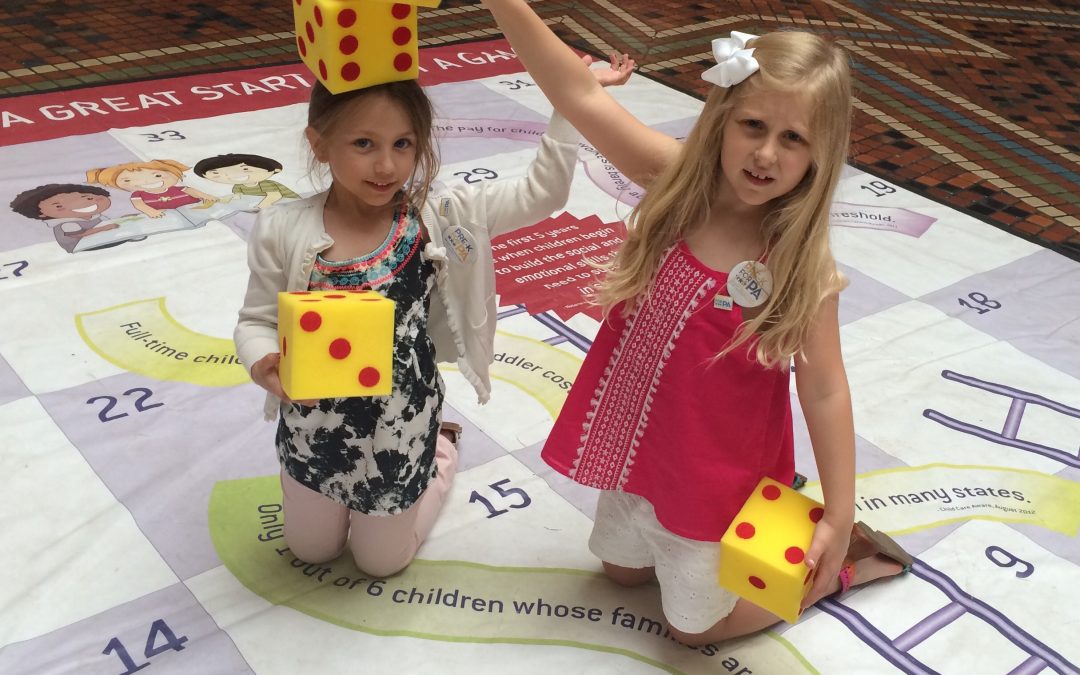
Harrisburg, PA (June 23, 2016) –While pre-k advocates and legislators show their continued support for pre-k expansion by trying their hand at a life-sized Chutes & Ladders game in the East Wing Rotunda today, the Pre-K for PA Campaign expressed its disappointment with Governor Tom Wolf stepping back on his commitment for meaningful pre-k expansion from his list of “must haves” in the final 2016-17 state budget agreement.
The principal partners of the multi-year Pre-K for PA campaign to increase funding for high-quality pre-k issued the following statement regarding the governor’s announcement:
“The governor’s backtracking on his campaign priority is a huge setback for the 120,000 3- and 4-year-olds who currently lack access to high-quality pre-k programs that will prepare them to enter school ready to learn. This pace of growth is inadequate.”
“In spite of this setback, the pre-k campaign remains hopeful that legislative leaders on both sides of the aisle will remain responsive to young children’s needs in their districts and boost pre-k funding beyond the governor’s current request.”
“Over the past several months a wide show of force that includes local philanthropic groups, mayors and municipal leaders, pediatricians, chamber of commerce officials, and an ever-growing corps of highly respected business, military and law enforcement leaders, have joined the Pre-K for PA campaign’s call for a $90 million expansion for Pre-K Counts and Head Start State Supplemental in the 2016-17 state budget. Such an investment would allow 7,400 more Pennsylvania children to attend high-quality pre-k next year in addition to making the 6,200 half-year slots full-year. These children will not have another chance to reap the benefits of high quality pre-k. The time to invest is now.”
Pre-K for PA and MomsRising are teaming up for a “Moms for Pre-k Day” at the State Capitol in Harrisburg today. Legislators, staffers and visitors to the Capitol are invited to join moms and kids for Chutes & Ladders fun.
Pre-K for PA is an issue campaign supported by individuals and organizations across Pennsylvania who believe that investing in our children is the right choice and an urgent necessity. Its vision is that every 3- and 4-year-old in Pennsylvania will have access to high-quality pre-k. For more information visit www.prekforpa.org.
# # #
Philadelphia Magazine: PA Business Leaders: We Need More Money for Pre-k
While the soda tax battle finally ended on Monday when Mayor Jim Kenney signed the long-contested sugary drinks tax into law, local business leaders are saying more needs to be done.
They’re calling on the state to to pump an additional $90 million into funding for high-quality pre-K, the Philadelphia Business Journal reports.
Representatives from the Greater Philadelphia Chamber of Commerce, the Main Line Chamber of Commerce, the African American Chamber of Commerce and the U.S. military say the investment would bridge the STEM workforce skills gap beginning in the formative pre-K years. The money would expand pre-K access for 7,400 more children and extend the school year for 6,200 students, CBS Philly reports.
To back this position up, the leaders have cited STEM and Early Childhood — When Skills Take Root, a report released on Friday by Mission:Readiness, an education advocacy organization run by retired military leaders and Washington D.C.-based education advocacy group, ReadyNation.
The report says that STEM (science, technology, education, and math) jobs, like those in healthcare and computer science will drive the economy, growing by as much as 20 to 37 percent nationwide, but in Pennsylvania, the pipeline to these professions is weak — nearly two-thirds of eighth graders aren’t proficient in math and science and more than a quarter of students moving into higher education in the state require remediation in math and English.
The report also highlighted recent findings from the Pennsylvania Chamber of Business and Industry that show that companies spend over $188 million per year on retraining employees and that 52 percent of employers face difficulty hiring people with adequate skills, training, and education.
“Our future’s success and our nation’s technological advantage depend upon the constant supply of highly trained, highly capable technical talent,” Jim Waddington, director of strategic marketing solutions at Lockheed Martin told the Business Journal.
Read the full article here.