Reading Eagle: Berks County Sees a Boost for Pre-k Education
October 1, 2016 by David Mekeel
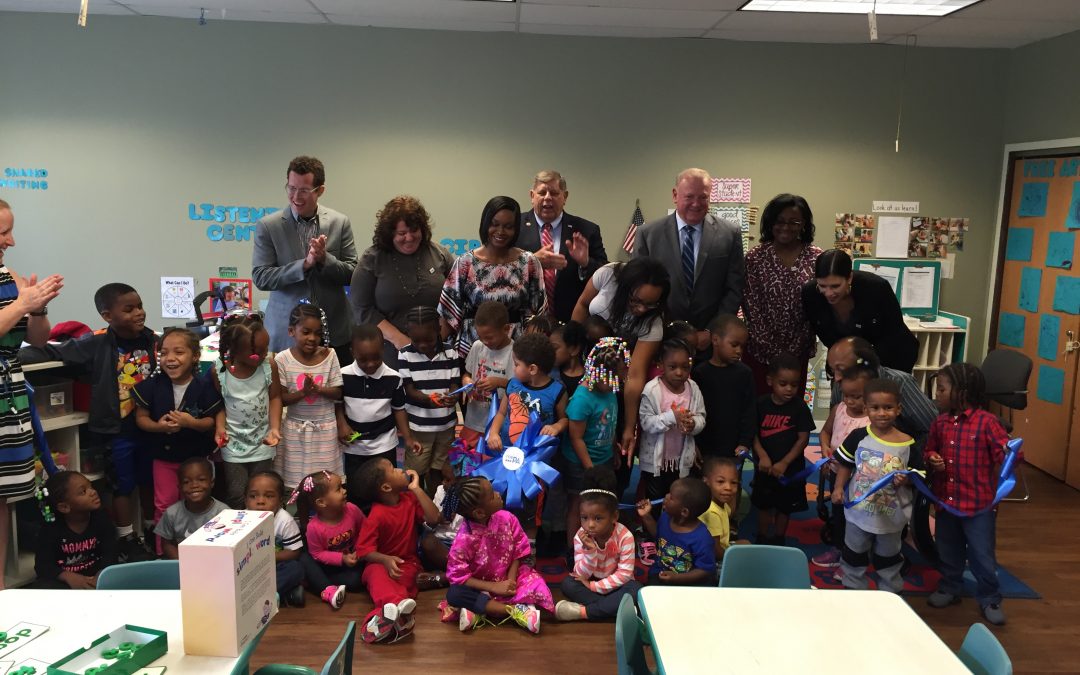
Seventeen sets of tiny hands grasped a long, blue ribbon, a bow at its center, and stretched it across their classroom.
The 3- and 4-year-olds were flanked by a group of grown-ups, smiling as pictures were snapped. At the count of three, four of the small children who had been given red and black safety scissors snipped away, making the opening of their new pre-kindergarten classroom official.
The Berks County Intermediate Unit on Friday celebrated the addition of seven new pre-k classrooms that have opened up across Berks County this school year with a special event at the BCIU Education Center along Centre Avenue. The new classrooms are the result of a $30 million increase in this year’s state budget for early childhood education.
Before the ribbon-cutting – and before state Sen. Judy Schwank sat down to read the kids a couple of stories – local and state officials gathered for a roundtable discussion about pre-k funding.
The discussion was led by Bruce Clash, state director of Fight Crime: Invest in Kids Pennsylvania. The group, which is made up of 160 district attorneys, police chiefs and sheriffs, pushes for increased funding for early childhood education.
The goal of the group, according to Clash, is to make sure every child in the state has access to high-quality pre-kindergarten.”We’re here today to celebrate that we’re taking a chip out of that need,” he said.
Clash said the $30 million increase in state funding this year opened up pre-k opportunities for 4,000 kids across the commonwealth. But, he added, the need hasn’t gone away.
In Berks County alone, more than 4,800 children living 300 percent below the poverty line still don’t have access to pre-k. That number represents 76 percent of the children in the county currently living at that poverty level.
The fight to change the situation is a long, often frustrating one, Clash said.
“We all have flat spots on the side of our heads from beating them against the wall,” he told the group gathered around the table.
The funding increase, however, is at least a start.”
There are real little ones here,” Cheri Woyurka, BCIU director of early childhood and student services, said with a smile. “We have lots of little bodies in this building.
“Woyurka said the new state money allowed the BCIU to more than double its number of Pre-K Counts classrooms, going from six to 13. This year they’re serving 283 children at sites throughout the county.
And that’s a big deal.
As Al Ottinger, president of QIC Inc., a precision castings manufacturer in Blandon, explained, early childhood education opportunities lead to a better prepared workforce.
Ottinger attended Friday’s event as a representative of the business community. And, he said, that community is willing and eager to help get kids off on the right foot.
“The most compelling number is that you get a $17 return for every dollar you invest in pre-k,” he said.
Ottinger said today’s workforce is facing a shortage of skilled workers, especially in technology fields. To change that, he said, will require bolstering education.
Early childhood education also has an impact on the criminal justice system, Berks County District Attorney John T. Adams said.”This is sort of a crime prevention tool for us,” he said.
“Just exposing kids to a good start goes a long way to investing in their future.
“Adams said many of the criminals he comes across share a common shortcoming – namely, education.
Clash added that about half of all inmates in state prisons in Pennsylvania don’t have a high school diploma. Early education could help keep many students from following that path.
“All those things that lead to productive citizenship begin right here,” Clash said.
Schwank agreed, saying it’s hearing from people like Adams and Ottinger – along with visiting classrooms – that help make it so easy for her to support early education funding.
Read the full article here.
Delaware County Daily Times: Pre-K programs create better citizens, advocates say
September 29, 2016 by Kevin Tustin
Clifton Heights >> The need for pre-kindergarten programs in relation to the criminal justice system was the focus of a roundtable discussion Thursday morning.
Delaware County District Attorney Jack Whelan and state Sen. Tom McGarrigle, R-26 of Springfield, met with leaders of Today’s Child Learning Center in Clifton Heights and local and state pre-K advocates to reinforce why access to these high-quality, public early education programs in the state are needed to create better citizens.
As a way of being proactive in fighting recidivism, Whelan said district attorneys are looking at the defectiveness of an incarcerated person’s educational background to deter young people from getting involved in the penal system.
“If given the opportunity that we can address these needs at the pre-K level, the expectation would be that they would not be at the point in life that they’re at when they are in the state system,” said Whelan. “If we can start from the back end looking from the front end and being able to reduce people getting involved in crime, education is a big part of that.”
The state currently spends about $2.6 billion on its corrections system for 50,000 inmates, many of whom Whelan noted have no formal education, if a high school diploma.
“It’s critically important. It’s labor intensive, it is cost intensive, but the payout over the long-term I think more than amply makes up for what it is we’re trying to fund now,” said President and CEO of the United Way of Greater Philadelphia and Southern New Jersey Jim Cawley.
Compared to the $50,000 the state spends per incarcerated person, pre-K programs are reported to return a profit of nearly $30,000 to the community for every child served by way of saving on student retention costs, special education costs and, ultimately, incarceration costs.
Funding has increased for pre-K programs in the state under Gov. Tom Wolf, jumping $120 million in two years for Pre-K Counts and Head Start Supplemental.
The boost in money has allowed Today’s Child to add 40 students this year alone to their highest-rated program in four locations, many of whom are in the Colwyn center.
Erinn Rinn, community relations coordinator for Today’s Child, gave feedback on the benefits that the Pre-K Counts program has been afforded to students.
“We talk with the kindergarten teachers and those teachers tell us themselves that the children who come from our programs are ready and more ready for the children who are not in this program and they succeed later on, K-through-12,” said Rinn.
Teachers at Today’s Child have degrees in early childhood education.
The state’s guidelines and mandates for selecting students for prioritizing applicants includes income levels, single-parent households, English as a second learning and even health.
Read the full article here.
New Pittsburgh Courier: County, Regional Officials Celebrate New Pre-k Classrooms in Homewood
By Stephan Broadus 9/20/2016
Pittsburgh, Pa. – Local and state officials helped mark the expansion of a pre-kindergarten classroom at YWCA of Greater Pittsburgh’s Homewood-Brushton Child Development and Education Center on Sept. 19.
The expansion of high-quality pre-k was made possible by the infusion of an additional $25 million in funding for Pennsylvania Pre-K Counts and $5 million for the Head Start Supplemental Assistance Program as part of the 2016-17 state budget. Early learning providers in Allegheny County received new state funding to serve more than 400 additional children in the current school year. Pre-K Counts and the Head Start State Supplemental are the primary state funding sources for high-quality pre-k in Pennsylvania.
Cara Ciminillo, executive director of the Pittsburgh Association for the Education of Young Children, said the region’s new pre-k classrooms are a step in the right direction, but noted access to high-quality pre-k in Allegheny County remains a challenge. “Only 42 percent of income eligible 3- and 4-year-olds have access to publicly-funded high-quality pre-k in the county. This equates to more than 7,300 income eligible three- and four-year-olds still lacking access to publicly-funded high-quality pre-k every year,” Ciminillo said.
Statewide, more than 120,000 3- and 4-year-olds—or 69 percent of all eligible young learners—are missing out on publicly-funded, high-quality pre-k each year. This lack of access is especially troubling considering the proven benefits it has for children, schools and communities. A large body of research shows children who benefit from high-quality pre-k:
Enter kindergarten with stronger literacy, language, math and social/emotional skills;
Are less likely to need special education services, less likely to repeat grades, and more likely to graduate and enroll in college.
Over a lifetime, these young learners will see stronger employment opportunities and increased earning potential, and they are less likely to commit juvenile and adult crimes.
Allegheny County Sheriff William Mullen stressed the role high-quality pre-k plays in reducing disruptive or anti-social behaviors that, if unaddressed, can lead to delinquent and criminal behavior. Mullen noted research compiled by the anti-crime organization Fight Crime: Invest In Kids showing that at-risk kids who attend high-quality early learning programs are dramatically less likely to commit crime and more likely to graduate from high school.
“A review of Pennsylvania’s state inmate population reveals that more than 50 percent of inmates have not graduated from high school,” said Mullen. “This revealing statistic is more reason for the imperative that law enforcement leaders place on educational success, which is best achieved by children getting a strong early educational foundation.”
Sheriff Mullen added: “Independent cost-benefit analyses show that high-quality pre-k can return, on average, net benefits to society of nearly $30,000 for every child served. These benefits accrue largely due to reductions in the cost of future crime and increases in participants’ future wages, as well as other costs such as children being held back in school or receiving special education services.”
Read the full article here.
WBRE: Invest in Kids!
By Jayne Ann Bugda
September 9, 2016
SELINSGROVE, SNYDER COUNTY (WBRE/WYOU) With the state budget passed this year – state funded pre-kindergarten classrooms are expanding.
On Friday, a ribbon cutting was held at the ‘Susquehanna Children’s Center’ in Selinsgrove.
Through a program called ‘Fight Crime: Invest in Kids’ — 25-million dollars in state funding will help enroll 3 and 4-year-olds into a pre-k class.
The goal is to lower crime in the future.
Watch video of the event here.
Pittsburgh Post-Gazette: Op-ed: The Academic Medal Count
High-quality pre-k should be available to all children in Pennsylvania
September 9, 2016
As the Rio Olympics fades into memory, let’s take a last look back and consider how America’s elite athletes once again won the medal count, extending our country’s all-time lead to more than 2,500 Olympic medals.
This victory was not solely theirs; Olympic athletes take the field backed by parents, coaches and our entire nation cheering them on. Years of training pay off when they climb the podium to claim their medals.
But increasingly, we athletes worry that the United States is winning the Olympic medal count but losing the academic medal count. In Rio, America’s 121 medals vastly outpaced second-place China. However, our children’s 2012 international academic scores ranked 35th in math and 27th in science.
Imagine all the squandered talent behind those academic markers. In athletic terms, it’s as if Kyle Snyder had never taken to the mat, or Simone Biles had never chalked her hands for the balance beam.
Champions for America’s Future, a nationwide network of top athletes and coaches helping kids succeed in life, believes it’s time for America to take the academic podium. Elite athletes start training young. Quality early-childhood education gives our children the same edge, making sure they reach the starting line known as kindergarten with the pre-math, pre-reading and social/emotional skills needed to reach their full potential.
We’ve all heard about the “achievement gap” of lower-income high school students whose academic scores trail their higher-income peers. It’s not as if those students were on par and then ran out of gas, like a leading runner suddenly faltering near the finish line. At least 60 percent of the achievement gap in reading and math is already present at kindergarten. Often, disadvantaged children start kindergarten knowing only one-fourth the words known by the children of professional parents.
For these kids, the race may be over before it starts. As champion Olympics and NCAA basketball coach Mike Krzyzewski puts it, “These children might be scrambling to catch up for the rest of their education – and possibly for the rest of their lives.”
It doesn’t have to be that way. We’ve seen high-quality pre-kindergarten turn disadvantaged children into champions:
• By the fourth and fifth grades, disadvantaged New Jersey children served by a preschool program were three-fourths of a year ahead in math and two-thirds of a year ahead in literacy. They were also much less likely to be held back in school.
• In North Carolina, the More at Four program improved third-grade reading and math scores by the equivalent of several months of extra instruction. It also led to 10 percent fewer special-education placements.
• By age 20, students from Chicago Child-Parent Centers preschool improved their graduation rates by 29 percent. Sadly, children not served by the program were 70 percent more likely to be arrested for a violent crime by age 18.
Unfortunately, here in Pennsylvania access to quality pre-kindergarten is limited. Among the 170,000 Pennsylvania 3- and 4-year-olds living in lower-income households, and therefore at greatest risk of academic failure, nearly 70 percent lack access to quality publicly funded early-childhood programs each year. This represents missed opportunities for 120,000 young children annually.
The years of training that result in an Olympic victory come with a cost, and so does greater access to high quality pre-kindergarten. When it comes to quality early learning, however, the investment actually saves money. A respected cost-benefit analysis of more than 20 different studies showed net benefits to society of $30,000 saved for each child served in pre-kindergarten.
Athletes know that every medal we earn represents a team effort, even when we enter the mat, pool, court or track all alone. Our youngest children deserve the same team effort guiding them toward success on and off the field.
For our children to be successful, our government leaders must write a game plan that expands quality pre-K to these 120,000 young children to help them achieve their potential. Then we can lead our commonwealth and nation to the top of the world’s academic podium.
Bruce Baumgartner, a four-time Olympic wrestling medalist, is director of athletics at Edinboro University and president of USA Wrestling.
Read the full op-ed here.
Centre Daily Times: Op-ed: Helping students find success starts at a young age
By Charlene Friedman
September 2, 2016
As we celebrate Labor Day weekend and honor the workforce this year, many hardworking Americans are giving thanks for having jobs in today’s sometimes-volatile economy. Indeed, too many are still struggling to find positions in a world where workforce needs have been shifting and where 52 percent of employers have difficulty hiring people with the skills, training or education they’re looking for.
In fact, according to a new report from ReadyNation, more than 170,000 positions in Pennsylvania will not be filled with in-state employees possessing the educational credentials their employers seek. Businesses spend about $188.9 million each year on retraining employees, and about 56 percent of employers expect the recruiting problem to worsen.
Sadly, these figures make sense since 28 percent of students entering the State System of Higher Education have to enroll in remedial courses, costing about $153 million every year. Looking back further, research shows that two-thirds of eighth-graders are not proficient in math and science — two disciplines in which proficiency has become more critical for thriving in today’s STEM-driven economy.
STEM (science, technology, engineering and math) occupations in sectors like health care and computer science have been growing by as much as 20 to 37 percent nationwide. Moreover, STEM jobs are typically higher paying than those in other fields, often commanding salaries more than double the median salary for all workers even though many of these positions do not require four-year college degrees.
So how do we prepare more children to succeed in these fields? Research data shows that children’s knowledge of mathematics at preschool age (3 and 4 years old) predicts their later success into elementary, middle and even high school.
Ninety percent of the human brain is developed before age 5, and the first three to five years of life are a unique period of growth for a child’s brain. Young children can learn more STEM content than many realize. A quality early learning curriculum that capitalizes on the natural curiosity and exploration of young children quickly develops into an understanding of math and science concepts.
Children can (and should) experience this content through enjoyable, play-based activities appropriate for their age. Programs like Pre-K Counts, Head Start, and Keystone STARS-3 and -4 are based on the Pennsylvania learning standards for early childhood prekindergarten and include topics and content that help lay this foundation for STEM abilities.
Pennsylvania has a long tradition of investing in high-quality early childhood education, but it’s not enough. While Pennsylvania’s recently enacted state budget for 2016-17 will allow 6,200 additional children to enroll for a full year, about 70 percent of the state’s income-eligible 3- and 4-year olds do not have access because of inadequate funding. That’s 120,000 young children each year who might lack learning experiences in math and science fundamentals.
Workers and business owners all benefit when our economy is operating on all cylinders. Leaving so many young children without access to high-quality publicly funded pre-K jeopardizes their individual futures and our collective prosperity. It is my hope that by next Labor Day our state policymakers will have acted boldly to serve more of these 120,000 young children.
Charlene Friedman is the broker of record for Industrial-Commercial Realty LLC, State College Downtown Properties and serves on ReadyNation and Pennsylvania’s Early Learning Investment Commission.
Read more here: http://www.centredaily.com/opinion/article99638062.html#storylink=cpy