Military strengthened by early learning
BY DAVID W. KUNKEL AND THOMAS J. WILSON III
Centre Daily Times Op-Ed
November 10, 2014
On this Veterans Day, we honor the fewer than 1 percent of Americans who are ready, willing and able to serve our nation in the armed forces.
This figure may be surprising to some, but it is better understood when you consider that 72 percent of today’s young Pennsylvanians are not eligible for military service because they lack adequate education, are medically or physically unfit or have disqualifying criminal records.
This shocking reality is concerning because it undermines the military’s efforts to recruit high-quality individuals.
We must strategically invest to help young Americans grow up to be educated, healthy and fit to do the work of our nation — as soldiers or civilians.
While trends in education reform come and go, decades of research have shown that high-quality pre-K programs can help to better prepare our children by boosting graduation rates, deterring youth from crime and even reducing obesity rates, all while providing a significant return on investment.
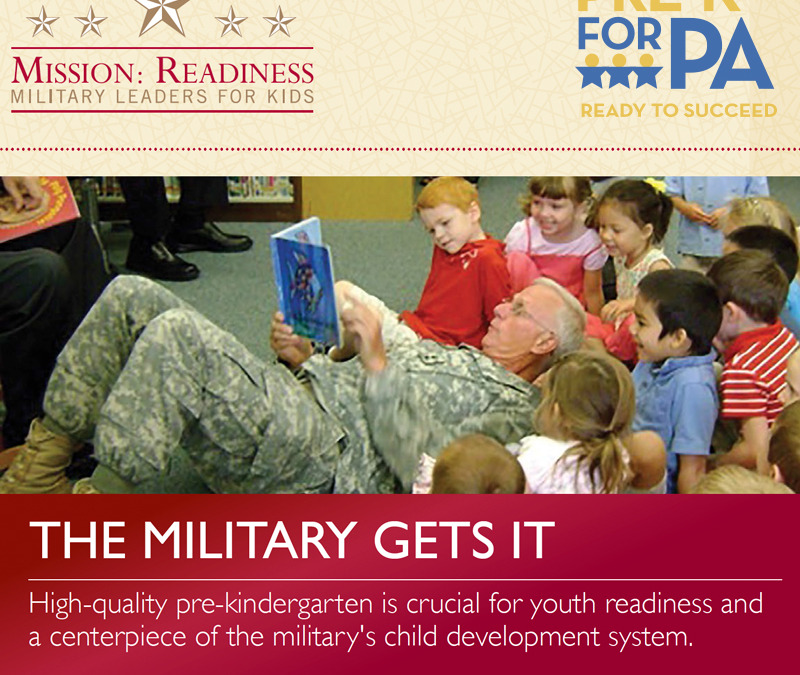
Recognizing the tremendous benefits of early education, the armed forces have developed and invested in exemplary prekindergarten programs.
These high-quality programs emphasize school readiness and are part of a larger comprehensive early-care and education system that all active-duty military families have voluntary access to.
This system has been recognized as a model for the nation in terms of quality and access.
Through the actions of Republicans and Democrats, Pennsylvania has made progress in recent years by expanding funding for high-quality early-learning programs such as Pre-K Counts and Head Start.
Unfortunately, access to these high-quality early-learning programs remains very limited. More than 200,000 — 70 percent — of Pennsylvania’s 3- and 4-year-olds do not have access.
We urge Gov.-elect Tom Wolf and the Republican-controlled General Assembly to work together and follow the military’s lead to enact a multi-year funding plan that better ensures voluntarily access to high-quality pre-K for all of the commonwealth’s 3- and 4-year-olds — starting with the children most in need.
The knowledge and skill base demanded of the young people who join the armed services is great. High-quality pre-kindergarten plays a critical role in ensuring that our next generation is academically fit and citizen ready.
Increasing access to Pennsylvania’s high-quality pre-kindergarten programs is not just an essential investment in a 21st century education system — it is also an essential investment in our future national security.
Rear Admiral David W. Kunkel, U.S. Coast Guard (retired) and Rear Admiral Thomas J. “T.J.” Wilson III, U.S. Navy (retired) are members of Mission: Readiness, a nonpartisan national security organization of retired senior military officials that works to reverse the high percentage of American youth who are ineligible for military service.

New Polls Show Strong Support for High-Quality Pre-K
Surveys indicate likely PA voters continue to prioritize early learning opportunities
Click here to contact Pre-K for PA’s media relations team.
With Election Day fast approaching, two recent statewide polls of likely Pennsylvania voters demonstrate consistent and strong support for high-quality pre-kindergarten programming and voter prioritization for pre-k has grown. The polls are consistent with a previously released survey that also shows increased voter support for pre-k in the span of just one year.
The two new polls, conducted separately by Pennsylvania-based polling firms Terry Madonna Opinion Research* and Susquehanna Polling & Research (SP&R), show that growing majorities favor access to high-quality pre-k for every 3- and 4-year old child in the Commonwealth. According to the polling:
- 63 percent consider pre-k a top or high priority (Terry Madonna Opinion Research, September 2014)
- 58 percent consider pre-k a high or medium priority (SP&R, October 2014)
“With just 15 days until Election Day, these latest poll results further cement the sentiment among Pennsylvania voters that pre-k is a top priority when they head to the voting booth in November,” said Steve Wray, executive director of the Economy League of Greater Philadelphia, a Pre-K for PA coalition member. “Each new poll conducted on the topic shows a strong majority of voters wanting the next Pennsylvania governor to improve access to pre-k.”
Consistent with other recent poll results, voters continue to prioritize pre-k as a top concern. An August 2014 Lake/Bellwether survey found that 58% of likely voters consider pre-k a top priority, an increase from 50% in December 2013. The two Lake/Bellwether polls were commissioned by Pre-K for PA and used the same methodology.
A summary of the poll findings can be viewed on Pre-K for PA’s website at www.prekforpa.org/priority.
Pre-K for PA is an issue campaign supported by thousands of individuals and organizations across Pennsylvania who believe that investing in our children is the right choice and an urgent necessity. Our vision is that every 3- and 4-year-old in Pennsylvania will have access to high-quality pre-k. While the campaign neither endorses nor opposes candidates, it advocates on behalf of this vision for Pennsylvania’s children, schools and communities.
# # #
Polls show support (Twitter):
| Polls show support (Facebook):
|

Pre-K for PA’s new issue brief — developed by the Economy League of Greater Philadelphia — focuses on the impact that high-quality pre-k has on K-12 education. Schools spend significant time and money helping children who arrive in kindergarten behind to catch up. By getting children ready for school, academically and socially, pre-k can reduce those costs and increase student success.
This is a particularly important topic given Pennsylvania’s current efforts to ensure adequate and equitable funding for public education. While there are no simple solutions to the challenges Pennsylvania faces, this brief explores how pre-k benefits K-12 systems and improves outcomes for children.
| Stronger Schools (Facebook)
|
Stronger Schools (Twitter)
|