Public News Service: Report: PA Needs to Invest More in Quality Pre-K
May 9, 2017 by Andrea Sears
HARRISBURG, Pa. – Pennsylvania is continuing to invest in quality pre-K programs for at-risk kids, but a new report says there’s still a long way to go.
According to the report, pre-K lays a solid foundation for success in school and beyond, raising graduation rates, reducing special-ed placements, decreasing crime and saving taxpayer dollars.
Joan Benso, president and CEO of Pennsylvania Partnerships for Children, says Pennsylvania is one of the 27 states that is investing in high-quality, publicly funded pre-K, and that investment has grown under four consecutive governors.
But, 64 percent of eligible children still are not being served.
“Other states, including our neighbors of New Jersey, Maryland, New York and West Virginia, are all doing a much greater amount of investments,” she says. “Economic competitors like North Carolina are also beating us.”
Pennsylvania ranks 20th in per capita investments in the programs.
Gov. Tom Wolf has proposed increasing state funding for pre-K by $75 million. That would make it available to an additional 8,400 three- and four-year-olds.
But, Benso points out that funding the program for the 113,000 eligible children in the state currently not being served will take an additional $340 million.
“And our hope in the Pre-K for PA campaign is that we’ll move forward in this state in making that investment by the year 2021,” she adds.
She also adds that every dollar the state invests in pre-K returns $4 in savings and benefits.
But Benso points out that the House budget, passed last month, only includes a $25-million increase in funding for it.
“We’re urging lawmakers to push that number up toward that $75 million of the governor’s, and make continued sustained investments so all of our eligible children can benefit from high-quality pre-K,” explains Benso.
Watch the video here.
CBS 21: Gov. Wolf Pushes for More Education Funding
May 8, 2017
Governor Wolf spoke out about early childhood education and his commitment to high-quality education in the Commonwealth.
The governor says he is proposing an additional $209-million dollars in education funding.
The investments would be put towards a number of programs.
The budget proposal also includes a nearly $8-million dollar increase for the 14 state owned universities.
Today Governor Wolf was also presented with the 2017 Pre-K Champion Award.
See the article and video here.
PennLive: Pa.’s investment in preschool lags behind other states, study shows
May 8, 2017 by Jan Murphy
Advocates pushing for an increase in state funding for preschool programs in the 2017-18 state budget released a study on Monday that shows Pennsylvania’s investment in pre-K programs is lagging behind other states.
It shows 19 states and the District of Columbia have a higher per-capita investment in high-quality preschool programs than Pennsylvania, which invests $682.17 per child, according to the National Institute for Early Education Research at Rutgers University. Fifteen states invest more than $1,000 per child including economic competitors New Jersey and New York.
What’s more, Joan Benso, president of Pennsylvania Partnerships for Children, said, “Sixty-four percent, two-thirds basically, of Pennsylvania 3- and 4-year-olds who are eligible for high-quality pre-k still don’t get the opportunity to attend. Why? Because we don’t invest enough state money.”
Her organization along with the Pre-K for PA campaign are calling on lawmakers to support Gov. Tom Wolf’s proposed $75 million increase for Pre-K Counts and Head Start, and not the $25 million one included in the House-passed Republican budget.
The proposed $75 million increase would up the state’s investment in preschool to $271.5 million and open up 8,400 more slots for children to access high-quality preschool programs.
At a Capitol news conference where she was joined by Gov. Tom Wolf along with other officials, Benso said she recognizes this is a big investment in a difficult budget year but reminded lawmakers, “our preschool children don’t have time to wait ’til the budget gets better for us to make a bigger investment. They have once-in-a-lifetime opportunity to attend high-quality pre-k. They don’t get a do-over when the economy improves.”
Wolf said he became a believer in the importance of preschool before he became governor. His cabinet company contributed to United Way to set up early childhood programs in York. He said the private sector has a role to play but to scale it up to serve more children, it needs government help.
He said his $32.3 billion state budget proposal for next year cuts funding and squeezes out some savings to avoid a broad-based tax increase. However he said it also “increases investment in places that make a difference in the lives of Pennsylvanians. Early childhood education is one of those places.”
Cumberland County District Attorney David Freed, a Republican who often disagrees with the Democratic governor on criminal justice issues, said when it comes to preschool, they are on the same side.
Investing in preschool keeps kids in school and out of the criminal justice system, he said. Half of Pennsylvania’s prison population has less than a 12th grade education. With over 47,000 adult inmates, that costs taxpayers $2.3 billion a year to keep them incarcerated.
“If we keep people out of the system, we will save all sorts of money,” he said. “It’s hard to look ahead. It’s hard make an argument that we need to do things that will help us down the road. But the studies show – and the reason that you have so many law enforcement people involved in this fight is that the studies show that these programs work.”
Watch video here. Read the article here.
Gov. Wolf pushes for early childhood education funds
HARRISBURG, Pa. (WHTM) – Gov. Tom Wolf called for increased funding for early childhood education during a news conference at the state Capitol on Monday.
Wolf’s 2017-2018 budget includes a $75 million increase for early childhood education. He says the nearly 40 percent increase will allow more than 8,400 additional children to enroll in Pennsylvania Pre-K Counts and the Head Start Supplemental Assistance Program.
He said early childhood education is one of the most effective interventions we can make in the lives of children.
“This is not something that is politically expedient, this is something that I really believe in, and I showed that when I personally contributed back in the early 90s and consistently through my period in the private sector for early childhood education,” Wolf said. “This really works.”
Wolf said it has been proven that children who participate in high-quality pre-k perform better in school later on.
Pre-K Should be a Top Budget Priority
PPC Report Shows States Outpacing PA in Pre-K Investments
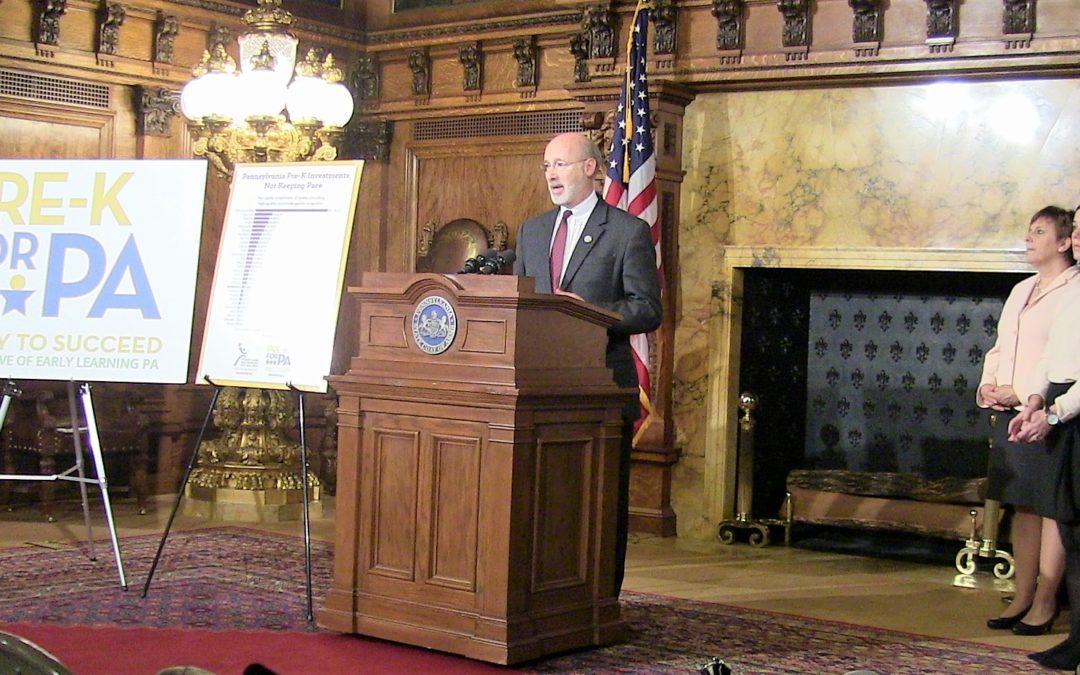
Harrisburg, PA (May 8, 2017)—Pennsylvania Partnerships for Children (PPC) released a report today in its role as a principal partner of the Pre-K for PA Campaign that commends Pennsylvania for making increased state investments in publicly funded, high-quality pre-k but highlighting that the commonwealth is lagging behind many other states, including economic competitors, in its per capita investment. PPC President and CEO Joan L. Benso was joined at a state capitol press conference by Governor Tom Wolf, Cumberland County District Attorney David Freed, York County business leader Michael Smeltzer and other partners in the campaign.
The report, “Prioritizing Pre-K in Pennsylvania: A State Comparison,” indicates that Pennsylvania joins 27 other states and the District of Columbia having made the wise choice to invest in high-quality pre-k, but only ranks 20th among the cohort in per capita investments. This places Pennsylvania behind many of our economic competitors and neighboring states including Maryland, New Jersey, New York and West Virginia.
“Countless research studies have proven time after time that pre-kindergarten works. The question is no longer does high-quality pre-k work, but how much is the commonwealth investing in high-quality pre-k to build a solid foundation for academic success,” said Joan Benso, President and CEO of PPC.
“Sixty-four percent of eligible preschool children in our state still cannot access this critical intervention as we have failed to invest enough resources,” she said.
Benso and her campaign partners call on the legislature to join the governor and expand pre-k investments in the state budget by $75 million for the coming fiscal year.
Children who attend high-quality pre-k are also less likely to be involved in crime later in life. Cumberland County District Attorney David J. Freed said, “I know from years of experience that we cannot simply arrest, prosecute and incarcerate our way out of our crime problems. We have to implement effective approaches that keep people from turning to crime in the first place. High-quality pre-k is a key focal point of that strategy.”
Business leaders have prioritized pre-k funding as a valuable public investment that helps create a productive workforce as it returns $4 in savings and benefits for every dollar invested.
“I know firsthand that if we fail to provide state support for early learning, we’re missing a critical opportunity to invest in the future of our economy,” said Michael Smeltzer, Early Learning Investment Commission (ELIC) member and President of Advancement Solutions LLC. “Children who attend high-quality pre-k enter school better prepared and while the research tells us that they enjoy higher academic achievement, we also know that they learn the soft skills necessary to become valuable future employees.”
Benso also presented an award to the governor from Pre-K for PA commending him for his leadership. The governor is joined by more than 50 bi-partisan legislators who are also being honored this spring.
“Prioritizing Pre-K in Pennsylvania: A State Comparison,” can be found at www.papartnerships.org/prekinpa or www.prekforpa.org.
###
Lancaster Online: Op-ed: We need to invest in high-quality pre-K in Lancaster County
April 26, 2017 by Randy Patterson and Sue Suter
Lancaster County today is bursting with opportunities.
In one aspect, however, opportunities fall short. Too few children have the opportunity to attend high-quality prekindergarten, which helps prepare kids for success in school and in life. When they lack this essential opportunity, later opportunities for achievement may be out of reach, and our entire community suffers from their absence as productive citizens.
High-quality pre-K coincides with the critical years before age 5, when 90 percent of brain development occurs. By building strong neurological pathways and connectors, the brain prepares the foundation for a lifetime of learning, critical thinking and even socialization.
There’s a hitch, though. Proper brain development requires careful guidance. Carefully crafted, scientifically proven activities such as play and exposure to books help the brain grow healthy and strong. A lack of enrichment discourages the brain from growing to its full potential.
High-quality pre-K provides that enriching atmosphere, and research shows that it’s especially effective for children from lower-income families. Given nurturing experiences, these children enter kindergarten ready to learn, on par with their peers.
By investing in high-quality pre-K, we give kids a strong start, yielding returns that are both immediate and long lasting:
— High-quality pre-K reduces grade repetition and special education placements in later grades, saving resources that schools can spend on other, equally pressing needs.
— Children who benefit from high-quality pre-K are less likely to drop out of school and more likely to graduate and receive post-secondary education. This powerful combination boosts their employment opportunities and earning power, while also reducing the costs to society for social services.
— Every $1 spent in Pennsylvania on early learning such as high-quality pre-K generates an additional 79 cents in other sectors of the economy. Viewed from another perspective, every dollar invested in high-quality pre-K returns up to $17 in long-term savings and benefits.
Despite these proven returns, Pennsylvania’s investment in early learning is lagging. More than 112,900 eligible preschool children aren’t served by high-quality, publicly funded pre-K, even though they qualify.
That’s 64 percent of children ages 3 to 5 who probably aren’t getting the enrichment that boosts their prospects for lifetime success. Chances are, we will never benefit from their future contributions to our businesses and neighborhoods.
Throughout Pennsylvania, the unmet need is felt sharply in every community, whether rural, urban or suburban.
In Lancaster County alone, more than 78 percent of all eligible children in low-income families aren’t afforded the opportunity to attend publicly funded, high-quality pre-K classrooms. Consider the numbers within some local County school districts:
— Penn Manor School District, suburban: 84 percent, an estimated 494 kids.
— Solanco School District, rural: 95 percent, an estimated 768 kids.
— Elizabethtown Area School District, suburban: 90 percent, an estimated 278 kids.
— School District of Lancaster, urban: 55 percent, an estimated 1,015 kids.
These numbers are not unusual. More information about regional school district results can be found in Pennsylvania Partnerships for Children’s recent report, “A Path Forward,” at papartnerships.org/prekinpa.
The United Way of Lancaster County has established a “bold goal” that all children will enter kindergarten ready to learn by 2025. We are funding eight community impact partnerships striving toward that goal through increased access to quality early care, helping teen parents receive post-secondary education credentials, coordinating other wraparound services with early education, increasing the quality of home-based child care, and developing interactive activities that help parents understand their children’s brain development.
By investing in the critical need for high-quality pre-K education, United Way and our partners will create systems in our community to ensure that all Lancaster County children enter kindergarten ready to learn by 2025. However, there is much more work to be done to make this possible.
Public investments are needed to ensure a strong and well-financed child care system that serves as the foundation of effective pre-K delivery. By supporting substantial investments in high-quality pre-K, including the $75 million funding increase proposed by Gov. Tom Wolf in this year’s state budget, we give more children the chance to become productive citizens, ready to deploy their talents for the good of our community and businesses.
Randy Patterson chairs the United Way of Lancaster County board. Sue Suter is the organization’s president and CEO.
See the op-ed here.