Pottstown Mercury: In West Pottsgrove, pre-k advocates press for increased state funding
By Evan Brandt 9/20/2017
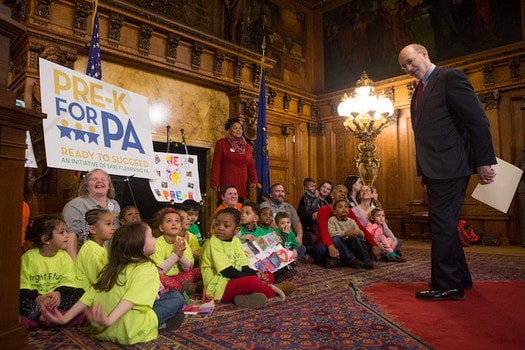
Wednesday marked the day that the school district’s first 20 Pre-K students took their seats at West Pottsgrove Elementary School.
So perhaps it was appropriate that on the same day, in the same school, educators gathered to release the results of a survey on the benefits of early education and to advocate for more funding to spread those benefits state wide.
“If every child who needs it had access to high-quality pre-K, we would see fewer children struggling or needing special education,” said Paul Healey, executive director of the Pennsylvania Principals Association.
Between April 11 and June 18, his organization asked every elementary principal in Pennsylvania to take a survey about the importance of pre-K education.
Of the 351 principals representing 217 of Pennsylvania’s 500 school districts who responded, 99 percent either agreed, or strongly agreed, that it is very important.
“High quality pre-K provides the opportunity for children to get ready for school, helping build their early literacy skills, which provides children with the foundation to have the stamina and skills to be successful in elementary school,” said Terri Koehler, the principal at West Pottsgrove Elementary.
POTTSGROVE DEBATES, APPROVES PRE-K
Last week, the Pottsgrove School Board approved an agreement to host the 20 pre-K seats provided through funding from the Montgomery County Intermediate Unit, but not before debating the matter.
Two board members, Robert Lindgren and William Parker, warned that should the state grant funding go away, “parents will still want the program and then it will become something local taxpayers have to pay for,” as Lindgren put it.
Parker, who voted no, said “schools are being asked to do too much, giving parents an excuse not to parent.”
But School Board President Matt Alexander and board member Rick Rabinowitz disagreed.
“There are lots of families in this district where both parents have to work and they have no choice but to access some kind of day care,” said Rabinowitz. “If this is an upgrade, that’s nothing but good for the students, the parents and the district.”
“We have 20 kids who need help who are going to get help as a result of this program,” said Rabinowitz. “This is a no-brainer.”
“When families don’t have access to pre-K, the are behind when they come to kindergarten,” Koheler told the board. “We talk about an achievement gap, well without pre-K, it’s there when they start.”
“I wish there were more seats available,” said Alexander. “This will make a huge difference in the quality of life for many of our families.”
STATE BUDGET PROVIDES MORE
There are more seats available this year state wide.
According to information provided by the Pre-K for PA Campaign, funding for pre-K was increased by $30 million in this year’s budget, adding 3,500 new pre-K seats to classrooms across Pennsylvania.
Locally, four early education programs in the Greater Pottstown Area have received an additional $1 million through the new state budget, as Digital First Media reported last month.
At $357,000, Pottstown School District received the region’s largest grant, which is in addition to the grant money it already receives from that program.
Pottstown can now offer a full day Pre-K Counts classroom at Franklin, Lincoln and Rupert elementary schools, in addition to the Barth pre-K classroom that started last year.
The grant funding, combined with district funds, means the district can now offer a full-day 4K classroom experience to all families of 4-year-old children regardless of income, as long as they reside in Pottstown School District.
The Owen J. Roberts School District in South Coventry received a grant of $170,000, which allows the district to bring up to 100 the number of students it serves through a partnership with Warwick Child Care.
Additionally, the Montgomery County Intermediate Unit received $340,000 and a portion of that money was used to provide the 20 seats at West Pottsgrove Elementary School.
BUDGET IMPASSE A THREAT
But all of those additional education opportunities could be at risk if the General Assembly cannot agree on a revenue program to fund the spending plan it adopted at the end of June.
“We’re in a crisis,” said Joan Benso, president and CEO of Pennsylvania Partnerships for Children. “Without a resolution of this half-baked budget, the Montgomery County Intermediate Unit will not get paid on Sept. 30 and we could have to tell all these children who just started school they have to go home.”
SUBURBS HAVE MOST UNMET NEED
Even if the budget matter is resolved, and with the additional funding budgeted this year, fully two-thirds of the Pennsylvania students eligible for access to pre-K — nearly 113,000 children — still don’t get it, said Benso.
An additional $310 million in state funding for pre-K by 2022 would provide access to every at-risk child in Pennsylvania, and $100 million more would open that access to middle income families, according to the Pre-K for PA campaign.
The percentage of underserved children is highest right here in the suburbs, according to a recent report by Pennsylvania Partnerships for Children titled “A Path Forward.” It found that 74 percent of income-eligible preschool students in the suburbs are not served.
According to an interactive map in the report, the local districts with the most unmet need — 80 percent or more of eligible children not receiving early education — are Daniel Boone, Boyertown and Upper Perkiomen.
In Spring-Ford, Owen J. Roberts, Perkiomen Valley and Pottsgrove, 60 to 80 percent of eligible children do not receive pre-K education.
The districts best meeting the early education needs of eligible children are Pottstown and Phoenixville, each of which nevertheless has 40 to 60 percent of eligible children not being served, according to the report.
GOOD RETURN ON INVESTMENT
Serving those at-risk children is a good investment, Benso said, pointing to research by University of Chicago professor and winner of the Nobel Prize for economics, James J. Heckman.
Heckman’s analysis of one pre-school program showed a 7-to-10 percent, per-year return on investment based on increased school and career achievement as well as reduced costs in remedial education, health and criminal justice system expenditures, according to his web site.
The authors of “A Path Forward,” went further, writing that “every dollar invested in high-quality pre-K returns up to $17 in long-term savings and benefits.”
According to the report, “children who benefit from high quality pre-K are less likely to drop out of school and more likely to graduate and attend college, boosting their employment opportunities and earning power while reducing social services costs.”
Read the full article here.
Centre Daily Times: In early learning, attention to detail is essential to success
August 23, 2017
As a superintendent, when it comes to early learning, I can’t stress enough the importance of the little things. So, a great deal of coordination goes into aligning pre-K curriculum with kindergarten expectations in math, reading and vocabulary — even installing a universal alphabet across classrooms, so kids will always have a bird as their picture clue for the letter “B.”
Assuring quality of pre-K and promoting access, within the district and communitywide, is a top priority at Tyrone Area. I know I have driven the business department crazy trying to squeeze every possible slot for its free pre-K from available funding sources Pre-K Counts, Title I, Keystones to Opportunities and the Educational Improvement Tax Credit program (plus district child care funded through state CCIS and parent tuition, and funding for the district’s role as Early Intervention provider for preschool-aged children.) Our district created a brochure listing quality pre-K programs, and district personnel even shows up at community events — a Labor Day picnic, an Irish heritage festival — to inform parents about quality pre-K opportunities.
The district puts forth the effort because the advantages of quality pre-K are evident.
Among children entering kindergarten from the district’s own pre-K, 78 percent have the skills kindergarten teachers felt were necessary for success. Those children were significantly higher than others in letter knowledge, word and phonemic awareness, and writing abilities, and also in the math functions of counting, number identification and measurement.
If you’re a student struggling, and your classroom environment changes with programs that aren’t connected or aligned, that’s a huge disadvantage. About 80 to 90 percent of students receiving interventions did not attend the district’s pre-K program. They didn’t have preschool and therefore need that opportunity to catch up in kindergarten.We see the successes of those students that have attended our pre-K and how much further ahead they are. The high-performing district has a Pennsylvania School Performance Profile building-level academic score of 93.3, and a lot of that is probably attributed to our students’ initial entry into our pre-K program.
The same assessments that show academic readiness for kindergarten also show that children from quality pre-K are equipped with curiosity, initiative, persistence, and task analysis. It’s about kids wanting to ask questions, eager to learn, eager to pick up books. We are eager to watch each of them as we begin a new school year.
Public News Service: Budget Agreement Called Victory for PA Kids
July 5, 2017 by Andrea Sears
HARRISBURG, Pa. – The budget agreement passed by Pennsylvania’s General Assembly gives a big boost to early childhood education.
The bipartisan spending plan adds $25 million for the state’s Pre-K Counts program, and almost $5 million for Head Start.
Joan Benso, president and CEO of Pennsylvania Partnerships for Children and a partner in the Pre-K for PA program, said that will open the door to critical learning programs for thousands more three- and four-year-olds across the Commonwealth.
“The Pre-K for PA Campaign is striving to ensure that every child at risk of school failure has access to high-quality, publicly-funded pre-K by 2021-22,” Benso said, “and this increase is a really great step in that direction.”
Gov. Tom Wolf is expected to sign the budget if the General Assembly is able to agree on a revenue package to pay for it in the next week.
Benso added that the budget also restores $20 million previously cut from child care, and funds a totally new program to help parents.
“That will create a grant program for evidence-based home visiting initiatives that reduce child abuse, improve health, improve early learning,” she explained. “That appropriation is nearly $5 million.”
Benso cited decades of studies showing that high-quality early education pays a lifetime of dividends, including higher high-school graduation rates and greater earning potential in adulthood.
“The estimates are that there’s a return of about $4, at least, for every dollar invested,” she noted. “And any public investment that returns more than the dollar you invested in it is a winner in our book.”
The budget agreement also increases K-through-12 spending by $100 million, and special education by $25 million.
Read the article and listen here.
The Intelligencer: Value of Quality Pre-k Education Benefits All of Us
July 4, 2017 by Marissa Christie CEO of the United Way of Bucks County
Research tells us that young children ask about 280 questions per day. As the parent of a preschooler, I can tell you this estimate feels a little low.
By day, I am the CEO of United Way of Bucks County, an organization dedicated to giving the most vulnerable people in our community access to care and opportunity. Before and after work, I am an information kiosk, patiently addressing all of my son’s burning questions: Why isn’t my birthday a holiday? Why are moths nocturnal? Why are squirrels hard to catch? Why do I go to school?
At his age, I keep the answer to that last one simple: He goes to school so that he can learn and play with his friends. But really, he goes to school because high-quality early education is one of the most important things we can ever give a child.
A child’s brain is 90 percent developed by age 5, which means the early years provide the greatest opportunity for us to make a difference. We have a small window to make the most of these years. Children get on (or are knocked off) the path to success very early in life.
There are both short- and long-term benefits to quality early education. Children’s early literacy, math, and social/emotional skills improve, ensuring that they are ready to enter kindergarten. Long-term, children who get a high-quality pre-K education are:
• Less likely to repeat a grade.
• Less likely to need special-education placements.
• More likely to graduate from high school, go to college, and get good jobs.
• Less likely to commit crimes later in life.
Why does all this matter? Even if you don’t care about children, there is a financial incentive to invest in early education. Reducing the need for special education and criminal justice intervention saves a lot of taxpayer money. Plus, our workforce and economy are strengthened with educated workers. Every dollar invested returns up to $17 in long-term savings and benefits and generates $1.79 in economic activity immediately.
These benefits help explain the groundswell of support for high-quality pre-K education. People from all walks of life agree that investments in high-quality pre-K make a difference in the lives of children: county commissioners, mayors, pediatricians, business leaders, military and law enforcement leaders, and, most importantly, parents of young children.
Although many groups, including United Way of Bucks County, are working together to increase support for quality pre-K education, Pennsylvania is falling behind in this critical investment area.
In Bucks County alone, there are 4,187 children who are eligible for publicly funded pre-K education; only 24 percent of these children actually get it. The remaining children are left behind due to lack of funding.
We must do more to help children and families overcome the financial barriers to quality pre-K education. This is the time to keep the pre-K momentum going; to ensure that all children can meet their potential.
Although Gov. Tom Wolf prioritized pre-K in his budget proposal for 2017-18, the budget passed by the House reduced new investments by two-thirds and cut child care subsidies by $28 million.
Not all children in Bucks County will have the access to early education that my son does. Their questions, now and in the future, will be different than my son’s. Someday, they will be left wondering why they never had a chance.
We can change that. The Pre-K for PA movement is calling for $75 million to serve an additional 8,400 children and $35 million to improve child care.
Support the movement for quality pre-K and encourage our state leaders to do so as well. Every call and email makes a difference.
When we unite to make pre-K education a priority, our children, families, and communities are all better off, now and in the future.
Read the op-ed here.

Bipartisan Budget Agreement a Victory for Kids, $30 Million Pre-K Investment Will Serve Thousands More Young Learners
Early Learning Programs Get Significant Boost in 2017-18
HARRISBURG (June 30, 2017)— The Pre-K for PA campaign called the $30 million investment in pre-k as part of the 2017-18 state budget agreement a momentum-building moment, making significant progress towards the goal of expanding access to all children eligible for Pre-K Counts and Head Start. The investment will open access to high-quality pre-k for thousands more three- and four-year-olds across the commonwealth.
The principal partners of Pre-K for PA issued the following statement regarding the investment:
“Governor Wolf along with Democrat and Republican legislators deserve a tremendous amount of credit for prioritizing the commonwealth’s three- and four-year-olds by investing $30 million in high-quality pre-k, to serve thousands more of the commonwealth’s youngest learners.
“Elected officials from both sides of the aisle have increasingly understood that expanded investment in high-quality pre-k programs is an effective long-term strategy to ensure that our next generation is ready to succeed. Access to a high-quality pre-k experience also reaps significant cost savings in the future in the form of less public spending on special education, social welfare programs, and criminal justice.
“In this difficult budget cycle, we commend the governor and legislature for their strong commitment to early learning programs. FY 17-18 state funding for child care and home visiting were at risk through this process but policymakers boosted funding for both in addition to the increase in pre-k. The stronger the investment in high-quality early learning – including pre-k, child care, and home visiting – the greater the return – for our children and our commonwealth.”
The 2017-18 spending plan includes the following expanded investments to early learning:
- Increases Pre-K Counts investment: $25 million
- Increases investment in Head Start Supplemental Assistance Program: $5 million
- Restores 2016-17 cut to Child Care Services: $20 million
- New investment in evidenced-based home visiting: $4.77 million
####
Pottstown Mercury: Pre-K important for child’s development
June 23, 2017
Since 1989, the Pottstown School District has supported half-day Pre-K for any child in the district. In 2006, the district’s commitment grew to embrace the community, with creation of the Pottstown Early Action for Kindergarten Readiness (PEAK Partnership), funded through a Pre-K Counts Public Private Partnership grant. The district is the senior manager of the PEAK Partnership, which convenes community partners in community outreach, family engagement, quality improvement, kindergarten transition, and health/wellness to ensure that children enter kindergarten ready to learn.
Today, the district still runs its self-funded, half-day pre-K in three of its four elementary schools, and it is piloting a full-day Pre-K Counts classroom in the fourth school. It is also the Pre-K Counts grantee for 10 classrooms established throughout the community.
Quality pre-K doesn’t just teach children their letters and numbers, but also how to share, take turns, and learn to self-regulate their behavior during the critical developmental years before kindergarten. Without those things, they are not going to be successful in kindergarten. Once you hit age five, a lot of characteristics are in place, and it’s hard to have children relearn things.
The impact of quality pre-K is evident in Pottstown schools.
Children from Pottstown Pre-K Counts classrooms enter kindergarten better prepared to learn than the district-wide average. In 2014, 75 percent of students entering kindergarten from pre-K had the core skills of literacy, compared to the district-wide average of 52 percent.
By third grade, students from Pre-K Counts outpaced the district average, 70 percent to 60 percent, in meeting benchmarks of learning.
With the advent of the PEAK Partnership and the district’s Pre-K Counts program, the district saw a reduction in its special education population.
So many of our parents who qualify for Pre-K Counts have been able to go back to school or work a job while their child was in school. One woman was raising two children while she was attending college, and her husband passed away suddenly. Pre-K Counts enabled her child to be in school and be a kid, and at the same time get ready for what kindergarten was going to bring. She was grateful because she knew she was dropping her son off in an environment that was caring and safe and also stimulating for him.
Most people understand that the most precious resource in any community is our children. They’re going to be tomorrow’s leaders, and it certainly makes sense to invest in them as early as possible.
That is why I support Gov. Tom Wolf’s efforts to increase funding for early childhood education and encourage legislators to make it a top budget priority.
In this year’s budget, the governor has proposed a $75 million increase for Pre-K Counts and Head Start programs; an increase that would allow 8,400 additional children the opportunity at a high-quality pre-K education. I encourage legislators in Harrisburg to make this increased investment in early education a priority.
Jeff Sparagana retired this year as superintendent of the Pottstown School District.