Patriot News: As We See it: When They Talk Budget, Wolf and Lawmakers Can’t Forget Early Childhood Education
By The Members of Pre-K for Pa.
The sharp elbows of politics can sometimes be bruising, however unintentional the bump. As Pennsylvania’s budget impasse stretches into its third month, across the commonwealth the impact of political gridlock is beginning to be felt.
As PennLive’s Jan Murphy notes in “Cash flow woes: Schools feeling the pinch of the Pa. budget impasse” (PennLive, Aug. 31), small business owners and non-profits who operate high-quality Pre-K Counts and Head Start classrooms across the commonwealth are being forced to make a hard decision.
And that’s this: Either take out loans (and pay the interest) to open their doors to eager young learners or close state-funded classrooms
We urge Gov. Tom Wolf and the Legislature to work together to craft a budget that resolves this hardship.
But their negotiations regarding pre-kindergarten funding can’t only be about preserving state funding levels from last fiscal year for pre-k and getting those grants out the door.
Each year, more than 200,000 3- and 4-year-olds in Pennsylvania are missing out on this once-in-a-lifetime learning opportunity.
These kids don’t get a “do-over” if they miss out on high-quality pre-k. For them, this negotiation must also be about increased funding.
That is why we, the 10 founding partners of Pre-K for PA, a statewide campaign to expand access to high-quality early learning, are cautiously optimistic that the eventual outcome of budget negotiations will favor our youngest learners.
Pre-K for PA’s vision is that every at-risk 3- and 4-year-old will gain access to high-quality pre-k by 2019.
In order to achieve that widely supported goal, the final 2015-16 budget must provide a substantial increase in state funding for pre-k.
It will take about $400 million in additional state investments over the next four years to increase access to children at greatest risk of academic failure.
The budget passed by the House and Senate, which included a $30 million increase, is a good first step to providing high-quality pre-k to an additional 3,500 children, but a $120 million increase this year would serve an additional 14,000 children and put us closer to our Pre-K for PA goal.
High-quality pre-k is a critical investment in the future of our children. Higher graduation rates, lower criminal activity, greater lifetime earnings and lower rates of special education are all connected by research to be outcomes of attending quality pre-k programs.
If we fall short of the much-needed $120 million additional investment this year, it will require larger increases in later years and leave more 3- and 4-year-olds missing out next school year. For these kids, delayed investments means lost opportunities.
Read the full op-ed here.
Centre Daily Times: LTE: Pre-K Funding Essential
Sheriffs and other law enforcement leaders across Pennsylvania have long-provided good reason for increasing access to high-quality, publicly funded pre-kindergarten.
Research is clear that front-end education investments improve graduation rates and help prepare at-risk kids for more successful lives.
High school dropouts are 3 1/2 times more likely than high school graduates to be arrested, and more than eight times as likely to be incarcerated. Department of Justice statistics show that 68 percent of state prison inmates do not hold a high school diploma. Participating in quality pre-kindergarten increases high school graduation rates by as much as 44 percent.
Quality pre-kindergarten should be part of a comprehensive approach to our crime problem. This is why both Republican and Democrat sheriffs and prosecutors throughout our commonwealth support increased access to pre-K as a crime-prevention strategy.
I commend both the General Assembly and Gov. Wolf for prioritizing pre-K in their respective draft budgets and hope that a final negotiated budget will include a substantial step towards serving more of the roughly 1,500 3- and 4-year-olds in Centre County that lack access to high-quality pre-K each year. For law enforcement leaders, this would be filling a crime-prevention gap.
DENNY NAU
BELLEFONTE
The writer is sheriff of Centre County.
Read the Letter to the Editor here.
Patriot News: As We See It – When They Talk Budget, Wolf and Lawmakers Can’t Forget Early Childhood Education
By The Members of Pre-K for Pa.
The sharp elbows of politics can sometimes be bruising, however unintentional the bump. As Pennsylvania’s budget impasse stretches into its third month, across the commonwealth the impact of political gridlock is beginning to be felt.
As PennLive’s Jan Murphy notes in “Cash flow woes: Schools feeling the pinch of the Pa. budget impasse” (PennLive, Aug. 31), small business owners and non-profits who operate high-quality Pre-K Counts and Head Start classrooms across the commonwealth are being forced to make a hard decision.
And that’s this: Either take out loans (and pay the interest) to open their doors to eager young learners or close state-funded classrooms
We urge Gov. Tom Wolf and the Legislature to work together to craft a budget that resolves this hardship.
But their negotiations regarding pre-kindergarten funding can’t only be about preserving state funding levels from last fiscal year for pre-k and getting those grants out the door.
Each year, more than 200,000 3- and 4-year-olds in Pennsylvania are missing out on this once-in-a-lifetime learning opportunity.
These kids don’t get a “do-over” if they miss out on high-quality pre-k. For them, this negotiation must also be about increased funding.
That is why we, the 10 founding partners of Pre-K for PA, a statewide campaign to expand access to high-quality early learning, are cautiously optimistic that the eventual outcome of budget negotiations will favor our youngest learners.
Pre-K for PA’s vision is that every at-risk 3- and 4-year-old will gain access to high-quality pre-k by 2019.
In order to achieve that widely supported goal, the final 2015-16 budget must provide a substantial increase in state funding for pre-k.
It will take about $400 million in additional state investments over the next four years to increase access to children at greatest risk of academic failure.
The budget passed by the House and Senate, which included a $30 million increase, is a good first step to providing high-quality pre-k to an additional 3,500 children, but a $120 million increase this year would serve an additional 14,000 children and put us closer to our Pre-K for PA goal.
High-quality pre-k is a critical investment in the future of our children. Higher graduation rates, lower criminal activity, greater lifetime earnings and lower rates of special education are all connected by research to be outcomes of attending quality pre-k programs.
Read the full article here.
LancasterOnline: Editorial: No Budget Should Mean No Labor Day Holiday for Top Pennsylvania Leaders
THE ISSUE
The state budget is now 65 days late. Pennsylvania Auditor General Eugene DePasquale says he will keep track of the effects of Harrisburg’s tardiness in upcoming audits — costs such as interest expenses and penalties for late payments to a school district’s vendors. DePasquale says he plans to release the numbers on those costs as he completes 50 audits this fall and eventually expects to compile a total from all districts.
Sure, it’s not easy to come up with a state budget.
And sure, we know it’s even harder when that budget must be agreeable to Republican majorities in both houses of the General Assembly that oppose tax increases and to Gov. Tom Wolf, a Democrat who promised voters that he would add an extraction tax on natural gas and increase education spending.
But does it really need to be this difficult?
At a news conference Tuesday in the Capitol, Auditor General DePasquale said he thinks agreeing on education spending, pension reform and how to handle Pennsylvania’s state-owned liquor sales should not take long.
“I think if everyone locked themselves in the Governor’s Residence for a weekend, and were willing to come up with a deal on those three things, they could do it within a weekend,” the auditor general said.
Perfect timing. Labor Day is a long weekend. It’s time to get this done.
Lawmakers and the governor should find a compromise that will reduce the state’s pension costs (now $53 billion in the red), sell off the state liquor stores, charge drillers for the gas they take from the Marcellus Shale and, most importantly, boost state funding of public education.
Granted, Pennsylvanians have endured long budget stalemates before: Gov. Ed Rendell signed the 2009-10 budget in October and the 2003-04 budget in December.
But, with the percentage of state funding comparatively low (45th among the 50 states and Washington, D.C.) and declining in Pennsylvania, this problem grows worse for school districts that depend more on the state than local taxpayers.
Critics will counter that Pennsylvania ranks seventh or eighth in per-pupil spending (depending on the source cited) but this avoids the issue of equity. Wolf also campaigned on a promise to reduce the difference in school funding based on a child’s ZIP code.
Given calls to spend smarter, not more — on everything including public education — it would be a shame if the stalemate were to force any Pennsylvania school district to spend money on late penalties and interest.
The pinch of the stalemate is greater on School District of Lancaster and Columbia Borough School District because larger shares of their budgets, 45 percent and 48 percent, respectively, come from the state. But, at some point, all school districts will be affected.
And K-12 education is not alone in feeling the effects.
The co-owner and five employees at Little People Day Care in Columbia have taken pay cuts because the state has not paid the nearly $30,000 it owes over two months for 20 children enrolled at the school through Pennsylvania’s Pre-K Counts program.
Co-owner Syamal Bhattacharya said he has taken no salary and his employees agreed to pay cuts of 10 percent or 15 percent each. Next week, Bhattacharya said, he has a meeting at the bank to talk about a loan.
Bhattacharya hopes to get his employees back up to full pay, and thinks he can, if the state starts paying its bills by the end of this year.
Read the full editorial here.
Uncertainty Grows in Pre-K Classrooms Across PA
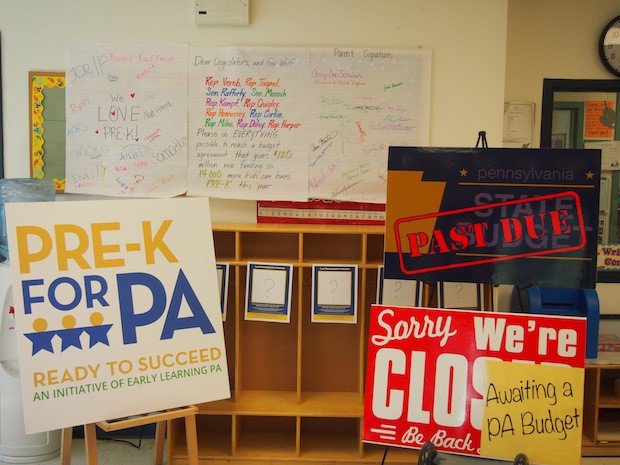
Providers Acquire Bridge Loans; Classrooms Sit Empty and Threat of Closure Remains as a Result of Harrisburg Budget Impasse
ROYERSFORD (August 28, 2015)– The budget impasse in Harrisburg has left many Pre-K Counts and Head Start providers seeking bridge loans to keep their doors open or pondering closure of state funded classrooms, while potential new expansion classrooms sit empty awaiting a resolution to ongoing budget negotiations.
Pre-K providers were joined by superintendents from Pottstown and Spring-Ford school districts at Play and Learn in Royersford, in a newly constructed pre-k expansion classroom, which will remain empty until the level of pre-k funding is resolved with the overall state budget.
Without a state budget in place, Pre-K Counts and Head Start Supplemental grants did not go out to pre-k providers across the Commonwealth, forcing them to make the hard decision to either solicit private bridge financing and pay the interest associated with that or close state funded classrooms.
Read the full press release here.
Media Coverage of this Event:
CBS3: Pre-K Counts and Head Start Providers Feeling Squeeze of PA Budget Stalemate
As the state budget impasse enters its third month, “Pre-K Counts” and “Head Start” supplemental grants are among the funds being held hostage in the budget stalemate.
Erinn Rinn with ‘Today’s Child’ in Delaware County says without state funding to pay for supplies and 14 teachers’ salaries and benefits: “We did have to take out a loan this past month.”
She says that $130,000 loan will only get them to October, but she says they’re lucky to get a loan at all.
“There are a lot of other programs that are much smaller than ours that cannot secure that funding,” says Rinn, “So they’re not going to be opening their classroom doors.” Read the full story here.
Philadelphia Sun Times: Lack of Pennsylvania State Budget Putting Pressure on Schools
WRITTEN BY JACK CASSIDY POSTED: 09/01/2015
Now more than two months without a state budget, Pennsylvania schools are beginning to feel more financial pressure entering the academic year.
Many schools will be unable to immediately provide Pre-K, while other schools will take out a bridge loan in order to have those classes, according to PennLive.com.
Though most believe those loans necessary to adequately prepare students for kindergarten, they aren’t without a substantial amount of uncertainty.
“It’s a risk because they don’t know what the outcome will be and they are nervous it won’t be enough,” Pre-K for PA spokeswoman Kate Philips told Penn Live. “Many are taking loans only through Sept. 30.” Read the full article here.
Delaware County Daily Times: Early Education Providers Urge PA Budget Passage, Funding Boost
By Evan Brandt
UPPER PROVIDENCE >> Harrisburg’s inability to adopt a budget on time is having an extreme impact on day care and pre-kindergarten providers and creating uncertainty for their employees and the families they serve as they get ready for the start of school, advocates said Friday.
“We have this beautiful new classroom to educate our children, but without additional state funding, it will sit empty,” said Melanie Godhania, program director for Play and Learn, which hosted a press conference calling on Gov. Tom Wolf and the Legislature to agree on a budget — one which includes Wolf’s proposal for enough funding to add 14,000 more toddlers to Pennsylvania’s pre-K roles.
Play and Learn operates facilities in Collegeville, Lansdale, Green Lane and Norristown, in addition to its Upper Providence location.
“As affluent as Spring-Ford is, we have families who are not being served in this community who are eligible for Pre-K Counts,” Spring-Ford Area School District Superintendent David Goodin said in reference to the state funding stream that helps pay early childhood education costs. Read the full article here. Also printed in the Norristown Times Herald and the Lansdale Reporter
West Chester Daily Local News: Pre-K, Schools Concerned Over State Budget Impasse
By Candice
UPPER PROVIDENCE >> Almost two months into the state budget impasse, with no end currently in sight, schools and Pre-K classrooms are getting ready to welcome students to the 2015-16 year.
Unfortunately, that welcome comes with a strained smile as the impasse threatens many programs and puts a large toll on school districts across the Commonwealth.
“We typically receive the first of our subsidy payments in August, but that date has come and done,” said West Chester Area School District Superintendent Jim Scanlon. “Because we only receive about 15 percent of our funding from the state, we are still in pretty good shape to start the school year.”
Though the district will have no trouble opening Aug. 31, the impasse does hit it in regards to charter schools.
“There has been an impact to our charter school payments as we were expected to make those payments in August,” Scanlon said. “Without state funding, we withheld those payments, but we received work last week that the state will deduct payments from our tax-relief allocation, which we were supposed to receive this week.” Read the full article here.
Philadelphia Inquirer: Schools Cut Back as Budget Standoff Continues
Kathy Boccella, Inquirer Staff
Amanda Darr, a 31-year-old working single mom in Langhorne, opened a letter recently that led her to believe her chronic child-care problems for her 4-year-daughter had finally been solved.
She thought that for a few seconds anyway.
“I got the letter of acceptance, and I was screaming on top of the world, ‘I got a break!’ ” Darr said of the communication from the Radcliffe Learning Center in nearby Bristol. “The front page said your child has been accepted. Then reading on, I’m like, ‘No, no, no, no, no, no, no!’ ”
The bad news on Page 2 was that the Bucks County early learning center won’t start taking children in the state-subsidized Pa. Pre-K Counts program until Oct. 16 – about a month and a half later than normal – because the state budget standoff in Harrisburg has forced the center to scramble to find money for the program. Read the full article here.