CBS21: PA mayors call for continued investment in publicly funded pre-k
April 11, 2016
HARRISBURG, Pa. — As Mayors from Pennsylvania’s largest population centers continue to advocate for major pre-k initiatives in Philadelphia and Pittsburgh, Mayors and other leaders from mid-sized cities and communities across Pennsylvania gathered in Harrisburg today to encourage Governor Wolf and legislators to continue investing in publicly funded pre-k. The Mayor’s said pre-k is a vital element in the development of municipalities, citing lower crime, improved education outcomes, and greater workforce readiness as the key reasons to invest.
Lancaster Mayor J. Richard Gray, President of the Pennsylvania Municipal League joined forces with leaders from Cranberry to Lebanon in a chorus of support for expanded access to pre-k, “I support expanded access to pre-k as a cost-effective strategy to make our communities safer, and grow new jobs and businesses. A growing body of research shows that early childhood education in a pre-kindergarten setting provides a proven pathway towards achieving these goals.”
Governor Wolf’s 2016-17 proposed budget includes another $60 million in new funding for high quality pre-k. That investment would build on this year’s expansion and allow more than 14,000 young children to access pre-k over the two-year time period.
Research shows that expanded access to high quality pre-k can also reduce crime rates and make communities safer. Hundreds of Pennsylvania police chiefs, sheriffs and district attorneys have lined up behind efforts to invest in pre-k.
“Less crime means less money spent fighting crime,” Pennsylvania Municipal League 1st Vice President and City of York Mayor C. Kim Bracey said. “Imagine what we could do to improve our city or lower our taxes if we didn’t have to devote so much of our local budget to dealing with crime on the back-end.”
Bracey cited the Chicago Child-Parent Center (CPC) preschool study, one of the nation’s most extensive studies that tracked child outcomes over 28 years, that found that children without access to a good pre-k program were 70 percent more likely to be arrested by the time they were 18 compared to children who had the benefits of pre-k.
In Pennsylvania, Department of Correction Secretary John Wetzel has touted research that shows a $120 million state funding increase for early childhood education will eventually lead to $350 million in Corrections and other cost savings for the Commonwealth every year.
Expanded access to high quality pre-k enjoys bi-partisan support in communities throughout the state. Lebanon Mayor Sherry Capello noted that mayors regardless of political affiliation see pre-k as an important part of their communities’ future. “Better education is an important part of any communities’ economic development plan and I believe that better education starts early. I think this is an issue that we all can agree on.” Capello went on to urge state policymakers to work in a bi-partisan fashion to invest in pre-k.
Read the full article here.
PA Mayors Call for Continued Investment in Publicly Funded Pre-K; Pre-K Helps Develop Vibrant Communities
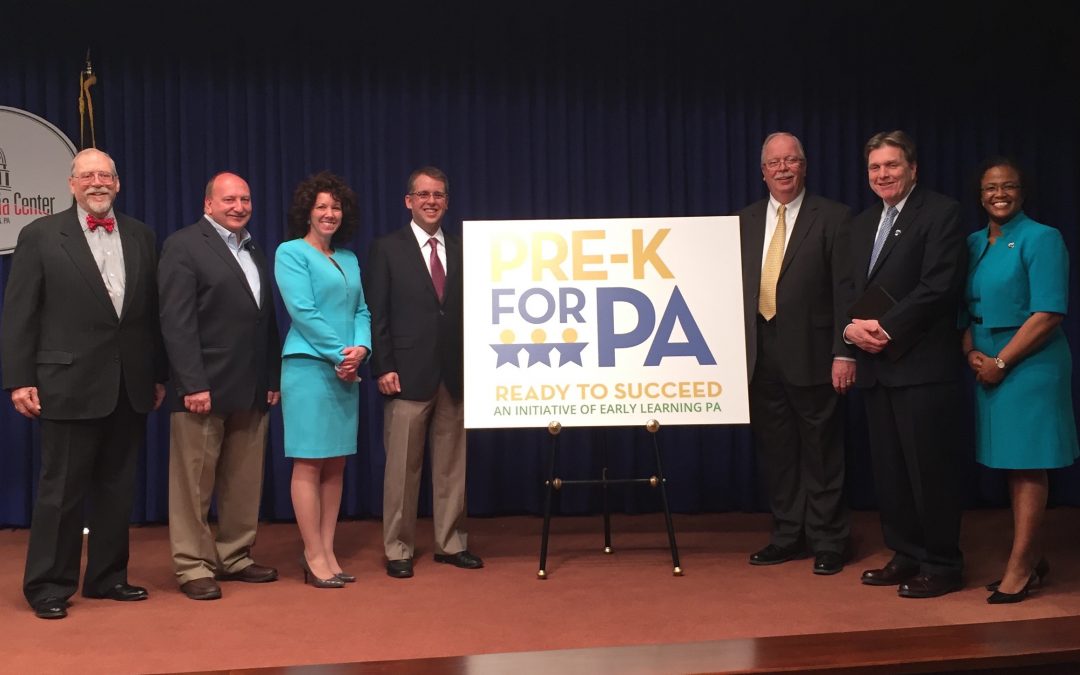
HARRISBURG (April 11, 2016)— As Mayors from Pennsylvania’s largest population centers continue to advocate for major pre-k initiatives in Philadelphia and Pittsburgh, Mayors and other leaders from mid-sized cities and communities across Pennsylvania gathered in Harrisburg today to encourage Governor Wolf and legislators to continue investing in publicly funded pre-k. The Mayor’s said pre-k is a vital element in the development of municipalities, citing lower crime, improved education outcomes, and greater workforce readiness as the key reasons to invest.
Lancaster Mayor J. Richard Gray, President of the Pennsylvania Municipal League joined forces with leaders from Cranberry to Lebanon in a chorus of support for expanded access to pre-k, “I support expanded access to pre-k as a cost-effective strategy to make our communities safer, and grow new jobs and businesses. A growing body of research shows that early childhood education in a pre-kindergarten setting provides a proven pathway towards achieving these goals.”
Governor Wolf’s 2016-17 proposed budget includes another $60 million in new funding for high quality pre-k. That investment would build on this year’s expansion and allow more than 14,000 young children to access pre-k over the two-year time period.
Research shows that expanded access to high quality pre-k can also reduce crime rates and make communities safer. Hundreds of Pennsylvania police chiefs, sheriffs and district attorneys have lined up behind efforts to invest in pre-k.
“Less crime means less money spent fighting crime,” said Pennsylvania Municipal League 1st Vice President and City of York Mayor C. Kim Bracey. “Imagine what we could do to improve our city or lower our taxes if we didn’t have to devote so much of our local budget to dealing with crime on the back-end.”
Bracey cited the Chicago Child-Parent Center (CPC) preschool study, one of the nation’s most extensive studies that tracked child outcomes over 28 years, that found that children without access to a good pre-k program were 70 percent more likely to be arrested by the time they were 18 compared to children who had the benefits of pre-k.
In Pennsylvania, Department of Correction Secretary John Wetzel has touted research that shows a $120 million state funding increase for early childhood education will eventually lead to $350 million in Corrections and other cost savings for the Commonwealth every year.
Expanded access to high quality pre-k enjoys bi-partisan support in communities throughout the state. Lebanon Mayor Sherry Capello noted that mayors regardless of political affiliation see pre-k as an important part of their communities’ future. “Better education is an important part of any communities’ economic development plan and I believe that better education starts early. I think this is an issue that we all can agree on.” Capello went on to urge state policymakers to work in a bi-partisan fashion to invest in pre-k.
By stimulating economic growth and reducing public safety costs, over time cities and communities are likely to see that expanded pre-k can take some pressure off the local tax base. In the short term, pre-k reduces special education costs so school districts see immediate returns.
Research from Pennsylvania and across the country indicates that where children start school with two years of high quality pre-k under their belts, the districts are seeing the number of children enrolled in special education services drop by as much as 50 percent by 2nd grade.
“In school districts across Pennsylvania, rising special education costs are a leading reason for regular property tax increases,” Dick Hadley, Supervisor, Cranberry Township. “A smart upfront investment in our children can curb that trend in short order. When combined with the savings on the public safety side of the ledger, pre-k makes sense for our kids and our local budgets.”
The mission of the Pennsylvania Municipal League (PML) is to strengthen, empower and advocate for effective local government. PML is a nonprofit, nonpartisan organization established in 1900 as an advocate for Pennsylvania’s 3rd class cities. Today, PML represents Pennsylvania’s cities, townships, town, boroughs, and home rule communities that all share the League’s municipal policy interests. The Board of Directors oversees the administration of a wide array of municipal services including legislative advocacy (on both the state and federal level), publications designed to educate and inform, inquiry and research, education and training certification programs, consulting-based programs, and group insurance trusts. For more information www.pamunicipalleague.org.
Pre-K for PA is an issue campaign supported by individuals and organizations across Pennsylvania who believe that investing in our children is the right choice and an urgent necessity. Our vision is that every 3- and 4-year-old in Pennsylvania will have access to high-quality pre-k. We will not endorse nor oppose candidates, but rather we will advocate on behalf of this vision for Pennsylvania’s children, schools and communities. For more information www.prekforpa.org.
Indiana Gazette: Pre-k Expansions to Benefit At-Risk Children in County
By Sean Yoder 4/2/2016
BLAIRSVILLE — Great Expectations Child Care and Early Learning Center in Blairsville is one of the latest education centers to expand its number of subsidized pre-kindergarten slots.
On March 1, Great Expectations learned it would gain another 17 Pre-K Counts-funded slots, on top of the existing 17, according to Madeline Savage, director.
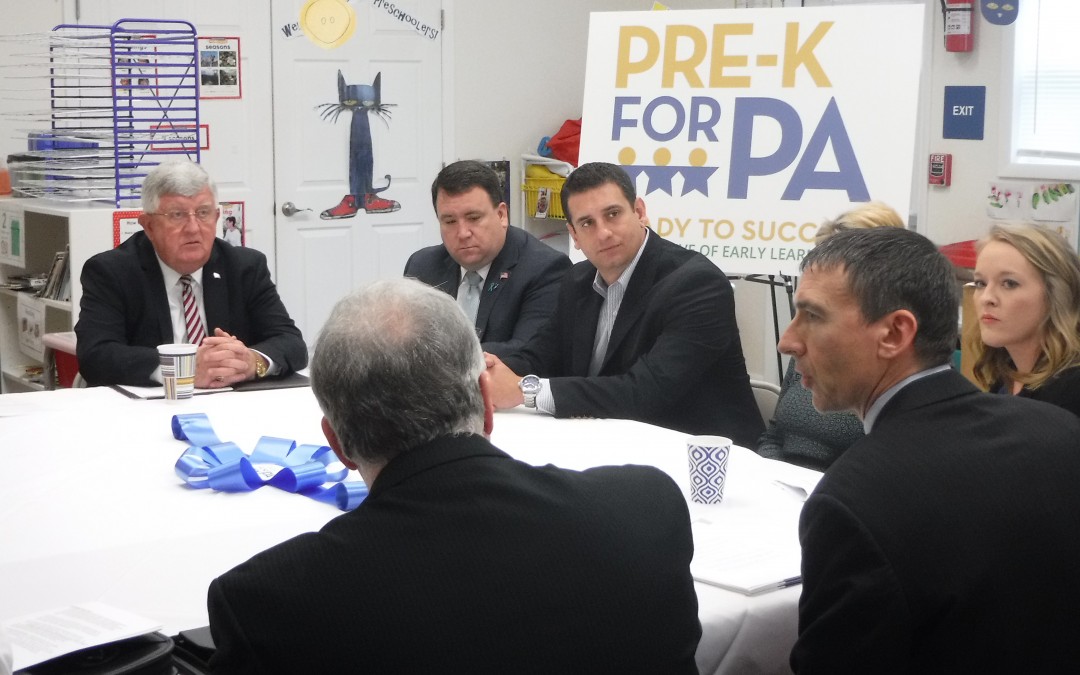
Several local elected officials and law enforcement gathered Friday to celebrate the expansion and talk about the benefits of early childhood education, especially for at-risk children from low-income families.
Savage told them that about 60 to 70 percent of the children do receive subsidies and qualify for the reduced meal program, which shows that many come from low-income families, she said. The grant expansion has allowed more of the 110 children at the center to receive subsidized pre-K and add some new children or those whose parents may have pulled them out for financial reasons.
Great Expectations expanded a year and a half ago and has been in Blairsville since 2009.
Advocates say that students who attend pre-K need fewer special needs through school and aren’t as likely to be held back, are healthier and aren’t years behind their peers when kindergarten starts.
Sarah Byrnes-House, representing the Pittsburgh Association for the Education of Young Children, said 58 percent of children below the poverty line in Indiana County don’t have access to high-quality pre-K. The percentage is the same in Allegheny County. In Washington County it’s 69 percent and it’s 71 percent in Westmoreland County. She said the U.S. lags behind other countries and ranks 24th out of 29 in spending for early learning.
The latest state budget called for $25 million more funding to Pre-K Counts and $5 million more for the Head Start Supplemental Assistance Program. Early childhood education centers and school districts across the state had been waiting for months on word about their Pre-K Counts applications due to the budget stalemate in Harrisburg.
Nationally, state funding increased by $672 million to a total of $6.3 billion for 2014-15.
In Indiana County:
• ARIN IU 28 received $70,500 in Pre-K Counts grant money for 2015-16. That equates to 20 full slots per day.
• The Indiana County Child Development Center was awarded $7,050, or two slots.
• Indiana County Head Start received $51,649 in Head Start funding, or 13 slots.
State Rep. Dave Reed said the discussion among lawmakers has changed a lot in the past decade.
“Folks in Harrisburg are much more open to investing in early childhood learning programs,” he said “There are still a few folks out there that look at it as a glorified day care program and I don’t think they quite understand it. And it’s a generational issue, absolutely.”
“You’ve got kids showing up to kindergarten ready to read, doing addition, subtraction, looking at multiplication and competing against kids who don’t know the difference between a circle and a square. That child is already left behind.”
Reed said pre-kindergarten could also help cut down on expenses for remediation later in a student’s career.
“This truly is the opportunity to balance the scale for those children who are living in atmospheres that are not ideal. They didn’t choose to be born into those atmospheres. They are products of a situation that is beyond their control.”
Also in attendance were Sheriff Bob Fyock, District Attorney Patrick Dougherty and Blairsville Police Chief Michael Allman.
Bruce Clash from Fight Crime: Invest in Kids has been helping to organize support for pre-kindergarten across the state from a law enforcement standpoint. The organization’s contention is that at-risk children who don’t attend a pre-kindergarten program can be more likely to be arrested for violent crimes and end up in prison later in life.
Half of inmates in Pennsylvania don’t have a high school diploma, said Dougherty. He said that education is cheaper than incarceration and that it was a no-brainer to invest in the front end to keep people out of the corrections system.
Fyock said in his years in law enforcement he’s seen generations of families follow the same patterns of crime. He said it was important to reach children when they’re young and be proactive.
“It’s going to be very valuable on down the road,” Fyock said. “If we can prevent them from getting into crime to start with it’s going to be very good.”
Mission: Readiness is an organization comprised of former service members who hope to prepare children for success in order to qualify for military service, or keep from being disqualified. Steve Doster, Pennsylvania director, said about 72 percent of 17- to 24-year-olds are not eligible for service. It can be due to inadequate education, lack of skills to pass the entrance exams or lack of physicality. Drug offenses also preclude people from serving.
Rod Ruddock, a retired U.S. Army Reserve major general and current county commissioner, said that young adults who are fit for military service are also more likely to be employable in the general workforce.
Read the full article here.
Indiana Gazette: Pre-k Expansions to Benefit At-risk Children in County
4/2/16 By Sean Yoder
BLAIRSVILLE — Great Expectations Child Care and Early Learning Center in Blairsville is one of the latest education centers to expand its number of subsidized pre-kindergarten slots.
On March 1, Great Expectations learned it would gain another 17 Pre-K Counts-funded slots, on top of the existing 17, according to Madeline Savage, director.
Several local elected officials and law enforcement gathered Friday to celebrate the expansion and talk about the benefits of early childhood education, especially for at-risk children from low-income families.
Savage told them that about 60 to 70 percent of the children do receive subsidies and qualify for the reduced meal program, which shows that many come from low-income families, she said. The grant expansion has allowed more of the 110 children at the center to receive subsidized pre-K and add some new children or those whose parents may have pulled them out for financial reasons.
Great Expectations expanded a year and a half ago and has been in Blairsville since 2009.
Advocates say that students who attend pre-K need fewer special needs through school and aren’t as likely to be held back, are healthier and aren’t years behind their peers when kindergarten starts.
Sarah Byrnes-House, representing the Pittsburgh Association for the Education of Young Children, said 58 percent of children below the poverty line in Indiana County don’t have access to high-quality pre-K. The percentage is the same in Allegheny County. In Washington County it’s 69 percent and it’s 71 percent in Westmoreland County. She said the U.S. lags behind other countries and ranks 24th out of 29 in spending for early learning.
The latest state budget called for $25 million more funding to Pre-K Counts and $5 million more for the Head Start Supplemental Assistance Program. Early childhood education centers and school districts across the state had been waiting for months on word about their Pre-K Counts applications due to the budget stalemate in Harrisburg.
Nationally, state funding increased by $672 million to a total of $6.3 billion for 2014-15.
In Indiana County:
• ARIN IU 28 received $70,500 in Pre-K Counts grant money for 2015-16. That equates to 20 full slots per day.
• The Indiana County Child Development Center was awarded $7,050, or two slots.
• Indiana County Head Start received $51,649 in Head Start funding, or 13 slots.
State Rep. Dave Reed said the discussion among lawmakers has changed a lot in the past decade.
“Folks in Harrisburg are much more open to investing in early childhood learning programs,” he said “There are still a few folks out there that look at it as a glorified day care program and I don’t think they quite understand it. And it’s a generational issue, absolutely.”
“You’ve got kids showing up to kindergarten ready to read, doing addition, subtraction, looking at multiplication and competing against kids who don’t know the difference between a circle and a square. That child is already left behind.”
Reed said pre-kindergarten could also help cut down on expenses for remediation later in a student’s career.
“This truly is the opportunity to balance the scale for those children who are living in atmospheres that are not ideal. They didn’t choose to be born into those atmospheres. They are products of a situation that is beyond their control.”
Also in attendance were Sheriff Bob Fyock, District Attorney Patrick Dougherty and Blairsville Police Chief Michael Allman.
Bruce Clash from Fight Crime: Invest in Kids has been helping to organize support for pre-kindergarten across the state from a law enforcement standpoint. The organization’s contention is that at-risk children who don’t attend a pre-kindergarten program can be more likely to be arrested for violent crimes and end up in prison later in life.
Half of inmates in Pennsylvania don’t have a high school diploma, said Dougherty. He said that education is cheaper than incarceration and that it was a no-brainer to invest in the front end to keep people out of the corrections system.
Fyock said in his years in law enforcement he’s seen generations of families follow the same patterns of crime. He said it was important to reach children when they’re young and be proactive.
“It’s going to be very valuable on down the road,” Fyock said. “If we can prevent them from getting into crime to start with it’s going to be very good.”
Read the full article here.

Scranton Times: Ceremony held for new Mid Valley Head Start classroom
March 30, 2016
THROOP — State, county and local officials stressed the importance of pre-kindergarten education and celebrated the opening of a second pre-k classroom in the Mid Valley Elementary Center during a roundtable Tuesday.
“Only 50 percent of 3- and 4-year-olds in Lackawanna County have access to publicly funded high-quality pre-k,” said Ann Lynady, Head Start project director.
The roundtable at the Mid Valley Elementary Center, spearheaded by Bruce Clash, state director of the Harrisburg-based Fight Crime: Invest in Kids Pennsylvania, celebrated another 17 students now enrolled in a second pre-k classroom at Mid Valley. Roundtable participants included Ms. Lynady; Sam Ceccacci, executive director of the Scranton-Lackawanna Human Development Agency; Lackawanna County District Attorney Shane Scanlon; Gary Drapek, president of United Way of Lackawanna and Wayne Counties; state Sen. John Blake, D-22, Archbald; state Rep. Frank Farina, D-112, Jessup; and Mid Valley District representatives. They discussed facts and figures on how the new early education classrooms will benefit local students. Mr. Clash’s organization campaigns for “Pre-K for PA” to help reduce crime rates.
When Governor Tom Wolf released a partial state budget in December, $25 million went to pre-k Counts programs and $5 million to Head Start programs across the state. From that funding, the Scranton-Lackawanna Human Development Agency received $356,280 to educate 60 children under the state Department of Education-funded Head Start Supplementary Assistance Program, which targets low-income families. The agency also received $168,075 for 63 children — in both full- and part-day programs — under the department’s pre-k Counts program. Families earning up to 300 percent of the poverty guidelines are eligible for Pre-K Counts.
Besides Mid Valley, new pre-k classrooms also are open in North Pocono, Carbondale Area and Wallenpaupack Area school districts.
“This area is traditionally saturated with income eligible Head Start children. We always have a lengthy wait list,” said Ms. Lynady, who worked with Mid Valley School Board Director Donna Dixon to move the classrooms into the school.
“It’s a nicer marriage when the children are able to transition right into the school district,” Ms. Lynady said.
Read the full article here.