Bucks County Courier Times: Former Lt. Gov. Jim Cawley and others press for more prekindergarten programs
February 1, 2017 by Chris English
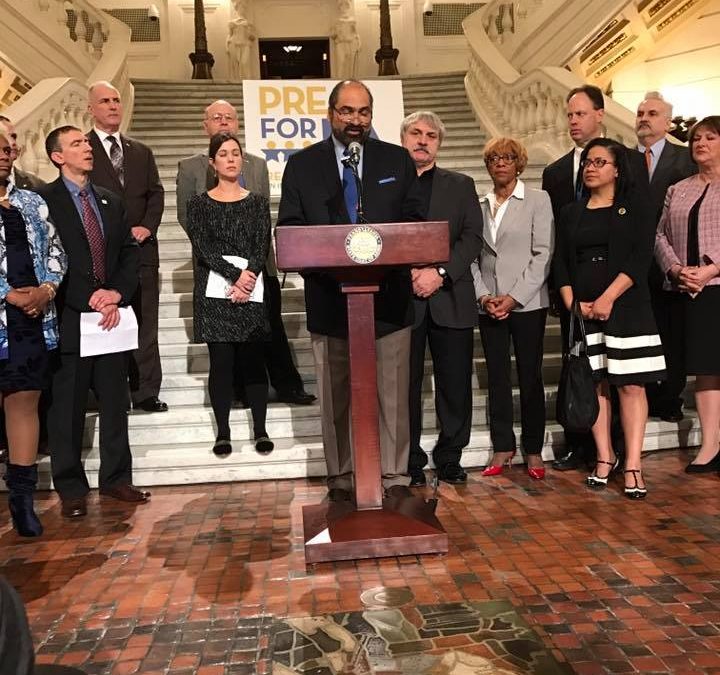
Prekindergarten programs for children from low-income families are sorely lacking in Bucks County and the state, former Pennsylvania Lt. Gov. Jim Cawley and other pre-K advocates said during a press conference Wednesday morning in Upper Southampton.
Gathering at the Jolly Toddlers Early Education Center on Second Street Pike, Cawley and others said a healthy infusion of public money and other pre-K support is needed so that families who meet income guidelines can send their children to quality programs like those offered at Jolly Toddlers.
Joan Benso, president and CEO of the nonprofit Pennsylvania Partnerships for Children, said research done by her group showed that 112,900 children in the state and 3,900 in Bucks County currently qualify for publicly funded pre-K but are not getting it because of a lack of state or other public funding.
Fixing that situation would mean a better future for thousands of children across the county and state, Benso and others at the press conference said.
“We are looking for a sizeable investment in pre-K in the governor’s budget address (on Tuesday) that moves us toward allocating enough public funds ($340 million) by fiscal year 2020-2021 to ensure that all eligible children have access to high quality pre-K,” she said. “It is an investment in our future.”
Cawley, who now lives in Wrightstown and is president and CEO of the United Way of Greater Philadelphia and Southern New Jersey, said his adopted son, Nick, benefited greatly from quality pre-K programs that Cawley and his wife, Suzanne, were able to send him to.
“This is a very personal effort for me,” said Cawley of his pre-K advocacy.
“Nick was very introverted but the pre-K seems to have unlocked a future for him and he’s now a reasonably well adjusted fourth-grader at St. Andrew (Catholic School in Newtown Township),” he continued. “Nick got lucky, but we need to make sure that all kids in Pennsylvania who need it get lucky. Quality pre-K programs give children a leg up educationally and also a chance to be social, and also gives educators an early opportunity to identify anti-social behavior and deal with it.”
Bolstering pre-K programs across the state would make for more solid citizens of the future, Cawley said.
“You can either invest today or be taxed two decades down the road for things like increased corrections system and welfare costs,” he said.
Christine Matik, supervisor of curriculum and instruction for the Centennial School District, said the district’s soon-to-come full-day kindergarten program is going to be great but will be even better with better prepared students entering it from quality pre-K programs.
“All research tells us a strong early foundation sets a trajectory for success,” she said.
Benso added that “military leaders, law enforcement officials, philanthropic groups, pediatricians and many state and local lawmakers have also talked about research that shows pre-K can make a difference. It can reduce grade repetition, special education placements, dropout rates and ultimately save the commonwealth money.”
Read the full article here.
Pittsburgh Post-Gazette: Letter to Editor: Let’s keep the momentum for pre-k in Pennsylvania
January 29, 2017 by Allen Kukovich
I was encouraged to read Mount Aloysius College president Tom Foley’s piece “Invest in the Bookends of Education” (Jan. 1 Forum). He got it right! All of the benefits correlated with access to high-quality pre-K that Mr. Foley described help explain this groundswell of support for it.
Over the past three years, I have supported an effort known as Pre-K for PA, which is urging greater state investments in high-quality prekindergarten. Statewide, 112,900 3- and 4-year-olds who qualify for publicly funded, high-quality prekindergarten are not served. That’s more than 64 percent of eligible children, according to “A Path Forward: Publicly Funded High-Quality Pre-K in Pennsylvania,” from Pennsylvania Partnerships for Children. This unmet need is fueling a wide array of voices supporting the goals of the campaign.
Our efforts are paying off! In the past two-years, under the shadow of a difficult political atmosphere, leaders in Harrisburg chose to prioritize pre-K by providing 6,000 more kids access.
Clearly, this is the time to keep the pre-K momentum going and help all children fulfill their promise. We believe that Gov. Tom Wolf will, once again, prioritize new investments for pre-K in his upcoming budget proposal. The Pre-K for PA movement is calling for an $85 million investment to serve an additional 10,000 children.
By uniting to make these pre-K investments a top priority, we assure that our children, families and communities reap the benefits of preparedness for school and life that Mr. Foley described. Let’s tell our leaders in Harrisburg to position access to pre-K as a top legislative priority and make 2017 the Year of the Child.
ALLEN KUKOVICH
Manor
The writer, a former member of the Pennsylvania Senate and House, is on the Pre-K for PA advisory council.
Read the Letter to the Editor here.
American kids losing the academic “medal count”
PA sports champions urge further state investment in quality pre-k to level the playing field for PA kids
Harrisburg, PA, January 25 ⎯ It is time to level the playing field and scale up access to high-quality pre-kindergarten programs that prepare kids for academic and lifetime success, top Pennsylvania athletes said at a Capitol news conference today.
Pittsburgh Steelers legend Franco Harris and four-time Olympic medalist wrestler Bruce Baumgartner helped release a new report from the nonprofit Champions for America’s Future entitled, “High-Quality Early Education Can Help Kids Win the Academic ‘Medal Race.’”
The report brings to light new data from the Organization for Economic Cooperation and Development (OECD) showing that American children are far back in the pack when it comes to the international “medal count” on academic achievement. America’s 15-year-old children finished 25th in science and 40th in math out of the 72 countries taking the (OECD) PISA exam in 2015. This is in stark contrast to the USA’s dominating performance at the 2016 Rio Olympics winning 121 medals compared to second-place China’s 70 medals.
Recalling the great amounts of support he received along the way to becoming an NFL Hall of Famer, Franco Harris noted that far too many kids lack adequate support for becoming competitive students. Harris pointed to research showing 60 percent of the “achievement gap” in reading and 70 percent of the achievement gap in math between low-income and higher-income children in high school is already present at the start of kindergarten.
“Access to prekindergarten creates an opportunity to level the playing field for all children to achieve their full potential regardless of the income level of the families they inherited,” Harris said.
The report documents studies across the nation showing high-quality pre-k helps children develop in all areas⎯social, emotional and behavioral skills⎯along with essential pre-math and pre-reading skills. Additionally, the analysis team at the Organization for Economic Cooperation and Development identified high-quality pre-k as one of the common characteristics among the world’s “smartest countries.”
Pennsylvania has made strides in expanding access to high-quality pre-k, but more needs to be done, the athletes stressed. They noted that 112,900 three- and four-year-olds qualify for high-quality, publicly funded pre-k that remain unserved due to lack of funding⎯that’s enough to fill Penn State’s Beaver Stadium and leave another 7,000 children in the parking lot.
Former Olympian freestyle heavyweight wrestler Bruce Baumgartner, one of just eight athletes in U.S. history to medal in four different Olympiads (two gold, one silver and one bronze), emphasized his desire to see all children achieve their full potential on and off the field and become champions in life. “Athletes know that every medal we earn represents a team effort,” he said. “Our youngest children deserve the same team effort guiding them toward success on and off the field. Unfortunately, far too many kids don’t have access to quality pre-k, which hampers their chances for success before they even reach the starting line of life.”
Bruce Clash, on behalf of the Pre-K for PA Campaign, explained that all Pennsylvanians bear the brunt of children being left behind academically. “When a child starts school already behind, the cost to educate that child already begins to escalate,” said Clash. “Kids that continue to fall behind in school have a greater risk of dropping out and engaging in criminal activity. This is why the research on pre-k shows that it can return over $29,000 on average, net benefits to society for every child served.”
The athletes join a growing chorus of voices across Pennsylvania that are part of the Pre-K for PA Campaign in calling on Pennsylvania lawmakers and Governor Wolf to expand access to publicly funded high-quality pre-k for all eligible children and begin to address affordability issues among the middle class. Specifically, the Campaign is calling for an $85 million increase to state pre-k funding in the 2017-18 state budget to serve 10,000 additional children.
Also participating in the event were State Senator Pat Browne and Representative Mark Longietti, who are Co-Chairs of the bicameral, bipartisan Early Childhood Education Caucus; and Suzann Morris, the Deputy Secretary of the Office of Child Development and Early Learning within the PA Departments of Education and Human Services.
###
PennLive: In another tight state budget year, advocates make case for preschool funding
January 25, 2017 by Charlie Thompson
In a tight budget year, one group that still feels confident enough to ask for growth in state funding are advocates for expanded access to preschool programs.
Leaders of the Pre-K for PA coalition pressed their case at the Capitol Tuesday at a rally headlined by two native-son athletes, Penn State and Pittsburgh Steeler great Franco Harris and Olympic wrestler Bruce Baumgartner.
Pre-school initiatives received a $30 million boost from Gov. Tom Wolf and legislators in the 2016-17 budget, for a total of more than $190 million in the state’s Pre-K Counts and Head Start programs.
Including federal- and locally-funded programs, about 64,000 low- and moderate-income children are served through quality publicly-funded programming.
The coalition, however, estimates there are still nearly twice that many kids unserved. Advocates are pressing state officials to continue working to close that gap this year, asking for an increase of $85 million.
Wolf has consistently said this winter that he will look to continue his pattern of increasing state investment in education.
Read the article here.
CBS21: Franco Harris and Bruce Baumgartner talk about the importance of pre-k
January 25, 2017
HARRISBURG, Pa — Two standout athletes talked about the importance of academics in Harrisburg today.
Pittsburgh Steelers legend Franco Harris and four-time Olympic medalist Bruce Baumgartner called on lawmakers to scale up access to high quality pre-kindergarten programs.
I had what we called nursery school back when I was growing up and I could see that some of the kids had a little bit of an advantage over some of the kids who maybe didn’t have that opportunity.
They found that American children are far behind the pack when it comes to international academic achievements.
In creating more access to pre-K programs they hope kids will be better prepared for academic and lifetime success.
Watch the video here.