West Chester Daily Local: Local officials advocate for pre-K funding to prevent crime
April 3, 2018 by Bill Rettew
WEST CHESTER >> The consensus around the county commissioner’s board room table was that you can pay now or pay later when it comes to preventing crime.
About two dozen law enforcement leaders and members of the Chester County state legislative delegation talked Tuesday about the benefits of funding pre-K education for three- and four-year-olds.
The law enforcement leaders are members of “Fight Crime: Invest in Kids.”
A new report, “Pre-K Key to Cutting Pennsylvania Prison Costs and Boosting School Success,” was recently released.
The report cites “state and national research studies showing that quality early learning programs have been proven to reduce disadvantages resulting in fewer behavior problems, better school outcomes, increased high school graduation rates, and ultimately less criminal activity.”
District Attorney Tom Hogan said that providing a solid Pre-K education serves as an “inoculation and antibiotic” to keep kids from ending up in prison.
“Crime doesn’t pay, but like it or not, we do pay for crime,” West Chester Police Chief Scott Bohn said. “The investment saves us far more than the cost.”
“No child is destined at birth to end up in jail,” Sherriff Carolyn “Bunny” Welsh said. “If you are bad, we will be waiting for you with expensive solutions.”
Law enforcement leaders urged the state lawmakers to prioritize a $40 million expansion for high-quality Pre-Kindergarten within the 2018-2019 budget.
Additional funding would allow 4,400 more eligible children to get the schooling.
About 106,000 eligible three- and four-year-olds statewide, along with about 3,500 youngsters in Chester County, lack access to a good Pre-K education.
State Rep. Duane Milne, R-167, released the following statement:“The connection between well-funding early education initiatives and the later effects on reducing the likelihood of someone engaging in criminal activity and becoming a ‘regular’ of the criminal justice system is clear, convincing and compelling.
“Strategic investments of public dollars into education can save taxpayers billions of dollars in the longer run, by decreasing levels of welfare, crime and other challenges facing our society.
“This is a classic (policy) case that an ounce of prevention is worth a pound (and then some) in cure.”
State Sen. John Rafferty, R-44, said that in the long run the added funding would save money.
State Rep. Carolyn Comitta, D-156, asked her fellow elected officials how to best push for the funding and subsequently not “pay out down the road.
“For a while, it’s going to cost more.”
Veteran state Rep. Becky Corbin, R-155, said that in the end increasing funding will pay off.
“You just have to make your case,” Corbin told Comitta.
Moderator and state director of Fight Crime: Invest in Kids, Bruce R. Clash, noted that 40 percent of first-time prison inmates have no high school degree.
Hogan said that many inmates never learned to read.
“If you can’t read, you can take the pipeline straight into prison,” Hogan said. Hogan also said that with a simple investment in education, many more of the youngest will live “productive, happy, and free lives.”
State Sen. Andy Dinniman, D-19, talked about the trauma for many three- and four-year-olds growing up in a negative environment.
“It doesn’t matter what your party is,” Dinniman said. “And we can’t give up on middle school or high school kids either.”
County Commissioner Michelle Kichline said that lawmakers are often tasked with making choices. She said that public officials need to look at how to best spend the dollars.
Christine Fox, curriculum director for Warwick Child Care Center said that the child care provider was able to expand from 90 to 110 students because of expanded funding.
“High quality early childhood educators provide an atmosphere where children feel safe and eager to learn new things through hands-on learning experiences,” Fox said. “Children who attend high-quality learning programs will enter kindergarten ready to learn, do better in school, are more likely to graduate high school and college and become thriving citizens within the community.
“It takes a community to raise a child and we need everyone’s help to do this well.”
Read the full article here.
WFMZ TV: Berks pre-K students invited to Pa. governor’s Easter event
April 3, 2018
HARRISBURG, Pa. – Pre-school students from across Pennsylvania, including some from Berks County, traveled to Harrisburg on Tuesday for an Easter event with the state’s first couple.
Gov. Tom Wolf and his wife, Frances, welcomed the children to the governor’s residence for an event that included the opportunity for them to visit with the Easter Bunny and pet some of his furry friends.
“These are our future, all these kids, and they’re going to determine how Pennsylvania is 20, 30, 40, 50 years from now,” Wolf said. “We got to make sure that we’re doing everything we can to get them the education they need.”
The event was co-sponsored by Pre-K for PA, a nonpartisan group that advocates for the expansion of publicly funded pre-kindergarten.
“Pre-K doesn’t just benefit the children fortunate enough to access a high-quality program, it benefits the entire commonwealth,” Wolf said. “We must get serious about investing in early childhood education to make sure all of Pennsylvania’s children enter kindergarten ready to learn.”
Read the full article here.
WBRE: Governor and First Lady Host Annual Easter Egg Event 2018
April 3, 2018 by Jayne Ann Bugda
HARRISBURG, DAUPHIN COUNTY (WBRE/WYOU-TV) Governor Tom Wolf and First Lady Frances Wolf today hosted pre-school classes from across the commonwealth at the annual Easter Egg Event at the Governor’s Residence.
The event was co-sponsored by Pre-K for PA, a non-partisan advocacy group that
supports the expansion of publicly funded pre-k.
In a prepared release from the PA Internet Services, the Governor said “Frances and I are proud that Pennsylvania delivers high-quality, publicly-funded pre-k to many
children, but over 106,000 kids remain unserved and a serious investment must be made to
continue toward the goal of providing access to all at-risk kids,”
In his 2018-19 budget, Governor Wolf proposed an additional $40 million to support high-quality
pre-k programs in the commonwealth. This expansion would mean access to publicly funded,
high-quality pre-k for 4,400 more kids.
Studies show that children who participate in high-quality pre-kindergarten perform better in
school, graduate at higher rates, and earn more throughout their working lives compared to
peers who do not have access to early learning programs. Additionally, children who were
previously enrolled in Pre-K Counts outperform their economically disadvantaged peers in third
grade math and reading.
Governor Wolf’s 2018-19 budget proposal contains education investments at all levels,
including:
• $100 million increase in Basic Education;
• $40 million increase in Pre-K Counts and Head Start;
• $20 million increase for Special Education;
• $15 million increase for the State System of Higher Education; and
• $10 million increase for Career and Technical Education
Watch the video here.
Valley News Dispatch: State Rep. Frank Dermody advocates for more state funding for pre-school education
Emily Balser March 24, 2018
State Rep. Frank Dermody, D-Oakmont, visited New Kensington on Monday to advocate for increased funding so more children can have access to quality pre-kindergarten education.
Dermody spent the morning at All Kids Are Special, a preschool and learning center inside St. Paul Evangelical Lutheran Church.
The state House minority leader, Dermody helped secure extra grant funding for the preschool last year, which allowed them to offer enrollment for 19 more children.
“They’re doing great things for our kids,” Dermody said.
A roundtable discussion and tour of the facility was planned by nonprofit organization Trying Together, which advocates for quality early child care and education in Pennsylvania.
Representatives from Trying Together, the United Way, private companies and staff from the facility all took part.
State data show 65 percent of eligible children don’t have access to pre-K in Westmoreland County.
That equals a need for 125 additional classrooms.
MIDDLE-CLASS FAMILIES QUALIFY
Many middle-income families qualify for the state’s Pre-K Counts program, which provides free pre-K education for children from 3 years old until they start kindergarten, but aren’t able to get their children into a preschool to utilize the funds.
For example, a family of four that makes $75,300 or less qualifies for the program but may not have access to a preschool.
Lissa Shulman, public policy director with Trying Together, said families could be saving thousands of dollars a year by qualifying for Pre-K Counts.
“Those extra thousands are more than housing, taking away from saving for college (and) saving for other expenses,” she said.
EARLY ED SEEN AS ESSENTIAL
Cheryl Gartley, director of All Kids Are Special, said having a quality education prior to kindergarten is essential to ensuring children have the skills needed for their K-12 education.
“We have seen such a difference in some kids,” Gartley said. “I think that Representative Dermody seems to understand the need.”
Dermody said he considers supporting early childhood education one of his biggest responsibilities as a state lawmaker.
Pottstown Officials Celebrate Pre-K Expansion
New data shows 72 percent of eligible kids in Montgomery County lack access to pre-k; Leaders urge continued state investment to further reduce unmet need
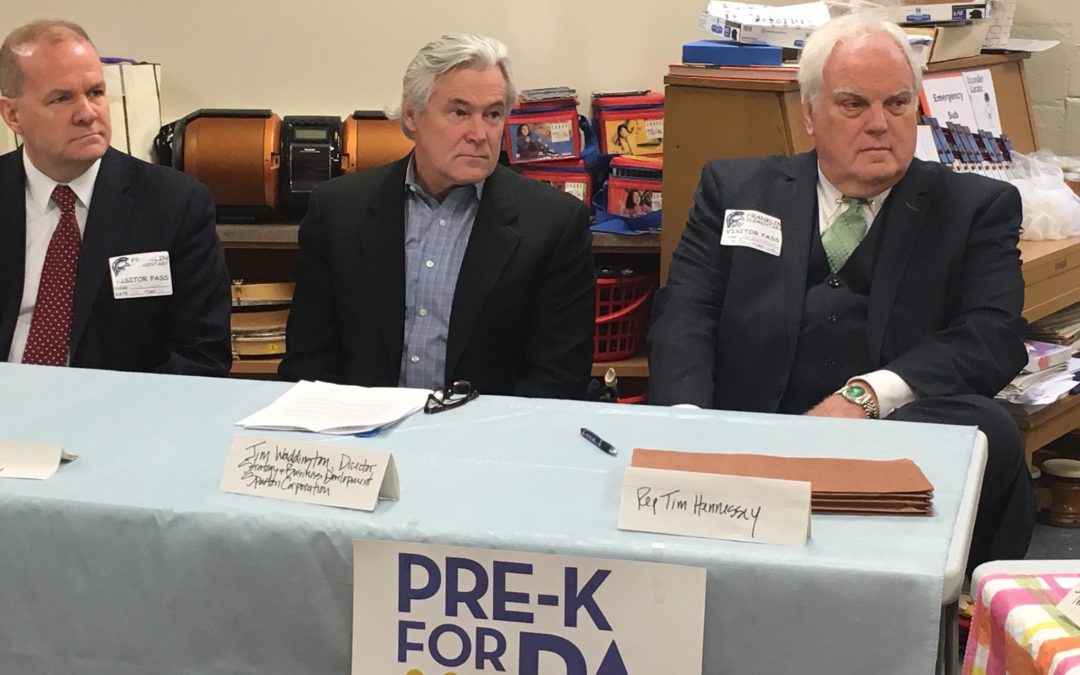
Pottstown, PA – Pennsylvania House members Tom Quigley and Tim Hennessey, joined Pottstown area leaders for a mid-year pre-k visit at Franklin Elementary. Officials took the opportunity to visit with pre-k students in a new state-funded Pre-K Counts classroom that was made possible by additional investments included in the 2017-18 state budget.
“Greater access to high-quality pre-k is an essential investment in our community,” said Tim Phelps of the PA Early Learning Investment Commission. Phelps continued, “Pre-k programs are backed by decades of research showing that children who attend have a more positive trajectory in life. This means more kids finishing high school, getting a job, less reliance on social services and less crime in our community.”
The expansion classroom at Franklin Elementary was made possible by the infusion of an additional $25 million in funding for Pennsylvania Pre-K Counts and $5 million for the Head Start Supplemental Assistance Program as part of the state’s 2017-2018 budget. Montgomery County early learning providers received new funding for 159 expansion seats. Pre-K Counts and the Head Start State Supplemental are the primary state funding sources for high-quality pre-k in Pennsylvania.
Pottstown School District Superintendent Stephen Rodriguez noted that the added capacity to high-quality pre-k is welcome news as only 28 percent of income eligible 3- and 4-year-olds in Montgomery County have access to publicly funded high-quality pre-k according to new data from the Pre-K for PA Campaign.
“While I join you to celebrate this new classroom, I must be clear that we still have a lot of work to do,” said Rodriguez. “More than 4,700 income eligible three- and four-year-olds in Montgomery County still lack access to this once-in-a-lifetime learning opportunity.”
More than 106,000 eligible children, or 61 percent of all three- and four-year-olds, across the commonwealth lack access to publicly funded, high-quality pre-k each year.
Jim Waddington of Sparton Corporation noted that Pennsylvania is experiencing a shortage of qualified workers and pre-k is the place to start to stem that tide.
“A recent survey from the statewide chamber of business and industry showed that more than half of the 400+ Pennsylvania employers that were surveyed reported trouble finding people with adequate skills, training, or education. This was especially true of technical and skilled job openings,” said Waddington. “It is particularly troubling considering the proven benefits of pre-k and lack of access to pre-k statewide.”
A large body of research shows children who benefit from high-quality pre-k:
-
- Enter kindergarten with stronger literacy, language, math and social/emotional skills;
- Are less likely to need special education services, less likely to repeat grades, and more likely to graduate and enroll in college.
- Over a lifetime, these young learners will see stronger employment opportunities and increased earning potential, and they are less likely to commit juvenile and adult crimes.
Participants thanked Representatives Quigley and Hennessey for supporting increased pre-k funding in the 2017-18 state budget, and encouraged all state policy makers alike to make increasing access to high-quality pre-k a top priority for current 2018-19 state budget negotiations in Harrisburg. Governor Tom Wolf has included $40 million in new state pre-k funding as part of his 2018-19 budget proposal.
Also participating in the event were Valerie Jackson, PEAK Coordinator; Karen Kile, Pre-K Counts Coordinator; Donna Cooper, Executive Director, Public Citizens for Children and Youth; Laurie Kolka, Director of Curriculum & Professional Development, Pottstown SD; Leslie Spilling, Family Engagement Coordinator, PEAK; Diana Gonzalez, Bilingual Parent Outreach Specialist; Tyrone Scott, Director of External Affairs, DVAEYC; Shirlee Howe, Montgomery County Coordinator, Public Citizens for Children and Youth.