Times-Leader: Their View: State Must Invest in its Children
By: Joseph Perugino March 30, 2019
As the state legislature debates budget priorities, an area of concern on both sides of the aisle is the readiness of our future workforce. As a retired U.S. Army general, I too am concerned about this especially since the young people of today are the service members of the future.
Unfortunately, a look at our youth shows a shortfall in “citizen-readiness” – the idea that they can be contributing members of society in any arena. In particular, too few are prepared for military service. The U.S. Army felt the effects of this by missing its 2018 recruiting goal by 8.5 percent, or about 6,500 recruits.
In fact, a shocking 71 percent of young Pennsylvanians do not qualify for military service. That’s three young people in four whose potential is doused before they arrive at the recruiting office. One third are obese. One third lack a high school diploma or can’t pass military entrance exams. The final third have records of criminal activity or substance abuse.
As a society we must be investing to ensure an expanding workforce talent pool, not a diminishing one. It’s time to support a citizen-ready generation with a three-part continuum of investment that strengthens learning from birth through high school. As part of the final state budget, our leaders must expand investments to:
• Strengthen families through voluntary home visiting programs: Parenthood is a learned skill, especially for young parents who never had good role models. Research-based home visiting pairs families with trained professionals who teach the ABCs of child development, health and education. The result: Better academic outcomes and child health, less spending on social services, lower abuse rates and help for families breaking away from substance abuse.
• Grow access to early education: In the years from birth to age 5, children develop one million brain synapses per second. When “hard-wired” through high-quality early learning, these connections become the building blocks of future learning, physical health that averts obesity and emotional wellness. The U.S. military recognized this fact in 1989 with a challenging mission – to intensify investments in early childhood education. Throughout the world, we now offer high-quality child care and pre-k that prepare children for school and lifetime success. As a bonus, our commitment to quality in early learning helps parenting service members concentrate on their jobs protecting national security, confident that their children are learning and well cared for.
• Provide adequate and equitable K through 12 education funding: Pennsylvania’s academic gaps are among the worst in the nation. Minority children and those living in poverty trail far behind their white and better-off peers in grade-level achievement. Research shows that money and how we spend it makes a difference. It’s especially effective when targeting underfunded schools and delivering classroom improvements and direct services that help children overcome hardship, explore career opportunities and achieve academically.
Together, these three initiatives create an education pipeline that feeds into our military, colleges, job-training programs, and workplaces. When we complete this mission, our children will be prepared for successful adulthoods as contributing citizens and, if they choose, proud and capable members of the U.S. Armed Forces.
Major General (ret.) Joseph F. Perugino, U.S. Army is former commander of the 28th Infantry Division, PA National Guard and executive advisory council, mission: Readiness – Military Leaders For Kids, member.
Read the op-ed here.
Pittsburgh Post-Gazette: Letter to the Editor: Investing in Pre-k is a Big Win for PA Children
March 22, 2019
In Gov. Tom Wolf’s recent budget 2019-2020 proposal, education was again a focus. As an elected school board member, I am glad to see our evolving understanding of the importance of funding the full continuum of high-quality early childhood education for all children. Specifically, the governor’s proposed investment of $50 million for high-quality pre-K is a big win for thousands of Pennsylvania’s youngest children.
In this current school year, Pittsburgh Public Schools was able to serve 74 additional pre-K children thanks to increases in last year’s state budget. We especially appreciated our local legislators who attended a classroom opening celebration with us, including Sen. Jay Costa, Rep. Ed Gainey and Rep. Dan Frankel.
As we look to next year’s budget, there are still over 500 income-eligible children in Pittsburgh who are missing out on the opportunity to attend high-quality pre-K. Statewide, there are nearly 98,000 children missing out. Pittsburgh and Pennsylvania must keep pushing until access reaches all at-risk children, and I hope that in this budget cycle our legislators push to continue to expand access to thousands more kids next year.
Finally, we must remember that many pre-K classrooms are located in STAR 3 and 4 child care providers, including dozens that Pittsburgh Public Schools partners with in order to meet the needs of families in our district. The proposed $50 million investment in pre-K programs should be celebrated, and we must also invest $50 million in child care as we know that learning begins long before children turn 3 years old. I am excited that the conversation around pre-K investment has elevated the focus on early learning, and I hope the legislature will invest accordingly.
LYNDA WRENN
Point Breeze
The writer is the president of the Pittsburgh Board of Public Education
See the letter to the editor here.
Pottstown Mercury: Pottstown Singled Out for Early Education Leadership
By: Evan Brandt February 10, 2019
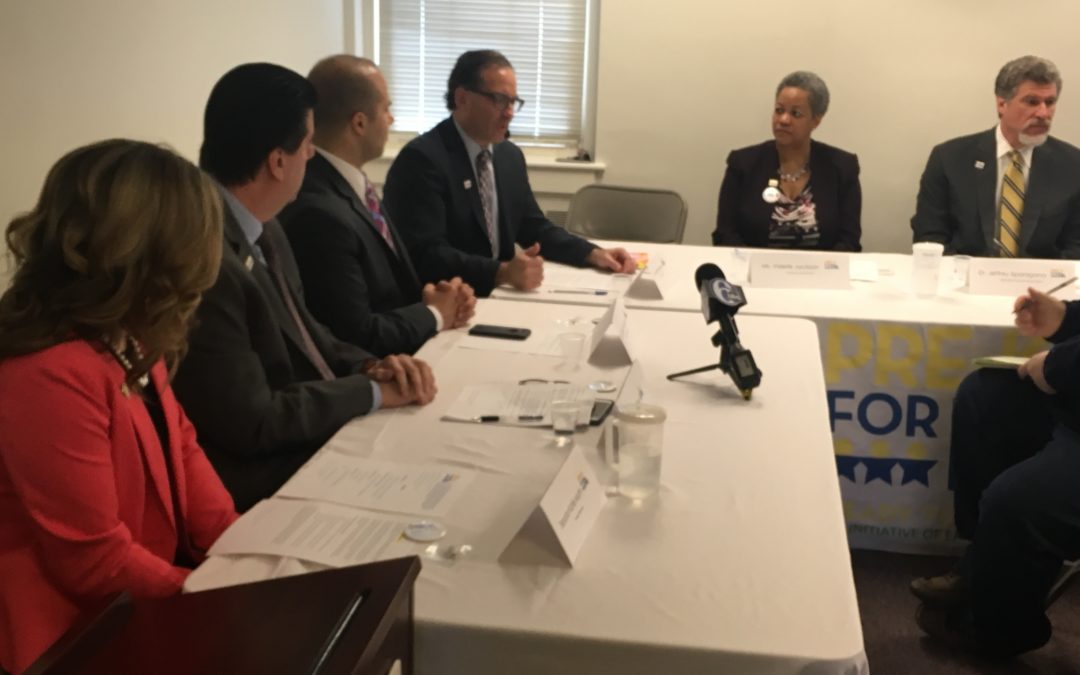
POTTSTOWN — As the state budget season kicked off with the presentation of Gov. Tom Wolf’s budget, early education advocates kicked off their efforts to ensure that budget funds pre-kindergarten education.
For their setting they chose the Learning Annex building on North Franklin Street where several of the Pottstown School District’s Pre-K Counts classrooms are held.
It is an easy program to support, said Schools Superintendent Stephen Rodriguez, because “it emotionally prepares students to deal with the world, and economically, it is the best way to invest in education.”
That too was the conclusion reached in a four-page study by the Economy League of Greater Philadelphia which was released during the event.
Jeff Hornstein, the executive director of the Economy League, said Pottstown was chosen as a case study because it has been on the forefront of early education since 1989 when it implement half-day Pre-K classes in all its elementary schools.
More recently, for the last 13 years, that effort has fallen under the umbrella of PEAK, Pottstown Early Action for Kingergarten Readiness, spearheaded by former schools superintendent Jeff Sparagana, who was on hand and called the effort “a unique partnership” between the school district and larger community.
“It more than life-changing work,” Sparagana said of public education. “It’s life-saving work.”
In 2007, the state jumped into the game with a program called Pre-K Counts and because of Pottstown’s existing program, provided 108 slots for low-income children. By 2015, it had grown to 220 slots and is now more than 300 full-day slots.
According to the Economy League information, “children who participated in Pre-K Counts were less likely to need intensive literacy support” in 2017.
“Research from 2016 found that children who participated in PEAK’s pre-kindergarten programs performed better than the district average on literacy assessments when they arrived in kindergarten and each subsequent year through third grade,” according to the Economy League data.
Read the full article here: https://www.pottsmerc.com/news/pottstown-singled-out-for-early-education-leadership/article_62c60e76-2bf5-11e9-9b2a-879ef3fe7b36.html

Gov. Wolf Ramps Up Pre-K Investment, Opens Opportunity to Thousands More PA Children
2019-20 State Budget proposal includes $50 million for pre-k programs
Harrisburg, PA (February 5, 2019)– Pre-K for PA marked the proposed new investment of $50 million in the 2019-20 PA budget as a big win for thousands of Pennsylvania’s youngest children. In a statement, the eleven principal partners leading the campaign to increase funding for high-quality pre-k, Pre-K for PA, issued the following statement regarding Governor Tom Wolf’s continued commitment to expanding access to pre-k in Pennsylvania:
“Governor Wolf demonstrated and amplified his commitment to expanding access to publicly funded pre-k by proposing funding to support thousands of additional young learners to attend high-quality programs.
“As we kick off our sixth year, Pre-K for PA—representing more than 25,000 individual supporters across Pennsylvania—is optimistic that the legislature will support this bi-partisan budget priority; members from both sides of the aisle have consistently supported expanding access to this valuable once-in-a-lifetime educational experience. Supporting increased funding for high-quality pre-k is a wise investment and good politics, as a recent Pre-K for PA poll showed 94 percent of Pennsylvanians agreed that early childhood education is important.
“Our celebration of the $50 million investment in pre-k programs in the 2019-20 state budget is tempered by the harsh reality that PA ranks 18thof the 30 states investing in high-quality pre-k, and with this new investment, about 100,000 eligible children still lack access.
“In Pennsylvania, publicly funded pre-k and high-quality child care are inextricably linked, with 48 percent of children enrolled in Pre-K Counts served by STAR 3 and 4 child care providers. Governor’s Wolf’s budget includes a plan for spending about $101 million in federal child care funds and reduced state child care funding by $150,000. It is important that Pennsylvania lawmakers recognize high-quality child care as a vital workforce support for young Pennsylvania families and a delivery system for high-quality pre-k.
“We salute Governor Wolf for making high-quality pre-k funding a budget priority, and we strongly encourage the legislature to fully-fund it.”
The 2019-20 proposed budget includes the following expanded investments to early learning:
- Increases PA Pre-K Counts investment: $40 million
- Increases investment in Head Start Supplemental Assistance Program: $10 million
- Increase in Federal Funding to support child care services: $101 million
- Increase of $5 million to support Evidence-based Home Visiting services
Pre-K for PA is an initiative of Early Learning Pennsylvania (ELPA), a statewide coalition of advocates focused on supporting young Pennsylvanians from birth to age five. ELPA also advocates for expanding Evidence-based Home Visiting Services via the Childhood Begins at Home Campaign, and the coalition recently launched Start Strong PA, a statewide advocacy campaign to increase access to affordable, high-quality child care for Pennsylvania’s families and their children, starting with infants and toddlers.
Pre-K for PA is an issue campaign supported by individuals and organizations across Pennsylvania who believe that investing in our children is the right choice and an urgent necessity. Its vision is that every 3- and 4-year-old in Pennsylvania will have access to high-quality pre-k. For more information visit www.prekforpa.org.
# # #
The Intelligencer: DA joins call for more pre-K in Bucks County
January 10, 2019 by Christian Menno
Bucks County needs 174 more pre-kindergarten classrooms to meet demand, according to an educational group.
When Bucks County’s top law enforcement officer speaks in front of a crowd, it’s usually a throng of media members or a packed courtroom.
But on Thursday District Attorney Matt Weintraub had a captive audience of a different kind when he visited with youngsters at Radcliffe Learning Center in Bristol Borough.
He urged students to keep each other safe and treat each other with respect.
But his message to residents and lawmakers in Harrisburg was to continue to push for funding of quality pre-kindergarten programs, to which 74 percent of eligible children in Bucks County do not have access, according to studies.
“Pre-k is critical,” Weintraub said after interacting with the kids. “It’s been proven … time and time again that the more education that we can give to the children and the younger that we can start the less problems that they face as they grow up, less crime that we have to attend to, the more intact that their families will become and it’s just a positive cycle that continues to grow.”
The number of students without access to high-quality providers statewide is less than in Bucks and sits at 61 percent, says data compiled by KIDS COUNT: Pennsylvania Partnerships for Children.
Thursday’s event, which also included Bristol Borough police Sgt. Pete Faight, was organized by Public Citizens for Children and Youth as part of the Pre-K for PA initiative.
PCCY’s Education Coordinator Bill Shoffler said the county needs 174 additional pre-k classrooms to meet the demand.
The benefits if that number is reach, he said, would be “immeasurable.”
“What studies have found is that kids who attend a quality pre-k do better in school, have higher graduation rates and as adults they’re actually healthier,” Shoffler said. “They rely less on social support and one of the reasons our district attorney is so supportive of pre-k is that they have less interaction with the criminal justice system.”
He called the $25 million in pre-kindergarten funding included in the final 2018-19 state budget a good start, but stressed that more efforts are needed.
One of the ways an institution in Pennsylvania is viewed as “high quality” is through participating in certification programs.
Read the full article here: http://www.theintell.com/news/20190110/da-joins-call-for-more-pre-k-in-bucks-county