PA Post: Retired military leaders say Pa. schools need more money
November 12, 2019 by Ed Mahon
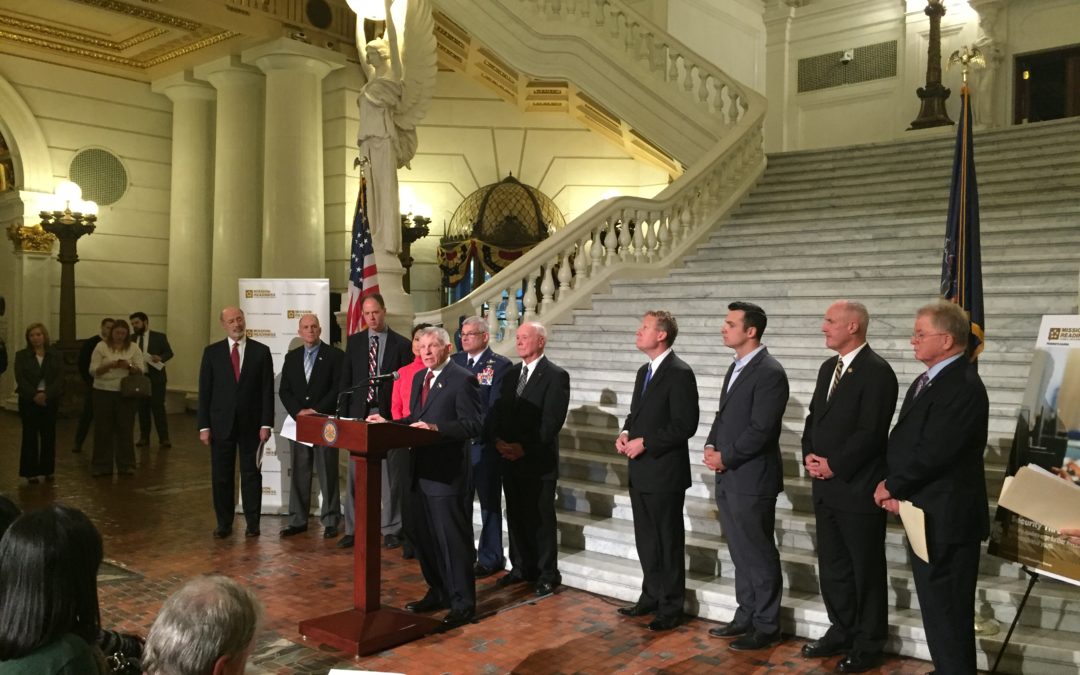
A group of retired military leaders says too many young Pennsylvanians don’t meet standard eligibility requirements for serving in the armed forces, and the country’s “thriving economy” makes the recruiting challenge even more difficult.
“Gaps in workforce readiness threaten our country’s future economic success and national security,” the group, Mission: Readiness, asserts in a new report released Tuesday.
The group’s proposed solutions include more funding for schools, high-quality care for infants and toddlers, and for pre-K programs. Stressed in the report is the need to do more to level the funding gaps between Pennsylvania’s richest and poorest school districts.
“Pennsylvania is home to the widest per-pupil spending gap in the nation between wealthy and poor school districts,” the report notes. “This gap has a very real impact on students. Pennsylvania’s wealthiest districts spend 33.5 percent more than its poorest school districts, a gap significantly higher than the national average of 15.6 percent.”
Mission: Readiness is part of the Council for a Strong America, a group of law enforcement, retired military, business, faith and sports leader who advocate on children’s issues.
The report does not suggest a specific dollar amount for the proposed funding increases. But the report says lawmakers need to do more to ensure young people in Pennsylvania are ready for college or careers, including military service.
“Nothing less than our economy and our national security depends on it,” retired Army Lt. Gen. Dennis Benchoff said Tuesday.
The report makes the case that young people aren’t leaving school with the skills they need, saying that about 7 in 10 people who are 17 to 24 years old don’t meet the military’s core eligibility requirements. The most common barriers include inadequate education, obesity or other disqualifying health conditions, or having a record of crime or substance use.
Read the full article here.

Penn Capital Star: OpEd: Veterans Day honors those who served. Now we need to look to the next generation of warriors.
November 11, 2019 by Thomas J. Wilson III, U.S. Navy Retired
“Wars may be fought with weapons, but they are won by men.”
The nature of war may have changed since Gen. George S. Patton wrote those famous words, but the principle remains the same. No matter what we invest in weapons and technology, the men and women wearing the uniforms of our nation deliver the resourcefulness and skill that keeps America safe.
On this Veterans’ Day, we honor those who serve, but it’s also a time to cast our vision ahead to those who might someday serve.
Unfortunately, here is where we see potential problems. Like employers throughout Pennsylvania and nationwide, the U.S. military strains to draw recruits from an increasingly depleted workforce.
Low unemployment has created a hiring crunch, complicated for the military by the fact that nearly three out of four young Pennsylvanians do not qualify for military service due to educational deficiencies, health or fitness issues, or a criminal record.
If we do not address this eligibility problem and expand the readiness of young people, will we have the sufficient pool of talented recruits needed to serve in our military in the future? Will private sector employers have a sufficient pool of talented applicants needed to fill their labor force?
The retired admirals and generals of Mission: Readiness recommend a solution – investing in our young people today to better ensure the readiness of workers and service members tomorrow.
The starting place is to ensure greater access to high-quality child care and early education programs like pre-k. Research is clear that brain development from birth to age 5 sets the foundation for children’s future success. During these years, more than 1 million new neural connections form every second. This early foundation sets the stage for children’s cognitive ability, health and behavior throughout life.
The next step is to ensure that all students have the opportunity for a quality K-12 education, regardless of zip code, where these foundational skills can mature. Students should have access to smaller classes where more individualized instruction is possible, access to diverse academic offerings including STEM and Career and Technical Education, and access to critical lab, computer and other equipment that is so pervasive in our modern workforce.
Unfortunately, our public investments in our young people have not kept pace with the need. Many Pennsylvania families struggle to find and afford high-quality child care options for their children and more than 95,000 eligible 3- and 4-year-olds don’t have access to publicly-funded pre-k programs like Pre-K Counts and Head Start.
Added, too many young Pennsylvanians attend public K-12 schools that lack adequate resources to ensure a quality education. In fact, Pennsylvania is home to the widest per-pupil spending gap in the nation between wealthy and poor school districts.
Furthermore, Pennsylvania ranks third overall in the statewide percent of children attending severely financially disadvantaged districts, behind only Illinois and New Hampshire. Our state’s over-reliance on local property taxes to fund public education has drastically limited poorer communities’ ability to adequately fund their schools.
Our economic and national security suffers when the workforce is strained, but we can reverse course. Increased public investment in high-quality early care and education programs as well as equitable and adequate K-12 funding for all Pennsylvania schools are “pipeline” investments in workforce (and military) readiness.
For Veterans’ Day 2019, let’s honor our veterans by committing to investments sure to instill in young people the qualities they will need both in the workforce and in service to this great nation if they so choose.
Rear Adm. Thomas J. Wilson III (U.S. Navy, Ret’d) is a member of the executive advisory council of Mission: Readiness – Military Leaders for Kids. He writes from Biglerville, Pa.
Read the op-ed here.
Centre Daily Times: Centre County kids are benefiting from increased pre-K funding, but statewide gaps still exist
October 28, 2019 by Marley Parish
With help from a boost in state funding, what used to be empty space at the Learning Station is now home to a classroom for 3- and 4-year-olds who receive what director Lynda Mussi calls an “authentic” and high-quality early educational experience.
The increase in pre-K funding in the 2019-20 state budget — a total of $30 million in additional funding for Pre-K Counts and Head Start Supplemental Assistance programs — led to the 3035 Enterprise Drive school receiving a $157,000 grant to create a classroom for up to 20 additional 3- and 4-year-olds.
But while Learning Station has seen a direct benefit from the increased state funding, statewide gaps in pre-K education still exist. In Pennsylvania, 56% of eligible children — 97,702 — do not have access to high-quality pre-K programs, according to Pre-K for PA. Out of the 3,019 pre-K locations eligible to participate, an additional 4,885 pre-K classrooms are still needed to reach Pre-K for PA’s 2022 goal.
“Affordable, accessible high-quality child care is important to the health of Pennsylvania’s economy and to the development of young children, so we are also advocating for more state and federal investments to increase subsidized child care opportunities and to develop the professional workforce needed to drive those programs,” said Kristen Rotz, president of the United Way of Pennsylvania.
A family-owned business, the Learning Station has been operating since the early 1980s. Wanting to provide kids with high-quality education from the baby room through kindergarten, Mussi said kids are encouraged to express their thoughts and feelings verbally as they move through the program developmentally.
“We really want them to have an authentic experience,” Mussi said — noting that 95% of learning occurs between ages 0-5. “And we try to be natural in our supplies … the clocks are hung lower, and the tables and chairs are shorter, so the kids can really see everything from their view.”
Read the full story
here.
Tribune-Review: New Hempfield pre-k center puts spotlight on continuing need
October 10, 2019 by Stephen Huba
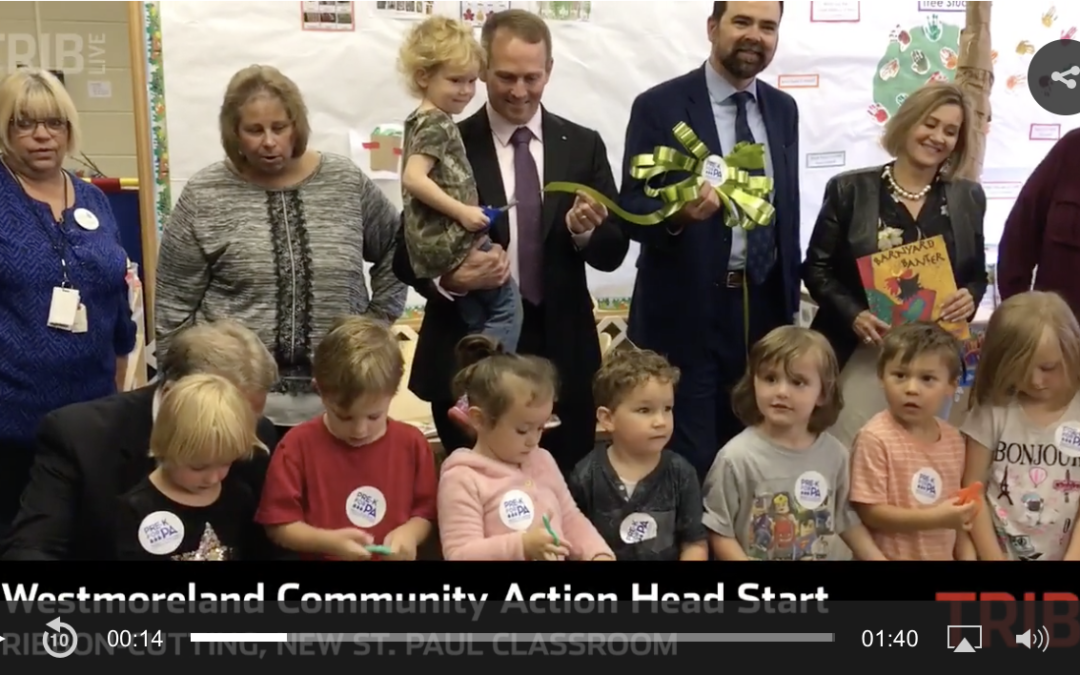
A new full-day pre-kindergarten classroom in Hempfield was cause for celebration Thursday, but the celebration was muted because of the ongoing unmet need in Westmoreland County.
Leaders of Westmoreland Community Action Head Start met with area lawmakers to officially open the classroom and to advocate for more funding for pre-K classrooms in the 2020-21 state budget.
“We are at 38% of eligible children in Westmoreland County who have access to pre-K, so we still have some work to do,” said Cara Ciminillo, executive director of Trying Together, a regional early childhood education organization.
Ciminillo noted that 62% of income- eligible children in Westmoreland County don’t have access to pre-K because of a lack of funds. Pre-K programs such as Head Start (federal) and Pre-K Counts (state) serve low-income children ages 3-5 and prepare them for kindergarten.
The new classroom, one of two at the St. Paul Head Start in Carbon, was made possible as part of a $30 million line item in the 2019-20 state budget and serves 17 children, Ciminillo said. The original classroom, which serves 18 children, moved to St. Paul from Hutchinson Elementary School.
“Head Start and Pre-K Counts serve the most high-risk families in the county in an effort to narrow the gap between low-income kids and their middle-income and higher-income peers,” said Patti Prior, Westmoreland Community Action operations manager.
That gap represents not only academic performance but also social and emotional skills, she said.
“We try to engage parents very early. … Research indicates that when families are engaged early, they’ll be involved later in life,” Prior said.
Westmoreland Community Action operates 25 pre-K classrooms in 14 school districts, and has an enrollment of 491 students. It was the only county Head Start agency to receive funding for a new classroom this year.
“We were lucky to get the 17 slots that we did get,” said Tammy Patterson, vice president for Westmoreland Community Action’s Children & Family Services.
Read the full article here.
Delaware County Times: Educators in Interboro Make the Case for Pre-k Education
October 10, 2019 by Kevin Tustin
PROSPECT PARK — Extending access to pre-kindergarten education access in Interboro School District was lauded by early-education advocates and state lawmakers Wednesday morning.
Over 50 district students are enrolled in full day pre-K at the district’s Kindergarten Center in Prospect Park, up from 34 in the last school year and 16 half-day students in 2017-18. A state grant worth $446,240 helped to establish three full-time classes for the year which goes to pay for three teachers and three paraprofessionals.
“We truly embrace pre-K and know and recognize the valuable role it plays in supporting our youngest students,” said Interboro Superintendent and former Kindergarten Academy Principal Bernadette Reiley. “I have always wanted to provide pre-K. With the help of Dr. Valerie Eckman, our curriculum director, and the support of the board we had a vision that if there was ever an opportunity to apply and bring pre-K to Interboro that is something we wanted to do.”
A roundtable discussion about the benefits of the district’s program yielded feedback about student’s having better social and emotional development, comprehensive learning skills and, quite simply, being ready “to school” ahead of the full-day kindergarten program that follows.
At present there are 270 kindergartners in the district and 51 pre-K slots. The current cohort will represent almost one-fifth of the next kindergarten class.
Read the full article here.