
Letters: Kindergarten must be made mandatory

Letters: Kindergarten must be made mandatory

BY STATE REP. BRENDAN F. BOYLE
POSTED: March 05, 2014

OVER THE past several years families across Pennsylvania have had to struggle in the face of drastic education cuts; and despite Gov. Corbett’s recent attempts to make up for them, the negative side effects and harm that they have brought upon our students’ education remains.

In the coming months, as Harrisburg moves to debate the budget, we should truly consider how we can transform our state for the better and establish a legacy that will last for decades. Pennsylvania is at a crucial time. Like hot steel it is ready to be molded, and we must strike.

The best way to do this is by fostering and investing in a widely available but often overlooked resource: our young children.

With this in mind, I will introduce legislation that creates universal pre-K programs and mandatory kindergarten in Pennsylvania.

Our education system is the bedrock of our society. It is integral to the health and success of our neighborhoods and our state. A well educated workforce leads to better economic performance, a reduction of crime and even better health.

These are only a few examples of the infinite ripple effect education has on us all.

The U.S. Census Bureau has projected that in 2025 there will be over 22,000 Pennsylvania children under the age of 5. That is 22,000 children we can set on a path to academic excellence; children who will be prepared to lead and contribute to our economy from the onset of their development.

We cannot ignore the indisputable evidence that supports the implementation of universal pre-K and the good brought about by kindergarten programs.

Children who participate in high-quality early-childhood education have a higher performance in reading, speaking and language development – and social skills.

What’s more, children from low-income areas who are enrolled in such programs are 40 percent less likely to be held back or need special education, 30 percent more likely to complete high school and twice as likely to attend college.

Over the course of a year, attendance in kindergarten strengthens a child’s social development, and, on average, improves student’s reading scores by ten points and their math scores by eight points.

These benefits are prolonged, leading to higher pay and a better lifestyle. They are the factors that contribute to lower crime rates and better living standards. By establishing universal pre-K in Pennsylvania we are allowing people to lift themselves up by their own bootstraps.

Once we have created a sturdy foundation for our young children we must continue our pursuit of excellence. It is hard to imagine the absence of kindergarten in our children’s education and development, and yet there are states that do not require it. What is even harder to believe is that Pennsylvania is among them.

We have the ability to be transformative and the path to creating a better tomorrow is clear; we need only to act.

By pursuing funding mechanisms, such as the Marcellus Shale extraction tax, we can make this reasonable and commonsense legislation a reality.

As a new father, when I look at my daughter, I see all the promise in the world, and like any parent I wonder what she will make of herself.

Prior to her birth I had advocated for a sound and well-established education system, but I can say now that when I look at her I know we must move forward. We cannot afford to do otherwise.

If we wish to have a Pennsylvania, and an America, that is built to compete in the ever-changing global economy we must be prepared to invest in the children who will build tomorrow.

We must not allow ourselves to fall behind only to look back and say, “If only.”


Brendan F. Boyle represents the 170th Legislative District in Northeast Philadelphia and Montgomery County. He was elected in 2008 and is currently serving his third term in office.
The Case for High Quality Pre-k

The Case for High Quality Pre-k

By Joan Benso, president and CEO, Pennsylvania Partnerships for Children

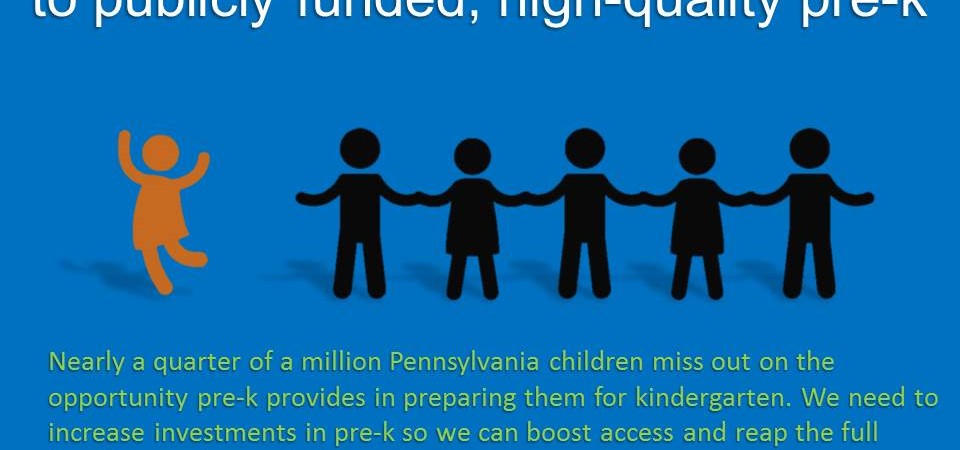
Not long after the statewide “Pre-K for PA” campaign launched in January, Pennsylvania Partnerships for Children (PPC) released a report showing only about 18 percent of Pennsylvania’s 3- and 4-year-olds – or 1 in 6 children – are able to access high-quality, publicly funded pre-kindergarten programs.

That means nearly a quarter of a million Pennsylvania children are missing out on the once-in-a-lifetime benefits high-quality pre-k provides. This lack of access not only means lost learning opportunities, it also results in additional long-term costs for Pennsylvania’s taxpayers. These issues can be addressed through stronger public investments in high-quality pre-k.

PPC’s report, A Smart Choice for a Solid Start: The Case for Pre-k in PA, details the proven benefits of high-quality pre-k for 3- and 4-year-olds, including stronger academic and social skills in kindergarten and later grades, reduced costs for special education services, and an increased likelihood of high school graduation and better employment opportunities. The report also includes local data showing how many young learners lack access to high-quality pre-k in each of Pennsylvania’s 67 counties.

Pre-k has earned growing support among elected leaders from both major parties, business leaders, and military and law enforcement officials in Pennsylvania and across the country. And most Pennsylvania voters support increased funding for pre-k, even if it means increased taxes.

Yet despite this strong support, Pennsylvania’s investments in high-quality pre-k have not significantly increased in recent years, even as several other states are making or moving toward stronger investments. Most of Pennsylvania’s neighboring states – including Maryland, New Jersey, New York and West Virginia – have higher rates of pre-k participation among 4-year-olds, underscoring the need for Pennsylvania to do more.

###

The Case for High Quality Pre-k

1 in 6 Children

1 in 6 Children (Facebook):


1 in 6 Children (Twitter):

From Georgia: More Proof That Pre-k Pays Off

Screen Shot 2014-03-26 at 4.15.32 PM

GAPreKEval_RDDReport 3-4-2014
(click image to download)

This week, new research came out showing just how much Georgia’s investments are paying off for kids: It found kindergartners who completed Georgia’s pre-k program significantly outperformed students who hadn’t benefitted from pre-k on seven of 10 school readiness skills.

The researchers who conducted the study said their findings “provide strong evidence that Georgia’s Pre‐K provides a beneficial experience for enhancing school readiness skills for all children – boys and girls, those from families of different income levels, and children with differing levels of English language proficiency.”

We’ve seen similar benefits from high-quality pre-k here in Pennsylvania, with 4-year-olds in publicly funded pre-k programs making dramatic gains in academic and social proficiency. Yet only 1 in 6 of the commonwealth’s 3- and 4-year-olds are able to access high-quality, publicly funded pre-k programs, leaving nearly a quarter of a million kids missing out on the once-in-a-lifetime benefits high-quality pre-k provides. Some of them live in your community.


Letters: Kindergarten must be made mandatory

Pre-K for PA Introduces Initiative to Bucks County

Amanda Kuehnle |  

Education is a core issue for Pennsylvania voters. In fact, 41 percent of voters identify education and schools as one of the most important issues for elected officials to focus on, according to recent polling. In working to make our area schools successful, the organization, Pre-K for PA, spans this priority to include more than just students enrolled in PA area public schools.

Officials with Pre-K for PA say the group brings the focus to early childhood education, stating all local children’s accessibility to a voluntary, high quality Pre-K program could change the true trajectory of our schools success and the bottom line, tax payer dollars.

Pre-K for PA brought their initiative to the local area on Thursday, February 27 by holding an open meeting at the Middletown Township Municipal Building, the meeting was attended by various local public service employees and educators. The informal meeting allowed various members from across the community to speak and become involved in the cause.

The focus of the organization and local schools is one simple concept, that children above all circumstances, should arrive in a Kindergarten program, ready and able to learn and succeed. Preparing more children for this outcome by providing all children with a quality, early childhood education program can take the focus of tax payer dollars away from remedial programs.

Click here to sign the Pre-K for PA petition

According to findings by the Committee on Integrating the Science of Early Childhood Development, and the National Research Council and Institute of Medicine, a child’s brain is 90 percent developed by the time a child turns 5, making early childhood education not only significant, but imperative. According to James Harvey, investment in Pre-K saves taxpayers’ money in the long term by reducing the need for special education and remedial instruction, and increasing the rates of graduation and college enrollment.

David E. Baugh, the current Superintendent of Bensalem Township School District, and previous Principal for a school in North Philadelphia, stated that despite the school being located in one of the roughest areas of town, children began Kindergarten ready to learn because of a high quality, Head Start program in the area. “Kids in the area were ready to start school, and were ahead of children in more successful school districts because of this program,” Baugh stated with passion. “I personally, wholeheartedly, believe in the importance of Pre-K and the role it has in the future of the PA economy.”

Pre-K for PA is a nonpartisan coalition made up of a variety of organizations, who see it as their mission to educate the public and the candidates for governor on the importance of quality education for every three and four year old. While Pre-K for PA does not endorse a particular candidate, they see 2014 as a landmark year for progressing the future of early childhood education and have taken it upon themselves to develop a petition, send letters to political candidates, and raise awareness about the importance and the future of all local children’s education.

Click here to find out how you or your organization can become involved in Pre-K for PA

Republican Governor Tom Corbett is running for re-election and will face the winner of the Democratic primary on November 4. Listed below are the websites for each of the candidates, if you or your organization is interested in joining Pre-K for PA and stressing the importance of early childhood education in the state of Pennsylvania, Pre-K for PA encourages that you reach out to the candidates, telling them to vote in favor of education this fall.