By Joan Benso, president and CEO, Pennsylvania Partnerships for Children
Not long after the statewide “Pre-K for PA” campaign launched in January, Pennsylvania Partnerships for Children (PPC) released a report showing only about 18 percent of Pennsylvania’s 3- and 4-year-olds – or 1 in 6 children – are able to access high-quality, publicly funded pre-kindergarten programs.
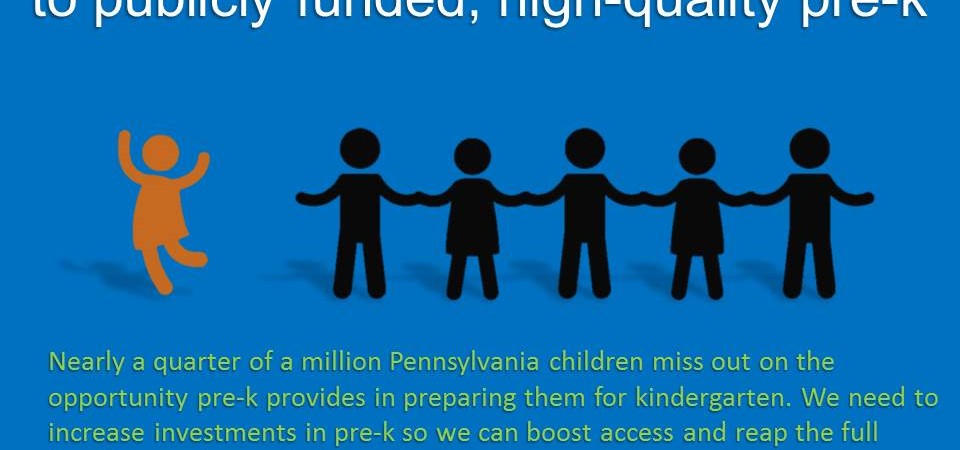
That means nearly a quarter of a million Pennsylvania children are missing out on the once-in-a-lifetime benefits high-quality pre-k provides. This lack of access not only means lost learning opportunities, it also results in additional long-term costs for Pennsylvania’s taxpayers. These issues can be addressed through stronger public investments in high-quality pre-k.
PPC’s report, A Smart Choice for a Solid Start: The Case for Pre-k in PA, details the proven benefits of high-quality pre-k for 3- and 4-year-olds, including stronger academic and social skills in kindergarten and later grades, reduced costs for special education services, and an increased likelihood of high school graduation and better employment opportunities. The report also includes local data showing how many young learners lack access to high-quality pre-k in each of Pennsylvania’s 67 counties.
Pre-k has earned growing support among elected leaders from both major parties, business leaders, and military and law enforcement officials in Pennsylvania and across the country. And most Pennsylvania voters support increased funding for pre-k, even if it means increased taxes.
Yet despite this strong support, Pennsylvania’s investments in high-quality pre-k have not significantly increased in recent years, even as several other states are making or moving toward stronger investments. Most of Pennsylvania’s neighboring states – including Maryland, New Jersey, New York and West Virginia – have higher rates of pre-k participation among 4-year-olds, underscoring the need for Pennsylvania to do more.
GAPreKEval_RDDReport 3-4-2014 (click image to download)
This week, new research came out showing just how much Georgia’s investments are paying off for kids: It found kindergartners who completed Georgia’s pre-k program significantly outperformed students who hadn’t benefitted from pre-k on seven of 10 school readiness skills.
The researchers who conducted the study said their findings “provide strong evidence that Georgia’s Pre‐K provides a beneficial experience for enhancing school readiness skills for all children – boys and girls, those from families of different income levels, and children with differing levels of English language proficiency.”
We’ve seen similar benefits from high-quality pre-k here in Pennsylvania, with 4-year-olds in publicly funded pre-k programs making dramatic gains in academic and social proficiency. Yet only 1 in 6 of the commonwealth’s 3- and 4-year-olds are able to access high-quality, publicly funded pre-k programs, leaving nearly a quarter of a million kids missing out on the once-in-a-lifetime benefits high-quality pre-k provides. Some of them live in your community.
Education is a core issue for Pennsylvania voters. In fact, 41 percent of voters identify education and schools as one of the most important issues for elected officials to focus on, according to recent polling. In working to make our area schools successful, the organization, Pre-K for PA, spans this priority to include more than just students enrolled in PA area public schools.
Officials with Pre-K for PA say the group brings the focus to early childhood education, stating all local children’s accessibility to a voluntary, high quality Pre-K program could change the true trajectory of our schools success and the bottom line, tax payer dollars.
Pre-K for PA brought their initiative to the local area on Thursday, February 27 by holding an open meeting at the Middletown Township Municipal Building, the meeting was attended by various local public service employees and educators. The informal meeting allowed various members from across the community to speak and become involved in the cause.
The focus of the organization and local schools is one simple concept, that children above all circumstances, should arrive in a Kindergarten program, ready and able to learn and succeed. Preparing more children for this outcome by providing all children with a quality, early childhood education program can take the focus of tax payer dollars away from remedial programs.
According to findings by the Committee on Integrating the Science of Early Childhood Development, and the National Research Council and Institute of Medicine, a child’s brain is 90 percent developed by the time a child turns 5, making early childhood education not only significant, but imperative. According to James Harvey, investment in Pre-K saves taxpayers’ money in the long term by reducing the need for special education and remedial instruction, and increasing the rates of graduation and college enrollment.
David E. Baugh, the current Superintendent of Bensalem Township School District, and previous Principal for a school in North Philadelphia, stated that despite the school being located in one of the roughest areas of town, children began Kindergarten ready to learn because of a high quality, Head Start program in the area. “Kids in the area were ready to start school, and were ahead of children in more successful school districts because of this program,” Baugh stated with passion. “I personally, wholeheartedly, believe in the importance of Pre-K and the role it has in the future of the PA economy.”
Pre-K for PA is a nonpartisan coalition made up of a variety of organizations, who see it as their mission to educate the public and the candidates for governor on the importance of quality education for every three and four year old. While Pre-K for PA does not endorse a particular candidate, they see 2014 as a landmark year for progressing the future of early childhood education and have taken it upon themselves to develop a petition, send letters to political candidates, and raise awareness about the importance and the future of all local children’s education.
Republican Governor Tom Corbett is running for re-election and will face the winner of the Democratic primary on November 4. Listed below are the websites for each of the candidates, if you or your organization is interested in joining Pre-K for PA and stressing the importance of early childhood education in the state of Pennsylvania, Pre-K for PA encourages that you reach out to the candidates, telling them to vote in favor of education this fall.
Most parents remember with great amazement and admiration the period when their children were toddlers.
Their young brains are like sponges, we are told. Let them soak up information. Answer questions. Expose them to music and arts. Encourage learning. Start molding them into wonderful people. It’s not too early.
Parents can see this growth occur, and it leads to some outstanding memories. Not only that, it helps shape who those young people will be for the rest of their lives.
Engaged, inquisitive toddlers turn into engaged, inquisitive adults. Learn to learn at a young age, and it will continue for life.
So we were disappointed to hear about a report this week that states that 70 percent of Pennsylvania’s 3- and 4-year-olds don’t have access to high-quality preschool.
Nearly 209,000 young children lack access to pre-kindergarten programs because their families either can’t find or can’t afford it, the Pennsylvania Partnerships for Children found in its new report, “A Smart Choice for a Solid Start: The Case for Pre-k in PA.” Less than 18 percent, or about 53,000 children, are enrolled in publicly funded pre-kindergarten programs statewide.
In Cumberland County, the report estimates that 79 percent of children ages 3 or 4 don’t have access to high-quality preschool — defined as schools involved in Pre-K Counts, Head Start, Keystone STARS, public schools, Pennsylvania Department of Education licensed nursery schools or have accreditations by national associations.
A coalition of 10 nonprofit organizations is trying to ensure every child has the opportunity to attend a strong preschool program and wants lawmakers to devote more resources to early education as they develop the 2014-15 budget.
We wholeheartedly support quality pre-kindergarten programs.
Gov. Tom Corbett’s proposed $29.4 billion 2014-15 budget includes an increase in funding for early education of about $10.8 million, a 3 percent increase over the previous year. The bulk of the increase — $10 million — would go toward the Pre-K Counts program to enroll 1,670 more students.
We want to see improvement in pre-kindergarten programs, and more children involved in them. It’s much easier to start out youngsters on the right track than to get them there later in life.