Early Education Advocates Warn Historic Early Childhood Staffing Shortages will Persist
HARRISBURG, PA (February 6, 2024)–Today, the principal partners of Early Learning Pennsylvania (ELPA), a statewide coalition of advocates focused on supporting young Pennsylvanians from birth to age five, issued the following statements regarding Governor Josh Shapiro’s 2024-25 state budget proposal. ELPA operates four issue-based advocacy campaigns: Pre-K for PA, Start Strong PA, Childhood Begins at Home, and Thriving PA.
Shapiro proposal boosts pre-k rates to begin addressing teacher shortage; work remains
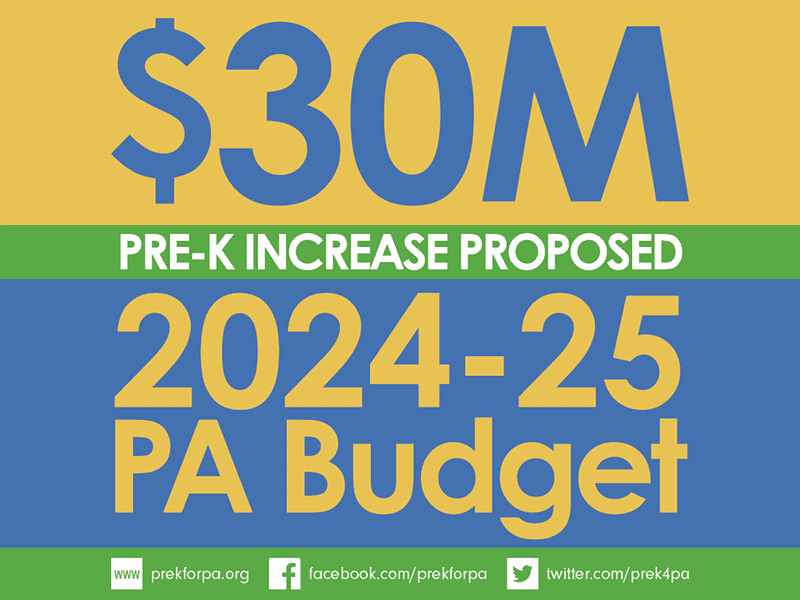
“Pre-K for PA applauds the Administration’s 2024-25 state budget proposal that offers progress for a system struggling with historic teacher staffing shortages exacerbated by wage growth in other sectors. For the state’s publicly-funded pre-k programs, thenearly $33 million in new state funding for Pre-K Counts ($30M) and Head Start Supplemental Assistance ($2.7M) for rate increases will provide much-needed aid to pre-kindergarten providers to combat inflationary pressures and unrelenting staffing shortages.
“Inadequate wages across the early care and education sector are causing pre-k classrooms to close throughout the commonwealth. Pre-k teachers earn roughly half of their (K-5) counterparts in public schools and face the tough choice of staying in their chosen profession as wages increase across other sectors. This investment is a critical first step in closing this gap and ensuring adequate staffing levels to operate state funded pre-k programs at current-funded capacity.
“Currently, 87,000 three-and four-year-olds in Pennsylvania are eligible but do not have access to publicly-funded pre-k programs. Additional investment will be needed in future years to further mitigate teacher shortages in this competitive economy and ensure greater access to this once-in-a-lifetime opportunity for our preschool learners.”
Budget proposal boosts rates for subsidized care; direct action needed to solve historic shortage of child care teachers
“Start Strong PA welcomes the Administration’s proposal to increase the child care subsidy reimbursement rate to the 75th percentile of the current price of child care services. While this increase will alleviate some of the rising facility, food, utility, and supply costs for providers participating in Child Care Works, more will need to be invested to solve the unprecedented teacher shortage occurring throughout the entire system that continues to drive up waitlists for working families.
“Across the country, states are investing in recruitment and retention programs on top of boosting rates for subsidized care to ensure that child care supply can meet the demand from working families. Maine, Florida, Kentucky, and Nebraska all pay at or above the 75th percentile and have made additional investments in recruitment and retention programs to address staffing shortages and stabilize their child care systems.
“A September 2023 survey conducted by The Children’s Hospital of Philadelphia’s Policy Lab showed that a significant statewide shortage of child care workers continues to dramatically reduce the availability of care options for working families. According to the survey of 726 Pennsylvania child care programs (representing 11% of licensed capacity):
- Nearly 26,000 additional children could be served at child care programs if sites were fully staffed.
- Providers reported 2,395 open positions, resulting in the closure of 934 classrooms.
- Child care providers’ inability to recruit and retain staff is having a direct impact on the quality of their programming.
“Start Strong PA encourages Governor Shapiro and the General Assembly to tackle the child care teacher shortage head-on by establishing a program that will help providers better recruit and retain their staff. Pennsylvania’s economy depends on working families and working families depend on child care.”
Home visiting campaign concerned flat funding will lead to fewer young children, families and pregnant women being served
“Childhood Begins at Home is concerned the proposed 2024-25 budget does not account for the anticipated loss of one-time federal stimulus funds that were included in the Community-Based Family Center line (in DHS) as part of the 2023-24 final budget. Further, the proposal does not recognize the impact of federal sequestration on discretionary spending, including home visiting, due to Congressional action last year. The state rightfully included funds to offset sequestration in previous budgets, including $1million in funding in the 2020-21 final budget.
“Without any assurance that the state will sustain funding to backfill for expired stimulus funds and administrative cuts due to sequestration, we worry this ultimately will mean fewer home visiting services will be provided in Pennsylvania next year. Even more sobering is that only 7 percent of children under age 6 living in low-income households statewide currently receive voluntary, evidence-based home visiting services.
“Home visitors are supportive partners who build a trusting relationship with families and help guide them through the early stages of having and raising a child. The evidence-based models show positive outcomes, from improving health for both children and adults to achieving economic self-sufficiency to reducing child maltreatment. Childhood Begins at Home will continue to work with policymakers in the legislature and the administration to ensure Pennsylvania does not unnecessarily see a reduction in families receiving and benefiting from evidence-based home visiting services.”
Budget proposal sustains current Early Intervention program
“Early Intervention is a critical part of the Thriving PA campaign, and the governor’s proposal includes an increase of $16.7 million for Early Intervention Part C (infants and toddlers) in the Department of Human Services budget to maintain the current program and an increase of $17 million for Early Intervention Part B (age three to five) in the Department of Education budget to serve additional children. All children birth through age five with developmental delays, regardless of family income level, must be identified, referred to, and provided needed services so that they and their families reach their fullest potential.
“Thriving PA urges policymakers to build on this proposal and ensure an investment would provide for a long-needed rate adjustment for Early Intervention providers and serve additional children. Additional support would help to address key issues in the sector, including workforce shortages, achieving equitable enrollment, and addressing the growing needs of families across the Commonwealth. National data shows that not all children who are eligible to participate in Early Intervention do so.”
Governor Shapiro’s State Budget Proposal Includes:
- $32.478 million in additional funding for the state’s Pre-K Counts program.
- $2.7 million in additional funding for the Head Start Supplemental Assistance Program.
- $31.709 million in additional funding for child care ($29.331 million in Child Care Services and $2.378 million in Child Care Assistance).
- Level funding for evidence-based home visiting in the Community-Based Family Center line item and a minor reduction in the Nurse-Family Partnership line item to adjust for federal matching rates.
- $16.7 million increase for the Early Intervention Part C (infant and toddler) program through DHS.•$17 million increase for the Part B Early Intervention program (age three to five) through PDE.
About Pre-K for PA
Pre-K for PA launched in 2014 with the vision that every 3-and 4-year-old in Pennsylvania will have access to high-quality pre-k. Learn more at www.prekforpa.org.
About Start Strong PA
Start Strong PA launched in 2019 to support healthy child development, working families, and the economy by increasing access to and affordability of high-quality child care programs for young children. Learn more at www.startstrongpa.org.
About Childhood Begins
At HomeChildhood Begins AtHome is a statewide campaign launched in 2017 to help policymakers and the public understand the value of evidence-based home visiting and support public investments in the programs. Learn more at www.childhoodbeginsathome.org.
About Thriving PA
Thriving PA is a perinatal and child health campaign launched in 2021 and is working to ensure each birthing person, infant, and toddler in Pennsylvania has the opportunity for affordable, quality health care access. Learn more at www.thrivingpa.org.

HARRISBURG, PA (July 6, 2023) – Today, the principal partners of Early Learning Pennsylvania (ELPA), a statewide coalition of advocates focused on supporting young Pennsylvanians from birth to age five, issued the following statements regarding House Bill 611 that still awaits the signature of the Senate President Pro Tempore and finally Governor Shapiro to become the enacted 2023-24 Pennsylvania state budget. ELPA operates four issue-based advocacy campaigns: Pre-K for PA, Start Strong PA, Childhood Begins at Home and Thriving PA.
First Budget in a Decade to Not Expand Pre-K Counts and State Funding for Head Start
“The Pre-K for PA campaign is deeply disappointed by the failure to expand the state’s publicly funded pre-k programs – PA Pre-K Counts and the Head Start Supplemental Assistance Program. When nearly 90,000 eligible 3- and 4-year-olds do not have access to these once-in-a-lifetime early learning opportunities, and pre-k and Head Start programs can’t keep teachers in their classrooms because of inadequate reimbursement rates, this budget bill is simply unacceptable.
“Public investment in high-quality pre-k has historically been a consensus issue in Pennsylvania; aligning political parties, rural, urban and suburban communities, and families across the commonwealth on a once-in-a-lifetime opportunity that improves the life chances of Pennsylvania’s children. In fact, a February 2023 Susquehanna Polling and Research poll showed that 98% of PA voters believe that early learning is important, and 78% of PA voters support increasing state funding to serve more eligible children in pre-k programs, which was an increase from 65% in 2022.
“Unfortunately, HB 611 is a noticeable departure from a decade of growing investment in high-quality pre-k and threatens the stability of the early care and education sector and the futures of the 90,000 young children that lack access.
“With no new funding and all PA Pre-K Counts contracts up for renewal as part of a complete competitive rebid in FY 2023-24, Pre-K for PA urges the Shapiro Administration to maintain (to the greatest degree possible) the current per county slot allocation to ensure stability in access for our youngest learners.”
Budget Fails to Address Historic Labor Shortage; Continues Child Care Crisis Impacting Working Families
“With a child care sector that is on the brink of collapse, the Start Strong PA Campaign is shocked by the lack of investment to address the child care teacher shortage in the state budget bill. Policymakers ignored calls from chambers of commerce, working parents, child care providers, military leaders and others to stabilize the sector by investing in child care wages. Failing to invest in the workforce, which supports all other sectors, will continue to harm the commonwealth’s children, working families and the overall economy.
“HB 611 currently allocates slightly more than $100 million in new state funding to maintain the status quo in the child care system. This includes supporting the current child care subsidy caseload and utilization, as well as maintaining the increase in subsidy rates as one-time federal funding lapses. While maintaining the 60th percentile of market rates is important to help alleviate inflationary pressures on child care providers, it has not stabilized the child care workforce. This maintenance of effort of the subsidy system is simply woefully inadequate given the scale of the commonwealth’s child care crisis.
“Across Pennsylvania, child care providers are closing classrooms and entire programs due to this historic child care teacher shortage. According to a February 2023 Start Strong PA survey of more than 1,000 child care providers across the state, 85% of responding providers had open and unfilled positions amounting to more than 3,600 open staff positions resulting in 1,500 closed classrooms, and a combined waitlist of more than 35,000 children.
“Low wages within the child care sector are driving this staffing shortage. The average wage of a Pennsylvania child care teacher is less than $12.50/hour. At this earning potential, 21 percent of the child care workforce relies upon Medicaid for their health care coverage and SNAP to put food on the table. There is no county in the commonwealth where this wage covers the cost of living.
“For families with young children, access to child care is a critical factor in their ability to go to work and ensure their children are in a safe and nurturing environment. Nearly 70 percent of all households with children younger than age 6 have all available caregivers in the workforce—that’s over 537,000 households.
“For all other business sectors, the child care sector is the workforce behind the workforce. When families can’t get child care, their children suffer, their income drops and the state’s economy is shortchanged. In a time of severe labor shortages and billions in state budget surplus, the commonwealth’s failure to ensure parents have access to child care is a tragic outcome.
“For all Pennsylvanians, when businesses aren’t fully staffed, or staff are unreliable due to lack of child care, they cannot produce goods or provide services, creating shortages and increasing prices. So, whether one has young children or not, Pennsylvania’s child care crisis should matter to all of us.”
Infant and Toddler Early Intervention and Maternal Health Increases Included in Budget
“The budget bill also contains an increase of $15.4 million for Infant and Toddler (Part C) Early Intervention in the Department of Human Services budget. This is short of Governor Shapiro’s March budget proposal, which called for a $20.2 million increase. While the additional $15.4 million will serve more children and sustain a rate increase initially achieved through one-time federal stimulus funding, Thriving PA is disappointed more was not done to support the Early Intervention system holistically. This includes solutions to address workforce shortages needed to create a viable and sustained service delivery platform.
“Additionally, Preschool (Part B) Early Intervention received a $10.4 million increase in the Department of Education budget, which was what Governor Shapiro included in his March request.
“A $2.3 million increase in the Department of Health budget was included in HB 611 in order to implement recommendations included in the Maternal Mortality Review Commission report. Thriving PA appreciates support for these funds, which will help address maternal mortality and morbidity in Pennsylvania.”
In summary, House Bill 611, which still awaits the signature of the Senate President Pro Tempore and finally Governor Shapiro to become the enacted 2023-24 Pennsylvania state budget, includes:
- Level funding for the state’s Pre-K Counts program.
- Level funding for the Head Start Supplemental Assistance Program.
- Increase of $103,747,000 to maintain the status quo in the child care subsidy program (increases of $13,370,000 million for the state Child Care Assistance line item and $90,377,000 million for the Child Care Services line item).
- Level-funding for evidence-based home visiting in the Community-Based Family Center line item and $25,000 for the Nurse-Family Partnership line item, which is a technical adjustment from previously enhanced federal matching funds.
- $15.4 million for the Early Intervention Part C (infants and toddlers) program through DHS.
- $10.4 million for the Early Intervention Part B (age-three-to-five) program through PDE.
About Pre-K for PA
Pre-K for PA launched in 2014 with the vision that every 3- and 4-year-old in Pennsylvania will have access to high-quality pre-k. Learn more at www.prekforpa.org.
About Start Strong PA
Start Strong PA launched in 2019 to support healthy child development, working families, and the economy by increasing access to and affordability of high-quality child care programs for young children. Learn more at www.startstrongpa.org.
About Childhood Begins At Home
Childhood Begins At Home is a statewide campaign launched in 2017 to help policymakers and the public understand the value of evidence-based home visiting and support public investments in the programs. Learn more at www.childhoodbeginsathome.org.
About Thriving PA
Thriving PA is a perinatal and child health campaign launched in 2021 and is working to ensure each birthing person, infant, and toddler in Pennsylvania has the opportunity for affordable, quality health care access. Learn more at www.thrivingpa.org.
Early Care and Education in Governor Shapiro’s 2023-24 State Budget Proposal
HARRISBURG, PA (March 7, 2023) – Today, the principal partners of Early Learning Pennsylvania (ELPA), a statewide coalition of advocates focused on supporting young Pennsylvanians from birth to age five, issued the following statements regardingGovernor Josh Shapiro’s 2023-24 state budget proposal. ELPA operates four issue-based advocacy campaigns: Start Strong PA,Pre-K for PA, Childhood Begins at Home and Thriving PA.
Budget Proposal “Maintains” Child Care System in Crisis
“Governor Shapiro correctly emphasized the importance of high-quality child care for working families and the need to boost childcare wages to get “more teachers and professionals on the job,” and eliminate growing wait lists. Unfortunately, the Administration’s$66.7 million proposal merely maintains a system already in crisis.
“The proposal continues subsidized child care access to 75,000 low-income working families and sustains Child Care Works reimbursements to meet or exceed base rates at the 60th percentile of the market rate for a child care provider’s region. This represents a continuation of the current child care operating environment that has been in place since January 2022 after utilizing one-time federal funds to boost rates. Since that time, conditions within the system have not improved, in fact, wait lists have increased.
“Currently, Pennsylvania’s child care system is experiencing a 4,000 person workforce shortfall resulting in more than 35,500 children sitting on wait lists making it difficult for parents to work.
“The average child care teacher earns less than $12.50/hr. with approximately 21 percent of those child care teachers relying on SNAP benefits and 21 percent insured by Medicaid. As many of these staff are college educated, it’s no surprise that nearly 50 percent of educators surveyed say they are unlikely to remain in their child care jobs. Without a direct investment in the child care sector’s workforce, this crisis will continue and is likely to mean that more classrooms will close and more working parents will struggle to find care for their children.
“The child care crisis is costing working families, employers, and taxpayers $6.65 billion annually in lost wages, productivity and revenue. Fortunately, child care is an issue that crosses over the political divide with 81 percent of Pennsylvania voters in favor of allocating state funding to increase wages of child care workers and 78 percent percent of voters supporting an increase in state funding to help more low-income working families afford high-quality child care.
“The PA House and Senate must build on what’s been proposed by Governor Shapiro and not simply maintain a system that is currently in crisis but invest more, prioritizing the sector’s workforce to get ahead of this staffing shortage. Pennsylvania businesses depend on working families and working families depend on child care.”
Shapiro Proposal Boosts Pre-K Counts / Head Start Supplemental Assistance Program Rates In Effort to Combat TeacherShortage / Stops Short of Expanded Access
“Governor Shapiro’s first budget proposal begins to address the growing shortage of pre-kindergarten and Head Start teachers by including a $33 million increase to boost cost per child reimbursement rates in the 2023-24 budget. Specifically, the proposal would add $30 million in new funding for the Pre-K Counts program to increase rates by approximately $1,000 per child (full-day) / $500 per child (part-day) and $3 million in new funding for the Head Start Supplemental Assistance Program to also increase the cost per child rate. This funding is intended to further support pre-kindergarten providers in combating rising inflation and address increasing staffing shortages. It is worth noting, however, that the classroom closures and teacher shortages resulting from low wages found in the child care sector is also impacting pre-k availability because 48 percent of the children served in Pre-K Counts classrooms are located in high-quality child care centers.
“As part of his budget address, the Governor also noted the importance of giving Pennsylvania children a “ladder up” through pre-k. Unfortunately, this budget proposal does not provide the resources necessary to expand publicly-funded pre-k opportunities tomore of the 100,000 Pennsylvania children that are eligible but not served.
“The General Assembly should respond to the 78 percent of Pennsylvania voters that supported increasing state funding to serve more eligible children in pre-k programs by building on the Governor’s proposal and expanding pre-k access.”
Sustained Funding in Home Visiting Appropriate Following Historic Increase in 2022
“Following last year’s historic budget increase for evidence-based home visiting, the Childhood Begins at Home campaign appreciates the continued funding in the proposal. Voluntary, evidence-based home visiting programs mentor parents and others raising children and provide supports for child development and school readiness, child health, family economic self-sufficiency, linkages and referrals, maternal health, positive parenting practices, reductions in child maltreatment and reductions in juvenile delinquency, family violence and crime.
“While there is a large unmet need for services with only 5 percent of eligible pregnant women, young children and families currently receiving them, we acknowledge increased access must be done in a manner that home visiting programs can effectively implement.”
Budget Address Emphasizes the Importance of Referral Services for Young Children
“All children birth through age five with developmental delays must be identified, referred to and accepted for the services they need to reach their fullest potential. The proposed state budget includes a needed investment in Early Intervention services with an increase of $10.4 million for the Early Intervention Part B (age three to five) program in the Department of Education (PDE) budget and a $20million increase for Early Intervention Part C (infants and toddlers) program in the Department of Human Services (DHS) budget.Thriving PA welcomes both of these proposed increases.”
Governor Shapiro’s State Budget Proposal Includes:
- $30 million in additional funding for the state’s Pre-K Counts program to boost reimbursement rates by nearly $1,000 per child (full-day)/ $500 per child (part-day).
- $3 million in additional funding for the Head Start Supplemental Assistance Program to boost cost per child.
- $66.7 million in new funding for the state’s Child Care Services line item to maintain subsidized child care access to 75,000low-income working families and sustain Child Care Works reimbursements to meet or exceed rates at the 60th percentile of the market rate for child care facilities.
- Level funding for evidence-based home visiting in the Community-Based Family Centers line item as well as level funding for the Nurse Family Partnership line item.
- $10.4 million increase for the Part B Early Intervention program (age three to five) offered through PDE.
- $20 million increase funding for the Early Intervention Part C (infant and toddler) program through DHS.
- $2.3 million increase to expand Maternal Health Programing, implementing strategies outlined by the MaternalMortality Review Committee (MMRC).
About Start Strong PA
Start Strong PA launched in 2019 to support healthy child development, working families, and the economy by increasing access to and affordability of high-quality child care programs for young children. Learn more at www.startstrongpa.org.
About Pre-K for PA
Pre-K for PA launched in 2014 with the vision that every 3- and 4-year-old in Pennsylvania will have access to high-quality pre-k. Learn more at www.prekforpa.org.
About Childhood Begins At Home
Childhood Begins At Home is a statewide campaign launched in 2017 to help policymakers and the public understand the value of evidence-based home visiting and support public investments in the programs. Learn more at www.childhoodbeginsathome.org.
About Thriving PA
Thriving PA is a perinatal and child health campaign launched in 2021 and is working to ensure each birthing person, infant, and toddler in Pennsylvania has the opportunity for affordable, quality health care access. Learn more at www.thrivingpa.org.
###
2022-23 State Budget: Growth for Pre-k, Child Care and Home Visitation
Budget deal stops short of recurring funds to raise child care wages
HARRISBURG, PA (July 8, 2022) – Today, the principal partners of Early Learning Pennsylvania (ELPA), a statewide coalition of advocates focused on supporting young Pennsylvanians from birth to age five, issued the following statements regarding the final 2022-23 Pennsylvania state budget. ELPA operates four issue-based advocacy campaigns: Pre-K for PA, Start Strong PA, Childhood Begins at Home and Thriving PA.
Budget Expands Pre-K Access and Boosts Rates for Providers
“The Pre-K for PA campaign applauded the Pennsylvania General Assembly and Governor Wolf for once again expanding state funding for high-quality pre-k. The 2022-23 state budget includes $60 million in new state funding for PA Pre-K Counts and $19 million for PA’s Head Start Supplemental Assistance Program. Over the past eight years, investment in these critical early learning programs have increased by nearly 180%, serving tens of thousands more eligible children.
“Public investment in high-quality pre-k has become a consensus issue in Pennsylvania; aligning political parties, rural, urban and suburban communities, and families across the commonwealth on a once-in-a-lifetime opportunity that improves the life chances of Pennsylvania’s children. State leaders including Governor Wolf and Senator Pat Browne deserve recognition for their role in Pennsylvania’s continued expansion of Pre-K for PA. According to a recent poll, 90% of likely Pennsylvania voters said that formal early childhood care and education are important in helping set kids on a path toward leading healthy and productive lives.
“The $79 million expansion will provide high-quality pre-k to over 2,300 additional young learners as well as increase rates for providers to support the early care and education workforce and address rising costs. The Pre-K for PA campaign thanks our more than 20,000 supporters for lending their voices to advance the power of pre-k to more of Pennsylvania’s youngest learners.”
Budget Utilizes One-Time Funds to Stabilize Child Care Workforce
“The Start Strong PA Campaign appreciates the General Assembly’s effort to stabilize child care programs by including $90 million in one-time discretionary American Rescue Plan Act federal funding to support bonuses for child care staff. These funds will provide desperate child care programs the short-term solutions they need to alleviate the workforce recruitment and retention crisis.
“Unfortunately, this budget misses the opportunity to provide long-term solutions to the tens of thousands of families who are struggling to find child care to return to work, as it fails to address the root cause of Pennsylvania’s devastating child care crisis – a history of low wages, resulting in thousands of open staffing positions and more than 1,600 closed classrooms. Currently there are 32,400 children sitting on waiting lists in child care programs as a result of 7,000 vacant child care staffing positions statewide.
“Even though child care professionals have a significant impact on our children, their families, and our economic recovery, they make, on average, less than $11.00 an hour. This budget does nothing to raise child care wages on an on-going basis to help solve for this systemic issue. It is not surprising that this industry, with 50% of professionals who work in it qualifying for government benefits, cannot compete for staff with other industries offering higher wages for less specialized skills.
“This budget also increases state child care funding by $25 million, allowing families currently enrolled in Child Care Works to continue receiving a child care subsidy up to 300% of poverty. These new funds should also have the flexibility to support the 160,978 children younger than age 5 who are eligible but have yet to be served. Start Strong PA partners have long encouraged the state to advertise Child Care Works to ensure every family who needs the financial support is aware and thus able to enroll their children in child care.
“Sadly, Pennsylvania’s elected leadership has fallen short on ensuring the availability of sustainable child care funds to stabilize the industry. Without a stabilized child care system, families will continue to struggle to find and afford high-quality child care significantly impacting their ability to return to work and remain employed.”
Budget Makes Historic Investment in Evidence-Based Home Visiting
“Childhood Begins at Home is pleased with the historic increase of $15 million for evidence-based home visiting in the Department of Human Services budget to serve an additional 3,800 pregnant women, children and families. In addition, $1 million is earmarked for the Nurse-Family Partnership line item to serve 200 more families.
“Voluntary, evidence-based home visiting programs mentor parents and others raising children and provide supports to address substance use disorders, develop school readiness, improve maternal and child health, promote economic self-sufficiency, and reduce abuse and neglect.
“Policymakers made a wise decision to diversify funding and meet families where they are in counties across the state so more parents and their children can access the research-proven benefits the home visiting models deliver.
“With this investment, we can increase service levels beyond the 5% of Pennsylvania families currently served.”
Funding Increases Included for Early Intervention Programs
“Our campaign is pleased the budget includes an increase of $9.3 million for the Early Intervention Part C (infants and toddlers) program in the Department of Human Services budget. Some budget documents show an increase of $12.2 million, which is also accurate, as it does not include additional stimulus dollars. The Early Intervention Part B (age-three-to-five) program in the Department of Education budget is receiving a $10 million increase.”
In summary, the final 2022-23 Pennsylvania state budget included:
- $60 million in additional funding for the state’s Pre-K Counts program, which will serve over 2,300 additional young children.
- $19 million in additional funding for the Head Start Supplemental Assistance Program.
- Level funding for the state Child Care Assistance line item.
- $25 million in Child Care Services specifically to serve families currently enrolled in Child Care Works up to 300% of poverty or the state median income (whichever is lower).
- $90 million in federal funding to provide one-time child care staff recruitment and retention bonuses.
- $15 million in additional funding for evidence-based home visiting in the Community-Based Family Center line item and $1 million for the Nurse-Family Partnership line item.
- $9.3 million for the Early Intervention Part C (infants and toddlers) program through DHS (this figure also appears as $12.2 million when stimulus dollars are not included).
- $10 million for the Early Intervention Part B (age-three-to-five) program through PDE.
- Creation of a Pennsylvania Child Care Tax Credit equal to 30% of the federal credit to support working families.
About Pre-K for PA
Pre-K for PA launched in 2014 with the vision that every 3- and 4-year-old in Pennsylvania will have access to high-quality pre-k. Learn more at www.prekforpa.org.
About Start Strong PA
Start Strong PA launched in 2019 to support healthy child development, working families, and the economy by increasing access to and affordability of high-quality child care programs for young children. Learn more at www.startstrongpa.org.
About Childhood Begins At Home
Childhood Begins At Home is a statewide campaign launched in 2017 to help policymakers and the public understand the value of evidence-based home visiting and support public investments in the programs. Learn more at www.childhoodbeginsathome.org.
About Thriving PA
Thriving PA is a perinatal and child health campaign launched in 2021 and is working to ensure each birthing person, infant, and toddler in Pennsylvania has the opportunity for affordable, quality health care access. Learn more at www.thrivingpa.org.
Early Care and Education in Governor Wolf’s 2022-23 State Budget Proposal
HARRISBURG, PA (February 9, 2022) – Today, the principal partners of Early Learning Pennsylvania (ELPA), a statewide coalition of advocates focused on supporting young Pennsylvanians from birth to age five, issued the following statements regarding Governor Tom Wolf’s 2022-23 state budget proposal. ELPA operates four issue-based advocacy campaigns: Pre-K for PA, Start Strong PA, Childhood Begins at Home and Thriving PA.
Wolf Proposal Continues to Expand Pre-K Access
Pre-K for PA applauds the $60 million state funding increase for Pre-K Counts and $10 million increase for Head Start Supplemental Assistance as proposed by Gov. Wolf in the 2022-23 state budget. This funding continues the commonwealth’s tradition and Gov. Wolf’s unwavering commitment of expanding access to high-quality pre-k. This $70 million proposal expansion could provide this once-in-a-lifetime opportunity to more than 2,300 additional young learners.
Research shows that high-quality pre-k benefits children’s cognitive, social, and emotional development and confirms the commonwealth’s investment in pre-k pays dividends for the children fortunate enough to access it. This investment is not only essential for our children, but high-quality early education supports labor force participation, healthy families and a globally competitive workforce of the future. By increasing pre-k access and opening the door to more families, our economic recovery reaps the benefits.
Pre-K for PA now urges the legislature to include the full $70 million for high-quality pre-k in the state budget— Pennsylvania’s youngest learners depend on it.
Budget Proposal Fails to Adequately Invest in Child Care
The Wolf Administration’s budget proposal is an inadequate response to the current child care crisis and misses an important opportunity to help working families in search of affordable high-quality care. Furthermore, failure to fully stabilize the child care sector jeopardizes the efforts of Pennsylvania businesses trying to rehire their labor force. Child care programs are closing classrooms and entire facilities due to teacher and staff shortages. Child care staff are overworked and underpaid with the average child care teacher making less than $11 per hour.
The Governor’s budget proposal does utilize federal funds to sustain the current fiscal year’s child care subsidy rate increase, reduction in parent co-payments and incentives for providing non-traditional hour care. While these steps are important, they are not sufficient, especially in light of flat funding for Pennsylvania’s Child Care Services and Child Care Assistance line items for the third consecutive year.
Start Strong PA urges state policymakers to allocate a portion of the projected year-end surplus of $2.8 billion to address staff recruitment and retention and increase access to quality care for working families, specifically for infants and toddlers.
Governor’s Home Visiting Proposal Marks Recommitment to Investments
Childhood Begins at Home is pleased with the $15 million increase for home visiting in the Department of Human Services (DHS) budget to serve an additional 3,800 pregnant women, children, and families. Voluntary evidence-based home visiting, funded in part by the Community-Based Family Center line, is backed by decades of research. The programs have been a lifeline for families in every legislative district during the pandemic.
The six state-funded models that deliver evidence-based home visiting are currently competitively applying for contracts as part of Pennsylvania’s Family Support Programs, which is a crucial part of the equation in serving more families. Following two years of level funding, the campaign is pleased to see Gov. Wolf’s proposed investment that restarts his commitment to increasing service levels beyond the 5% of Pennsylvania families currently served.
Address Highlights Importance of Perinatal and Child Health
When mothers are healthy, children are healthy. That is why ensuring individuals have access to insurance before, during, and after their baby’s birth is vitally important and can have lasting impacts on health outcomes. The proposed state budget includes funding to expand the postpartum coverage period in Medicaid from 60 days to 12 months, which the Thriving PA campaign welcomes. Medicaid is a significant source of insurance for Pennsylvania women and birthing individuals— especially for women of color— so expanding coverage to a full year postpartum is a vital step towards closing racial and health disparities.
Additionally, we must ensure all children birth through age five with developmental delays are identified, referred to and accepted for the services they need to reach their fullest potential. The proposed state budget includes an increase of $11.5 million for the Early Intervention Part C (infant and toddler) program in the Department of Human Services budget, which includes $1.2 million to specifically add an eligibility category for tracking children in early intervention with mothers who screen positive for maternal depression or anxiety. The Early Intervention Part B (age three to five) program in the Department of Education (PDE) budget is level-funded in the governor’s proposal.
Governor Wolf’s state budget proposal included:
- $60 million in additional funding for the state’s Pre-K Counts program.
- $10 million in additional funding for the Head Start Supplemental Assistance Program. Together, this $70 million expansion could serve approximately 2,300 additional young children.
- Level funding for the state Child Care Assistance and Child Care Services line items.
- $77.7 million in federal funding to sustain child care subsidy base rates.
- $44.3 million in federal funding to sustain the reduction in out-of-pocket family co-payments.
- $6.1 million in federal child care funding to sustain the incentive for providing non-traditional hour care.
- $30 million in state funding to provide state employees with increased access to and affordability of child care through the Department of General Services.
- $15 million in additional funding for evidence-based home visiting in the Community-Based Family Center line item as well as $8 million in one-time federal stimulus funds specified for home visiting.
- Funding allocated for postpartum coverage extension for women in Medicaid from 60 days to 12 months.
- $11.5 million in increased funding for the Early Intervention Part C (infant and toddler) program through DHS, with $1.2 million allocated for children eligible for tracking when their mothers have a positive screen for postpartum depression or anxiety.
- Level-funding for the Part B Early Intervention program (age three to five) offered through PDE.
About Pre-K for PA
Pre-K for PA launched in 2014 with the vision that every 3- and 4-year-old in Pennsylvania will have access to high-quality pre-k. Learn more at www.prekforpa.org.
About Start Strong PA
Start Strong PA launched in 2019 to support healthy child development, working families, and the economy by increasing access to and affordability of high-quality child care programs for young children. Learn more at www.startstrongpa.org.
About Childhood Begins At Home
Childhood Begins At Home is a statewide campaign launched in 2017 to help policymakers and the public understand the value of evidence-based home visiting and support public investments in the programs. Learn more at www.childhoodbeginsathome.org.
About Thriving PA
Thriving PA is a perinatal and child health campaign launched in 2021 and is working to ensure each birthing person, infant, and toddler in Pennsylvania has the opportunity for affordable, quality health care access. Learn more at www.thrivingpa.org.
HARRISBURG, PA (June 25, 2021) – The principal partners of Early Learning Pennsylvania (ELPA), a statewide coalition of advocates focused on supporting young Pennsylvanians from birth to age five, believes the commonwealth’s economic recovery hinges on helping working families by prioritizing greater state investments in high-quality pre-k, child care and evidence-based home visiting. ELPA operates four issue-based advocacy campaigns: Pre-K for PA, Start Strong PA, Childhood Begins at Home and Thriving PA. Reaction statements from three of these campaigns regarding the FY 2021-22 state budget follow:
PRE-K
“Pre-K for PA applauds the $25 million in new state funding for Pre-K Counts and $5 million for Head Start Supplemental Assistance as part of the 2021-22 PA State Budget. This funding continues the commonwealth’s tradition of expanding access to high-quality pre-k – providing this once-in-a-lifetime opportunity to more than 3,200 additional young learners.
“Research shows that high-quality pre-k benefits children’s cognitive, social and emotional development. A new study by the University of North Carolina Chapel Hill confirmed that the commonwealth’s investment in pre-k pays dividends for the children fortunate enough to access pre-k through the Pre-K Counts program. In language and math skills, the study showed that these kids outperformed their kindergarten peers who did not enjoy access—an advantage that equated to four to five months of learning gains. Even with this budget increase, more than 100,000 eligible three- and four-year-olds still lack access to high-quality pre-k.”
CHILD CARE
“The General Assembly and the Wolf Administration unfortunately missed the opportunity to prioritize families who are struggling to return to work. Ignoring recommendations developed with input from over 1,000 child care providers and parents, Pennsylvania’s elected leadership has fallen significantly short on ensuring American Rescue Plan child care funds are used to help families find and afford high-quality child care and to stabilize the industry.
“Given that 70% of Pennsylvania children under the age of five had all adults in their household in the labor force prior to the pandemic, high-quality child care is an essential workforce support. That workforce must be able to return to work for Pennsylvania to recover from the pandemic’s economic devastation.
“We now call on the Wolf Administration to prioritize and implement our recommendations for Pennsylvania’s $1.2 billion in American Rescue Plan child care funding. With nearly 700 child care programs permanently closed and over 350 temporarily closed, families are struggling to find child care. Those child care providers that have managed to stay open are still incurring additional pandemic-related costs while operating significantly under capacity and are struggling to attract and retain teachers.
“Not only is there less child care capacity in the system, only 42% of certified child care capacity currently meets high-quality standards. And only 39% of infants and toddlers that receive subsidized care attend programs that have met high-quality standards. High-quality care and education mean safer, healthier children and are critical to maximizing the period of a child’s most rapid brain growth.
“Start Strong PA’s recommendations for American Rescue Plan child care funding will stabilize, strengthen and ultimately secure the child care industry. This industry is critical to the success of our economic recovery.”
EVIDENCE-BASED HOME VISITING
“On behalf of the pregnant women, children, and families who would benefit the most from evidence-based home visiting – especially those disproportionately impacted by the pandemic – Childhood Begins at Home is dismayed that there is no increase in the state budget for these voluntary services backed by decades of research.
“Without funding increases to reach more Pennsylvania families, the unmet need remains at a staggering 95%. The Community-Based Family Centers line will be level-funded, and the Nurse-Family Partnership line will receive a minimal increase to restore the line to its prior level due to a slight reduction resulting from the state using enhanced Federal Medical Assistance Percentage (FMAP) funding last year.
“Throughout budget negotiations, policymakers emphasized the infusion of federal stimulus dollars to inform state spending decisions. Of the total amount of one-time state funds Pennsylvania received from the American Rescue Plan ($7.3 billion), home visiting gets less than .02% (or a paltry $1.3 million) through the Maternal, Infant, and Early Childhood Home Visiting (MIECHV) Program. This funding has yet to be distributed to programs that received no aid during the COVID-19 pandemic, and is limited in its use and timeframe to spend these dollars.
“Only pennies on the dollar for evidence-based home visiting are coming in federally. It adds insult to injury that policymakers in the legislative and administrative branches did not step up and recognize constituents would benefit from the same services that have been a lifeline for so many during the last 15 months.
“While states’ use of the ARP funds is flexible, the federal stimulus funding for evidence-based home visiting would not even reach one family in each of Pennsylvania’s 253 legislative districts.
“From birth to age five, brain growth is rapid, learning is happening, and our coalition of advocates is committed to ensuring that families can access it in high-quality, developmentally appropriate settings. In Pennsylvania, funding has not been prioritized to ensure the resources are there to offer these irreplaceable opportunities, creating deep inequity among children and their families at a very early age. We, and our tens of thousands of supporters, will continue to urge lawmakers to invest in early learning boldly – it is an urgent necessity.”