Pennsylvania Capital Star: Pennsylvania’s kindergarten teachers ask state lawmakers for more pre-K funding
May 29, 2019 by Elizabeth Hardison
The fight to secure more funding for high-quality early education in Pennsylvania has a new ally: the state’s kindergarten teachers.
A survey by the Pennsylvania State Education Association found nearly unanimous support for publicly funded pre-kindergarten education among the union’s members who teach children that age.
The results were released Tuesday by Pre-K for PA, a coalition of educators and education advocates that seeks to expand access to early education programs for Pennsylvania’s preschool-age children.
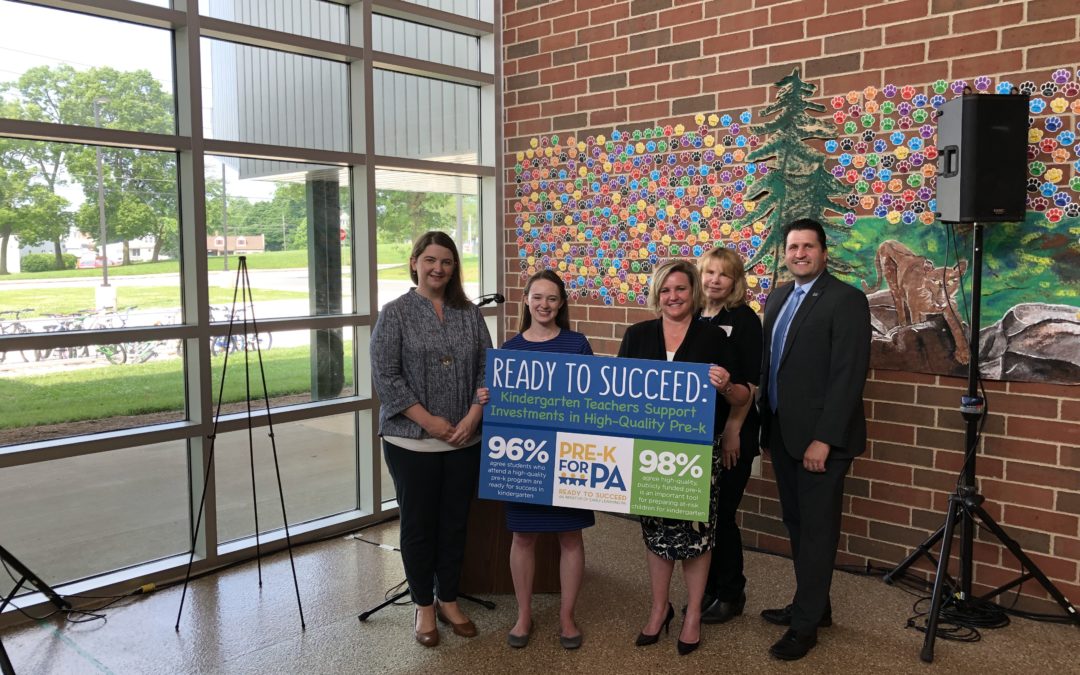
Members of the campaign appeared at Hamilton Elementary School in Carlisle, Cumberland County on Tuesday to tout the findings of the survey and call for additional funding for early education programs.
Ninety-six percent of the teachers surveyed by PSEA agree that students who attend pre-K are more prepared for kindergarten, they said. In addition, 98 percent said that high-quality, publicly funded pre-K is an important tool for preparing at-risk children for kindergarten.
A report that detailed the results did not disclose the survey’s methods or sample size.
According to a state Department of Education report, more than 115,000 children living in deep poverty did not have access to publicly funded pre-k programs in the 2016-17 school year.
Teachers say that children who arrive in kindergarten without pre-K experience have lower literacy and emotional readiness than their peers who did attend pre-K.
Read the full article here.
Kindergarten Teachers Survey Backs Research Showing Social-Emotional Benefits of High-Quality Pre-K
Report Highlights Unmet Need and Makes Case for Funding Increases for
High-Quality Pre-K in the 2019-20 State Budget
Harrisburg, PA (May 28, 2019)—The Pre-K for PA Campaign today released Ready to Succeed: Kindergarten Teachers Support Investments in High-Quality Pre-k, a report based on findings of a survey conducted with campaign partner the Pennsylvania State Education Association (PSEA), seeking the perceptions of kindergarten members about the role that access to high-quality, publicly funded pre-k plays in school readiness.
PSEA Treasurer Jeff Ney says the results show resounding support for high-quality pre-k among those surveyed, with 96 percent of elementary school teachers agreeing that students who attend a high-quality pre-k program are ready for success in kindergarten, and 98 percent agreeing that high-quality, publicly funded pre-k is an important tool for preparing at-risk children for kindergarten.
“Phrasing quality pre-k as ‘an important tool’ was intentional in this survey,” Ney said. “Kindergarten teachers know and understand that a quality pre-k experience provides each child entering kindergarten with a growth mindset and a readiness to succeed. Their personal experiences mirror what researchers have uncovered – that children who attend high-quality pre-k have a solid foundation for learning, which promotes increased student growth and achievement.”
Research shows that access to high-quality, publicly funded pre-k benefits children socially and emotionally, helps cognitive development through physical activity, promotes healthy brain development through positive interactions and helps them develop early literacy skills.
Responses from the kindergarten teachers surveyed support this research. The top three skills kindergarten teachers found to be most important for early learning programs to focus on to ensure incoming students are ready for a successful kindergarten year were physical well-being and motor development, emotional development and social development.
Miranda Clash, a kindergarten teacher at Hamilton Elementary School in the Carlisle Area School District in Cumberland County who took the survey, said, “Students who attend high-quality pre-k programs come into kindergarten ready to succeed. They have already practiced essential learning behaviors, know how to regulate their emotions, interact appropriately with peers, and have a solid foundation of language and background knowledge onto which they can add new learning. For students who have had a high-quality pre-k experience, I don’t have to spend as much time teaching these prerequisites to academic learning.”
Kari King, President and CEO of Pennsylvania Partnerships for Children, a founding member of the Pre-K for PA Campaign, said that while it’s no surprise that kindergarten teachers support programs that help students succeed in their classrooms, their collective voice is important.
“Almost immediately, kindergarten teachers can determine the ‘haves’ and ‘have nots’ in their classrooms – or those children who have had access to high-quality pre-k and those who have not,” she said. “Investments in high-quality pre-k have a significant return on investment for our children, schools and communities. However, the state is not investing enough to ensure access for the children who need it the most.”
More than 97,000 – or 56 percent – of eligible 3- and 4-year-olds do not have access. The Pre-K for PA Campaign is calling for a $50 million increase in the 2019-20 state budget; $40 million for Pre-K Counts and $10 million for the Head Start Supplemental Assistance Program (HSSAP). This investment will provide access to an additional 5,500 children.
The report notes that the Commonwealth still ranks 18th of the 30 states investing in high-quality pre-k, and aggressive steps must be taken to put Pennsylvania children on a level playing field with their peers in those states.
Ready to Succeed: Kindergarten Teachers Support Investments in High-Quality Pre-k is available at http://www.prekforpa.org/wp-content/uploads/2019/05/PPC-Pre-K-Report-Online.pdf.
Pre-K for PA is an issue campaign supported by individuals and organizations across Pennsylvania who believe that investing in our children is the right choice and an urgent necessity. Our vision is that every 3- and 4-year-old in Pennsylvania will have access to high-quality pre-k. We will not endorse nor oppose candidates, but rather we will advocate on behalf of this vision for Pennsylvania’s children, schools and communities. For more information www.prekforpa.org.
###
Carlisle Sentinel: Advocates make case for pre-K importance in Carlisle
May 28, 2019
Education advocates were at Hamilton Elementary School in Carlisle Tuesday morning to push for more access to high-quality, publicly funded pre-kindergarten programs.
The Pre-K for PA Campaign released a report, “Ready for Success: Kindergarten Teachers Support Investments in High-Quality Pre-K,” which was based on findings of a survey conducted by the Pennsylvania State Education Association.
Association treasurer Jeff Ney said the results of the report show that 96 percent of elementary school teachers agree that students who attend high-quality pre-K programs are “ready for success” in kindergarten, and that 98 percent agree that such programs are an important tool to help prepare at-risk children.
“Phrasing quality pre-K as ‘an important tool’ was intentional in this survey,” Ney said. “Kindergarten teachers know and understand that a quality pre-K experience provides each child entering kindergarten with a growth mindset and a readiness to succeed. Their personal experiences mirror what researchers have uncovered: that children who attend high-quality pre-K have a solid foundation for learning, which promotes increased student growth and achievement.”
The report also included responses from kindergarten teachers who were surveyed. They said the top three skills learned in early learning programs that were the most important for incoming students were physical well-being and motor development, emotional development and social development.
“Students who attend high-quality pre-K programs come into kindergarten ready to succeed,” said Miranda Clash, a kindergarten teacher at Hamilton. “They have already practiced essential learning behaviors, know how to regulate their emotions, interact appropriately with peers, and have a solid foundation of language and background knowledge onto which they can add new learning. For students who have had a high-quality pre-K experience, I don’t have to spend as much time teaching these prerequisites to academic learning.”
Read the full article here.
Public News Service: Survey Shows Broad Teacher Support for Pre-K
May 28, 2019 by Andrea Sears
More than 90% of Pennsylvania kindergarten teachers agree that high quality pre-k prepares children for school success, according to a new report.
The Pre-K for PA campaign and the Pennsylvania State Education Association surveyed kindergarten teachers about the value that access to publicly funded, high quality pre-k has in promoting school readiness.
Kari King is president and CEO of Pennsylvania Partnerships for Children, one of the founding organizations of Pre-K for PA. She says 96% of teachers surveyed agree that high quality pre-k is an important tool for helping children develop the physical, emotional and social skills that are needed to succeed in the classroom.
“And 98% said that they see investing in high quality pre-k makes sense for the return on investment that you’re seeing throughout the child’s life,” King states.
Since 2014 the state has invested $115 million to give 12,000 additional at-risk children access to pre-k, but more than half of eligible children are still left out.
With the state budget for the coming fiscal year due at the end of June, King is hoping legislators will agree to invest an additional $40 million in the state’s Pre-k Counts program, and $10 million in the Head Start Supplemental Assistance Program.
“With that we’ll be able to provide access to about 5,500 additional three and four-year-olds who are eligible and continue to chip away at about 56 percent of eligible preschoolers who currently don’t have access,” King states.
King points out that Pennsylvania still ranks 18th out of the 30 states that do invest in high quality pre-k.
King says it’s an investment that pays. Research shows that a child who attended a high quality pre-k program sees benefits that can last a lifetime.
“That child is less likely to need remediation, and even into adulthood where you see that they’re more likely to have successful outcomes in terms of not entering the criminal justice system and gaining employment,” she states
King notes that every dollar invested in high-quality pre-k returns $4 in savings and benefits to the Commonwealth from reduced crime, higher earnings and more.
Read the article here.
Times Observer: LTE: Every Child is Worthy
May 20, 2019 by Kenneth Klakamp Warren County Sheriff
People usually think of law enforcement as the guys who put the bad people away for their crimes – and that’s partially true. In my more than four decades in the Warren County Sheriff’s office, I often see people at their lowest points, whether they’re facing a judge in court or being transported to or from the County jail. Sometimes I’m transporting the kids or grandkids of offenders from early in my career.
Offenders who commit crimes deserve to face punishment. But if I had a tool that I could use to keep the kids of Warren County on the right path and keep them out of trouble in the first place, I would do everything in my power to deploy it. That’s why I support high-quality pre-K programs, which help to instill good behavior and social norms and put children on early paths to educational success.
My colleagues in the Pennsylvania Sheriffs’ Association agree and support the need for increased investment in pre-k programs, which provide an average “profit” to society of up to $27,000 for every child served. That means that the $50 million in increased funding proposed for the Pre-K Counts and Head Start State Supplemental Assistance Programs in the 2019-20 state budget could end up saving Pennsylvania nearly $150 million in societal benefits over these preschoolers’ lifetimes.
Simply put, every person diverted from criminal activity saves society money and, more importantly, makes our communities safer.
Some children don’t get the emotional support and attention at home that they need to become good citizens. A high-quality pre-k program helps meet that need for positive affirmation and attention, while also supporting parents in developing appropriate skills.
While Pennsylvania spends about $43,000 per prison inmate, we spend three times less on public school students and five times less on pre-K students. Investing in these kids when they’re young – and when we have a chance to curb some of this negative behavior – would significantly cut the $3.2 billion Pennsylvania spends every year on state and local incarceration. While those of us in law enforcement are tough on crime, we recognize that fewer people filing through the criminal justice system frees up resources that are better spent on schools, job creation, and economic growth.
Every child is worthy. They are our greatest asset and our future leaders, but if we aren’t giving them a chance, then we – as a community – don’t get a chance to thrive. We must make these investments now to improve our society for the future.
We have a choice to make, and it comes down to dollars and common sense. If we invest in our children today, we will pay far less for the costs of crime and lack of educational successes in the years to come. We’ve all heard the saying, be “smart on crime.” Let’s put that saying into action here in Pennsylvania and make the smart investment in pre-k.
West Chester Daily Local News: Police Chief: Investing in Pre-K Pays Off
May 17, 2019 by Scott Bohn, West Chester Chief of Police
I have seen a lot of trends come and go in my 33-year law enforcement career, 32 of which I’ve spent in West Chester.
One trend I’d like to see continue is Pennsylvania investing in evidence-based high-quality pre-kindergarten programs that make a positive difference in the lives of children, families and communities here and throughout the Commonwealth.
My job, and the job of our law enforcement officers, is to protect the community and put those who commit serious crimes behind bars. But with the state spending more than $2 billion a year to incarcerate inmates at roughly $43,000 each–which is three times as much that we spend on K-12 students and five times more than we spend on pre-k students– a better and less expensive way is to prevent as many children as possible from becoming involved in crime in the first place.
Certainly, an ounce of prevention is worth a pound of cure. High-quality pre-k programs have been demonstrated to reduce future rates of crime, cut the costs of special education and grade retention and increase students’ future wages. The benefits of society are estimated at a “profit” of up to $27,000 for every child served. Applying these cost savings to the 5,500 additional low-income children who would be served by the proposed $50 million funding increase for the Pre-K Counts and Head Start State Supplemental Assistance programs in the 2019-20 state budget could result in almost $150 million in societal benefits in Pennsylvania throughout these preschoolers’ lifetimes.
In order to stop pumping increasing amounts of money into incarceration, we need to put more resources up front where we can see a positive impact for our communities–even if it is in the long run.
Investing in high-quality pre-k is an example of one of the partnerships that is so critically important in preventing crime and unwanted behavior in our communities. A strong parental component, which high-quality pre-k can strengthen, is also key. Early education provides an essential foundation, especially for our disadvantaged youth, so that they do not fall behind, take the wrong path, or become victimized themselves.
We can’t afford to skimp on our children’s formational education, when they are learning to get along with others, respect authority, follow directions and form healthy relationships. When children are engaged in high-quality pre-k, our communities are stronger.
Pennsylvania taxpayers should look at the results we see in our communities from high-quality pre-k programs. It is clear that these dollars represent a smart return on our investment, and the Legislature should continue to prioritize these programs.
While we all know that “crime doesn’t pay,” Pennsylvania is increasingly paying for crime, over $3.2 billion annually on incarcerating adults at the local and state levels. Let’s make the shift from paying for crime to investing in our future and increase funding for pre-k today.
View the Letter to the Editor here.