Governor Wolf’s Commitment to Pre-K Goes Down the Chute
Campaign urges legislative leaders to put pre-k back in the game
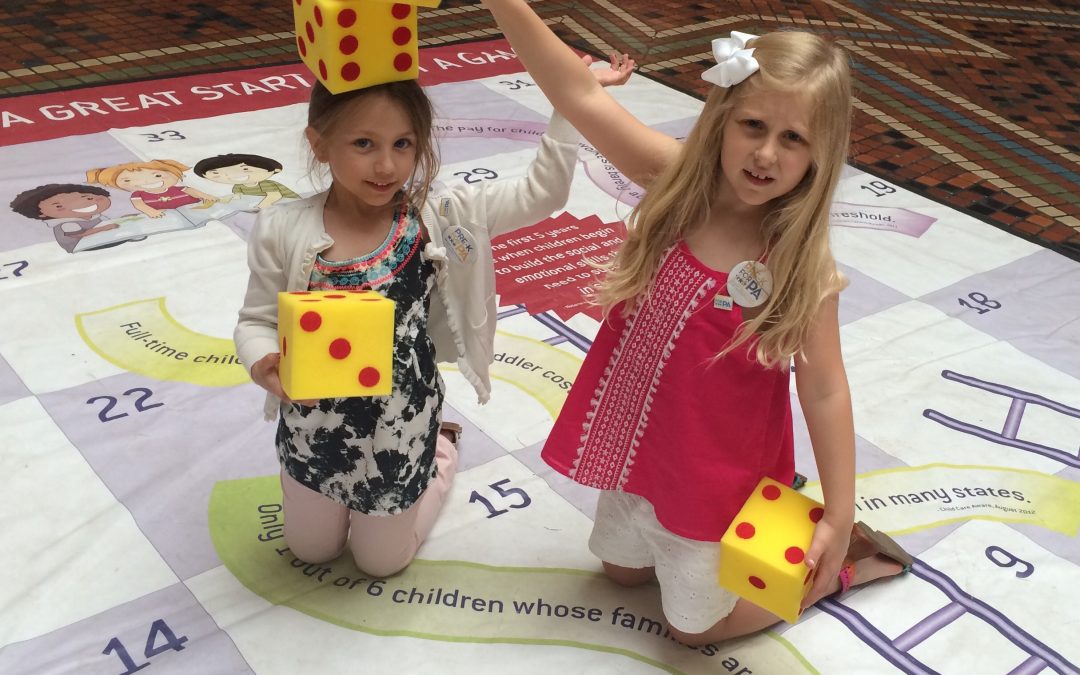
Harrisburg, PA (June 23, 2016) –While pre-k advocates and legislators show their continued support for pre-k expansion by trying their hand at a life-sized Chutes & Ladders game in the East Wing Rotunda today, the Pre-K for PA Campaign expressed its disappointment with Governor Tom Wolf stepping back on his commitment for meaningful pre-k expansion from his list of “must haves” in the final 2016-17 state budget agreement.
The principal partners of the multi-year Pre-K for PA campaign to increase funding for high-quality pre-k issued the following statement regarding the governor’s announcement:
“The governor’s backtracking on his campaign priority is a huge setback for the 120,000 3- and 4-year-olds who currently lack access to high-quality pre-k programs that will prepare them to enter school ready to learn. This pace of growth is inadequate.”
“In spite of this setback, the pre-k campaign remains hopeful that legislative leaders on both sides of the aisle will remain responsive to young children’s needs in their districts and boost pre-k funding beyond the governor’s current request.”
“Over the past several months a wide show of force that includes local philanthropic groups, mayors and municipal leaders, pediatricians, chamber of commerce officials, and an ever-growing corps of highly respected business, military and law enforcement leaders, have joined the Pre-K for PA campaign’s call for a $90 million expansion for Pre-K Counts and Head Start State Supplemental in the 2016-17 state budget. Such an investment would allow 7,400 more Pennsylvania children to attend high-quality pre-k next year in addition to making the 6,200 half-year slots full-year. These children will not have another chance to reap the benefits of high quality pre-k. The time to invest is now.”
Pre-K for PA and MomsRising are teaming up for a “Moms for Pre-k Day” at the State Capitol in Harrisburg today. Legislators, staffers and visitors to the Capitol are invited to join moms and kids for Chutes & Ladders fun.
Pre-K for PA is an issue campaign supported by individuals and organizations across Pennsylvania who believe that investing in our children is the right choice and an urgent necessity. Its vision is that every 3- and 4-year-old in Pennsylvania will have access to high-quality pre-k. For more information visit www.prekforpa.org.
# # #

Philadelphia Magazine: PA Business Leaders: We Need More Money for Pre-k
While the soda tax battle finally ended on Monday when Mayor Jim Kenney signed the long-contested sugary drinks tax into law, local business leaders are saying more needs to be done.
They’re calling on the state to to pump an additional $90 million into funding for high-quality pre-K, the Philadelphia Business Journal reports.
Representatives from the Greater Philadelphia Chamber of Commerce, the Main Line Chamber of Commerce, the African American Chamber of Commerce and the U.S. military say the investment would bridge the STEM workforce skills gap beginning in the formative pre-K years. The money would expand pre-K access for 7,400 more children and extend the school year for 6,200 students, CBS Philly reports.
To back this position up, the leaders have cited STEM and Early Childhood — When Skills Take Root, a report released on Friday by Mission:Readiness, an education advocacy organization run by retired military leaders and Washington D.C.-based education advocacy group, ReadyNation.
The report says that STEM (science, technology, education, and math) jobs, like those in healthcare and computer science will drive the economy, growing by as much as 20 to 37 percent nationwide, but in Pennsylvania, the pipeline to these professions is weak — nearly two-thirds of eighth graders aren’t proficient in math and science and more than a quarter of students moving into higher education in the state require remediation in math and English.
The report also highlighted recent findings from the Pennsylvania Chamber of Business and Industry that show that companies spend over $188 million per year on retraining employees and that 52 percent of employers face difficulty hiring people with adequate skills, training, and education.
“Our future’s success and our nation’s technological advantage depend upon the constant supply of highly trained, highly capable technical talent,” Jim Waddington, director of strategic marketing solutions at Lockheed Martin told the Business Journal.
Read the full article here.
Philadelphia Business Journal: Local business leaders call for $90M increase in pre-K funding from state
Pennsylvania businesses and military leaders are calling on state policymakers to put an additional $90 million towards quality pre-K, an investment they say will eventually help bridge a STEM workforce skills gap in the state.
Nearly two-thirds of Pennsylvania eighth graders are not proficient in math and science and more than a quarter of students entering the Pennsylvania State System of Higher Education require remedial education in math and English, according to STEM and Early Childhood – When Skills Take Root, a report released Friday by Mission: Readiness and ReadyNation.
The two nonprofits, with officials from the Greater Philadelphia Chamber of Commerce, the Main Line Chamber of Commerce and the African American Chamber of Commerce, said the report’s findings show Pennsylvania lawmakers must address the long-term STEM needs in the workforce.
“You don’t need a businessperson to tell you that the United States is facing changing workforce demands,” said Jim Waddington, the director of strategic marketing solutions at Lockheed Martin.
“Just take a look around,” he said. “Under the hood of your car to the hospital operating rooms to defense systems of our industry, the 21st century workforce is operating technology that one could only dream of just a generation or even a year or two ago.”
The report found more 52 percent of the state’s employers had difficulty hiring people with adequate skills, training or education – especially in technical and skilled trade jobs.
Steven Bradley, of the African-American Chamber added “economic empowerment is crucial to the growth of the African-American chamber,” pointing out the report shows African-American and Hispanic kindergartners’ math scores lag behind white and Asian children.
“Our future’s success and our nation’s technological advantage depend upon the constant supply of highly trained, highly capable technical talent,” Waddington said.
About 40,000 children between the ages of 3 and 4 live in Philadelphia, but 59 percent do not have access to publicly funded, high quality pre-K, according to Kids Count Data Center.
Efforts to correct this issue in the city are already underway as Mayor Jim Kenney signed Monday the sugary drinks tax into law, the funds of which are mostly dedicated to funding pre-K and adding more community schools.
Outside the city, thousands of other children are also in need of more quality pre-K options, according to the chambers.
In Delaware County, 77 percent of the municipality’s 13,856 children do not have access to pre-K. Eighty-three percent of Chester County’s 13,163 children, 82 percent of Bucks County’s 14,384 children and 85 percent Montgomery County’s of 19,320 children also do not have access to pre-K, according to the report.
The call by the business leaders to up the state’s pre-K funding on Friday echoes previous statements made by other officials throughout the state.
Read the full article here.
Main Line Times: Groups join to promote quality pre-K education
By Linda Stein June 20, 2016
Narberth >> A group of business leaders and retired military leaders joined with a state representative and educators at a press conference to garner support for $90 million in additional funding for quality preschool education to improve Pennsylvania children’s math and science learning.
The group cited a new report “STEM and Early Childhood—When Skills Take Root” from Mission: Readiness and ReadyNation that highlights some alarming statistics, including that 52 percent of Pennsylvania employers say they have trouble hiring people with adequate skills, training and education and 56 percent of employers expect that problem to get worse. Also, some $188.9 million is spent on retraining employees yearly in the state and 2/3 of Penn. 8th graders are not proficient in math and science. And 28 percent of students who enter the state university system need remedial courses. The rate for low income students is 40 percent.
James Waddington, director of strategic marketing solutions with Lockheed Martin and member of the PA Early Learning Investment Commission, said his corporation, and many others need people with good STEM (science, technology, engineering and math) skills. And with 90 percent of the human brain developing by age 5, kids can’t wait until kindergarten to learn those skills.
“The bottom line is, these investments in pre-K are investments in the future workforce,” said Waddington, noting that some 120,000 children ages 3 and 4 do not have access to pre-K in Pennsylvania.
“Our state must do better,” he said
Bernard Dagenais, president and CEO of the Main Line Chamber of Commerce, said local companies need tech savvy employees and the lack of those people is a topic that often comes up. Trained workers are needed for the region to compete, he said. So they either spend money training their employees or bringing workers in from out-of-state, he said. And STEM-based jobs, such as computer science and healthcare, are expected to grow by 20 to 37 percent nationally.
Steven Bradley, chairman of the African American Chamber of Commerce of PA, NJ and DE, also spoke, saying it was necessary to start early to “address deficiencies.”
“The first three to five years are crucial in children’s development,” said Bradley. The young brain is building neural synapses at 700 per second.
“Social factors and lack of pre-K (leave) disadvantaged children 18 months behind at kindergarten,” said Bradley. “It’s hard for them to catch up.”
He added, “It is important that we empower our children to achieve success.”
Retired Major General Wesley Craig, former commander of the Pennsylvania National Guard, said that Mission: Readiness began when the military learned that so many young people did not have the education needed to enlist.
Some 72 percent of 17 to 24 year olds in Pennsylvania are not able to enlist because they can’t meet the military standards, he said.
“That’s a terrible, terrible thing when you think about it,” he said. “We are increasingly reliant on technology.” Craig then cited a long list of sophisticated weapons now employed, from laser-guided weapons to drones.
“It’s not your father’s tank,” Craig said.
Thomas Wilson, retired rear admiral, said that while the military provides quality childcare more children in civilian life need access to quality pre-K programs and that Pennsylvania lags behind neighboring states in this area. In Montgomery County, 85 percent of children whose families are income eligible or 6,300 children do not have access to quality pre-K, he said. Also, about 120,000 children in the state are in the same situation.
While some people question the cost, “failing to invest in these children will have a far higher long-term cost than sending them to these programs…What we can’t afford is the price tag of these children failing to reach their full potential.”
Wilson added, “Mission: Readiness is supporting the governor’s request for $90 million more for pre-K in the 2016-17 budget.”
State Rep. Mary Jo Daley, D-148, also spoke. She said the $90 million is “absolutely essential” and would fund pre-kindergarten for some 7,400 more children. Another 6,200 would be able to go to pre-K for a full year instead of a half year.
Democratic women in the state House wrote a letter in support and as mothers and grandmothers they know how important early childhood education is, she said.
Read the full story here.
Reading Eagle: Letter to the Editor: Pre-k Programs Need More Funding
June 18, 2016
At the Albright Early Learning Center there is a waiting list for our high-quality pre-kindergarten program. As a Pre-K provider, I see the difference high-quality preschool can have socially, emotionally and intellectually on a child, and that the number of children who do not yet have access is unacceptable.
High-quality preschool can be such an integral part of early learning, especially for those who are the greatest risk for failure later in life. Without a great start in pre-K, the education gap only widens as children get older. As a director of an early-learning facility, I know this to be true, but I’m clearly not the only one. Pre-K has support from business leaders, law enforcement, parents and both sides of the political aisle in Harrisburg. It is a testament to just how strongly Pennsylvanians feel about the importance of pre-K.
I am aware that local pre-K centers have received some additional funding from the state recently to open up more slots for students (“Celebrating pre-K funding increase,” Reading Eagle, March 19). We must find a way to invest more in this once-in-a-lifetime opportunity for our young children. The need is still so great. Let’s provide access to a high-quality education to all of Pennsylvania’s youngest learners. Let’s make it count.
Laura Heckart
Spring Township
Editor’s note: Heckart is director of the Albright Early Learning Center in Muhlenberg Township.
See the letter to the editor here.