Times-Leader: Amid razor wire and prison blocks, advocates push for more early education money
April 18, 2019 by Mark Guydish
With perimeter cameras peering down and razor wire piled high behind them, advocates pushed Thursday for an increase in state funding for early childhood education, repeating the well-documented evidence that money spent on pre-school can pay huge dividends later in life by — among other things — keeping them from growing up into criminals.
“It is budget season and our hope is that access to state funded high quality pre-K will again be a priority,” Bruce Clash began a media conference near the double fencing of State Correctional Institute — Dallas
The Pennsylvania state director of “Fight Crime: Invest in Kids,” Clash stood flanked by nine area police department chiefs, Luzerne County District Attorney Stefanie Salavantis, state Department of Corrections Secretary John Wetzel, and several other dignitaries.
They had gathered outside the imposing double-fence of SCI-Dallas to unveil a new report titled “Law Enforcement Agrees: High Quality Pre-K is Crime Prevention.” The report updates data backing a long-standing contention that investing in publicly-funded early education helps avoid more costly interventions later in life.
Studies have followed children for decades after getting into high quality pre-K, Salavantis said, and “the results are remarkable: Better performance in school, less special education, fewer high school drop outs and ultimately fewer crimes committed and a reduction in the number of prisoners.”
Statewide, about 56 percent of those eligible for publicly-funded pre school — about 98,000 children — “lack access because of limited funding,” she said. In Luzerne County the rate is worse, where 64 percent — 2,939 — of eligible children lack access.
Fight Crime: Invest in Kids is pushing for approval of Gov. Tom Wolf’s plan to increase spending for pre-K by $50 million in the 2019-20 state budget. $40 million would expand the state’s Pre-K Counts program, while the other $10 million would get more children into the federal Head Start program.
“Years of experience have taught us we can’t simply arrest, prosecute and incarcerate our way out of the crime problems that currently plague our communities,” Hanover Township Police Chief Albert Walker said. “ We must be proactive, and implement strategies that keep people from turning to crime in the first place. And education must be a focal point of that strategy.”
Ingrid Everett, an education professor at Bloomsburg University, talked of the rapid development of the brain in the first three years, but also cited an instance where a mother was inspired by the support her child received and decided to go to college and get her degree.
“It’s much greater than investing in the child. You’re actually investing in the whole community when you support early education.”
Read the full article here.
ABC 16: Corrections Secretary: More Funding for Pre-K Will Reduce Crime
April 18, 2019 By Jessica Albert
The secretary of the Pennsylvania Department of Corrections came to Luzerne County highlight the importance of education when it comes to decreasing crime.
State leaders believe spending more money on pre-kindergarten will save money for the state’s prison system which costs about $2 billion to run each year.
“I think most citizens really want kids to have an opportunity to be successful, and I think that when citizens hear that if we invest money in quality early childhood education, we can spend a lot less money on places like SCI Dallas,” said Secretary John Wetzel, Department of Corrections.
Wetzel came to the State Correctional Institution-Dallas in Luzerne County to release a report in support of Governor Wolf’s budget. It proposes spending $50 million for Pre-K programs across the state.
Ingrid Everett, a Bloomsburg University faculty member who teaches early childhood education classes, was in attendance.
“Having worked with Head Start for a number of years, I’ve really seen how much you can support children in developing and I’ve also seen how it can help support the families, too,” Everett said.
Luzerne County District Attorney Stefanie Salavantis is one of the people who support this program. She says she’s seeing younger offenders committing more serious crimes.
“We in the district attorney’s office and law enforcement in Luzerne County see a lot of young children getting involved in criminal acts, and we want to do more to prevent that and this today, what we stand behind, this is proven that it will keep them from being involved in the criminal justice system,” said Salavantis.
Watch the video here.
FOX 56: A push for PA Pre-K programs to keep people out of prisons
By: Viktoria Hallikaar April 18, 2019
Pre-K is not just about kids learning their ABCs and 123s, it’s also setting them up for a lifetime of success.
“Building the right foundation is key here,” said Luzerne County District Attorney Stefanie Salavantis.
Lawmakers, police chiefs, and other local representatives were at the state correctional institution at Dallas Thursday pushing for an investment in pre-K.
“Crime prevention starts outside of these walls and these fences and really starts in the classroom for our most vulnerable kids,” explained John Wetzel, the state Department of Corrections Secretary.
“What we’re trying to do is invest in kids now so that we don’t have to deal with them later in the criminal justice system,” added Wilkes-Barre City Police chief Joseph Coffay.
Currently, PA spends $3.2 billion on corrections each year.
A report says a $50 million investment in high-quality Pre-K programs would save $150 million in criminal justice costs, but it’s not just about the money.
“This is about serving children in our community and I think when you come together to do that, we don’t worry about what letter is after your name,” said 20th District State Sen. Lisa Baker. She also chairs the Senate Judiciary Committee.
Governor Wolf proposed investing the $50 million in his 2019-2020 budget.
According to a study, that would add 5,500 Pre-K spots.
Giving the kids across PA access to the classrooms they need.
“We go over things like we treat people the way we want to be treated, to have manners, to have respect, to learn to cooperate,” explained Wilkes-Barre Academy Pre-K teacher Deborah Cooper. “All these things as a beginning will be fabulous as they get older.”
A strong foundation many behind bars might not have had.
“What we’re experiencing today is literally decades of neglect,” said State Rep. Eddie Pashinski of the 121st district.
Read the full article here.
Governor and First Lady Host Annual Easter Egg Event to Highlight Importance of Pre-K Investment
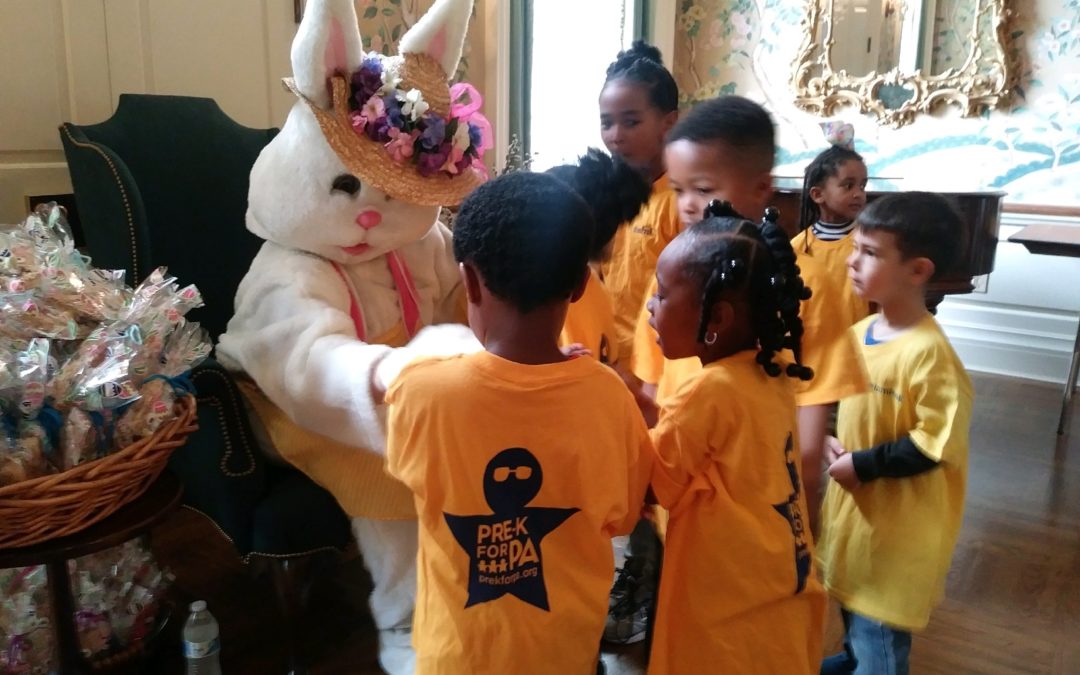
Harrisburg, PA (April 15, 2019) – Governor Tom Wolf and First Lady Frances Wolf today hosted pre-school classes from across the commonwealth at the annual Easter Egg Event at the Governor’s Residence. The event was co-sponsored by Pre-K for PA, a non-partisan advocacy group that supports the expansion of publicly funded pre-k. Over 100 pre-school aged children participated.
“The long-term benefits of high-quality early childhood programs are tremendous – it reduces costs to our schools, enables stronger earning potential in our workforce, and leads to increased tax revenues to support a robust economy,” Governor Wolf said. “Frances and I are very proud that Pennsylvania delivers high-quality, publicly funded pre-k to many at-risk children, but a serious investment must be made to continue toward the goal of providing access to all at-risk kids.”
In his 2019-20 budget, Governor Wolf proposed an additional $50 million to support high-quality pre-k programs in the commonwealth. With $115 million in funding increases secured over the past four years, this additional investment will more than double the funding for Pre-K Counts programs since 2014-15 and increase funding for Head Start Supplemental Assistance by 77 percent.
“Today, Pennsylvania ranks 18th of the 30 states investing in high-quality pre-k with nearly 100,000 eligible children still lacking access,” said Jodi Askins, founding partner of Pre-K for PA. “With Governor Wolf’s proposal to invest $50 million in this year’s budget, 5,500 more children will be able to access high-quality pre-kindergarten, a fundamental building block of our state’s education system that helps ensure children have the strong foundation necessary to enter kindergarten ready to learn.”
Studies show that children who participate in high-quality pre-kindergarten perform better in school, graduate at higher rates, and earn more throughout their working lives compared to peers who do not have access to early learning programs. Additionally, children who were previously enrolled in Pre-K Counts outperform their economically disadvantaged peers in third grade math and reading.
Governor Wolf’s budget also leverages $15 million in federal funding to expand high-quality childcare programs to nearly 1,000 Pennsylvania infants and toddlers. It also includes a $5 million investment for evidence-based home visiting programs, to serve an additional 800 vulnerable families.
New Pittsburgh Courier: Letter to the Editor
By Esther Bush 04/04/2019
Dear Editor:
With the state budget looming, interest in the state investment in public education is higher than ever. While Governor Wolf and the PA legislature have increased education funding over the past several budget cycles, more continued investments —like the governor’s proposed additional $50 million for high quality Pre-K programs—are sorely needed. Pennsylvania still ranks 18th of 30 states investing in high-quality pre-K, and children around the state are left without a high-quality public pre-K option. More than 700 eligible children in Pittsburgh are not being served. We must do more to provide access to these children.
It’s a matter of justice. As studies have shown, Pittsburgh has a racial equity problem. Our Black students disproportionately face suspensions, and it’s been proven that the city schools have a persistent racial gap in student achievement. While Pittsburgh City Schools aims to eliminate racial disparity in achievement levels of African American students by increasing proficiency in literacy and math, it is a slow-moving target.
A new study, “Pre-K works for Pittsburgh,” prepared by the Economy League, shows that high-quality pre-K programs are an important tool to further remedy the racial disparities in the city’s public education system. The study looked at the more than 3,200 eligible 3- and 4 year-olds who live in the City of Pittsburgh who are enrolled in public high quality pre-K, and found that investments in pre-K have contributed to a narrowing of the persistent racial achievement gap in literacy and math in the Kindergarten year.
Specifically, the study found a one-percent or smaller difference between White and African American children’s school readiness. Narrowing the racial gap in a city where 30 percent of children live in poverty is a huge achievement towards racial equity in Pittsburgh. With Pittsburgh Public Schools and community-based providers working closely together, they have improved the quality of early learning programs, allowing for smoother transitions into the K-12 system. Additionally, under the guidelines of the Every Student Succeeds Act (ESSA), there is renewed attention to the role all school districts must play to ensure alignment and collaboration with educators in the birth through third grade continuum.
In a city where these racial disparities are difficult to eradicate, any program that puts all of our children on equal footing from the start should be supported and encouraged.
Esther L. Bush
President & CEO
Urban League of Greater Pittsburgh