From Pre-K for PA:
Yesterday, Governor Corbett signed into law a $29 billion state budget with the following pre-k funding: a $10 million increase for Pre-K Counts and flat funding for the state’s supplement to Head Start. These amounts were proposed by the Governor to enable 1,670 more children to participate in high-quality pre-k programs.
Pre-K for PA was formed to advocate a bold vision that Pennsylvania will ensure access to high-quality pre-kindergarten for all our children. And the reality remains that public funds enable just 1 in 6 of Pennsylvania’s 3- and 4-year-olds to enroll in such programs.
So where do we go from here?
NEW ISSUE BRIEF: Pre-K for PA released this week a report on how Pennsylvania compares to competing states when it comes to pre-k. This is the first in a series of issue briefs that will lay out options for achieving our campaign’s policy vision.
Click here to read the new policy brief:
The National Perspecive — How Pre-K in PA Comapres to Other Competing States
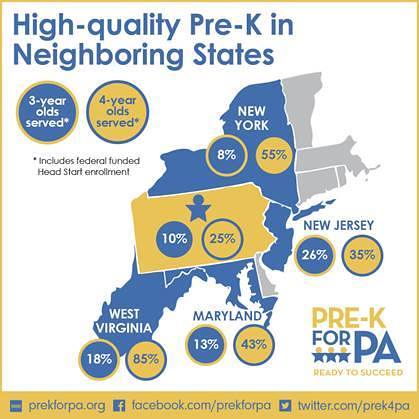
This latest analysis echoes the recently-announced finding by NIEER: Pennsylvania is falling behind. Other states, particularly those that border Pennsylvania, are outpacing us when it comes to expanding access to high-quality pre-kindergarten programs, putting us at a competitive disadvantage. From Maryland and West Virginia to New York and New Jersey, our neighbors have made a greater commitment to providing high-quality pre-kindergarten to more of their children.
Pennsylvania can do better for our children, and your support makes progress possible.
Share our state comparison graphic on Facebook and Twitter, and ask your friends and colleagues to sign the Pre-K for PA petition at www.prekforpa.org/join.
Thank you for everything you do for Pennsylvania’s children.
– The Pre-K for PA team

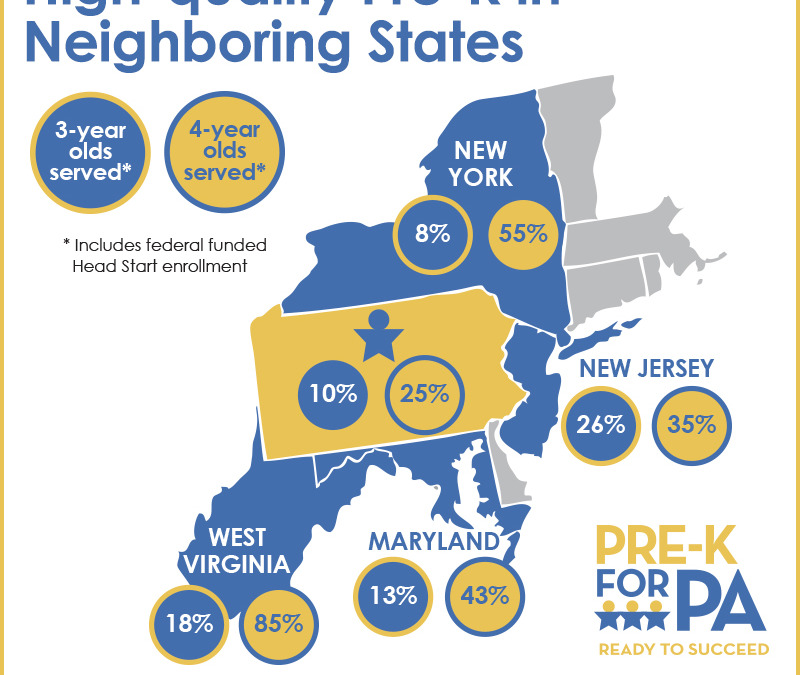
Pre-K for PA released a new issue brief: “The National Perspective: How Pre-K in PA Compares to Other Competing States, first in a series of three policy documents outlining the path to achieve our campaign vision in Pennsylvania.
Click here to download the new issue brief.
|
Issue Brief: Competing States (Facebook)
|
Issue Brief: PA Competitiveness (Twitter)
|

Pre-K for PA has developed issue briefs for policy makers and candidates to consider when developing proposals to ensure access to high-quality pre-kindergarten for every 3- and 4-year-old child in Pennsylvania. Please click below to download each policy brief:
- The National Perspective: How Pre-K in PA Compares to Other Competing States
- Driving Program Eligibility Toward High Quality
- Financing Access to High-Quality Pre-K
- Impact of High-Quality Pre-k on K-12 Education
Executive Summary
Why high-quality pre-k is a good investment
Access to high-quality pre-kindergarten gives young children the opportunity to make the most of a critical period in their academic, social, and emotional development. That is why the Pre-K for PA is working to expand access to high-quality pre-k to all 3- and 4-year-olds in Pennsylvania.
High-quality pre-k leads to reduced public spending on special education, social services, and incarceration and improves high school graduation rates, leading to increased earnings and tax revenues. Over the long-term, the return on investment (ROI) is between $7 and $17 for every $1 invested. In the short-term, expanded pre-k would create jobs and the sale of goods and services. In PA, the annual economic impact is estimated at $1.79 for every dollar spent on pre-k – a better ROI than investment in retail or manufacturing.[1]
How Pennsylvania fares on pre-k access
In PA, just 1 in 6 3- and 4-year-olds (53,000) have access to high-quality public pre-k, and more than 200,000 children lack access to high-quality pre-k, public or private. Many states, including most of our neighbors, are serving more children than PA.
| State |
3-year-olds |
4-year-olds |
| West Virginia |
18% |
85% |
| New Jersey |
26% |
35% |
| Oklahoma |
14% |
87% |
| Pennsylvania |
10% |
25% |
How the state can expand access to high-quality pre-k
Pre-K for PA is not advocating for a specific path to expanding access. Instead, the campaign is advocating for expansion guided by the following principles:
- By 2018, every 3- and 4-year-old child in Pennsylvania will have access to a pre-k program, public or private, that meets high quality standards.
- The roll-out process should be structured in phases, with support for a stable, qualified workforce and ensure coverage in all types of communities – rural, suburban, and urban.
- Priority enrollment will be given to families in the greatest need.
PA’s existing pre-k programs are high-quality based on standard measures, which include the use of comprehensive early learning standards, high teacher qualification requirements, and small class sizes. As the state expands access, we must maintain high-quality by continually monitoring programs to evaluate effectiveness, ensuring alignment with the k-12 system, and identifying opportunities for program improvements.
Currently, PA spends $165.4M on high-quality pre-k, representing 0.6% of the General Fund Budget, compared to the 1.7% to 3% invested by states that serve more than half of 3- and 4-year-olds. The following chart shows three potential expansion scenarios and the associated costs.[2]
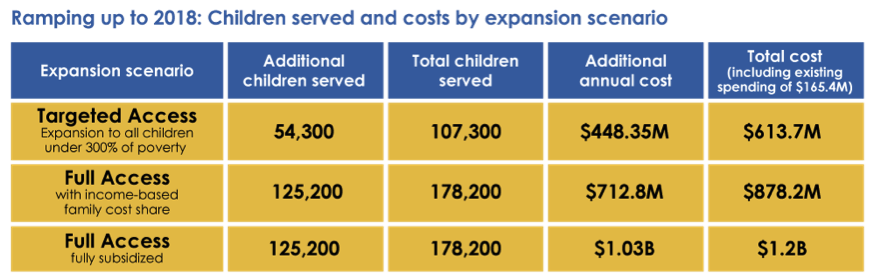
The Pre-K for PA campaign is mindful of the fiscal challenges PA faces. While increasing access to high-quality pre-k will require additional resources, the proven, long-term benefits of high-quality pre-k will ease other areas of state spending. Options for funding include:
- Maximize existing resources by ensuring all public funds are supporting high-quality programs
- Leverage private resources through tax credits and Social Impact Bonds (SIBs)
- Utilize family cost-sharing (sliding scale) so that higher-income families contribute to the cost
- Generate new revenues by increasing rates on specific taxes or removing exemptions on items not currently taxed.
The bottom line
Moving forward, PA must ensure the state’s public pre-k programs are high-quality and widely available. Because of its proven benefits and return on investment for taxpayers, high-quality pre-k has earned broad, bipartisan support among Pennsylvania policymakers and voters. For more details on how the PA can help every child be ready to succeed, see our full policy option briefs at prekforpa.org/issuebriefs. Additional resources on pre-k quality, economic impact analysis, and information about how to get involved in the campaign is available on the website, prekforpa.org.
[1] ReadyNation report footnote
[2] Cost is calculated at $8,250/child based on current state spending and modest anticipated capacity building costs.