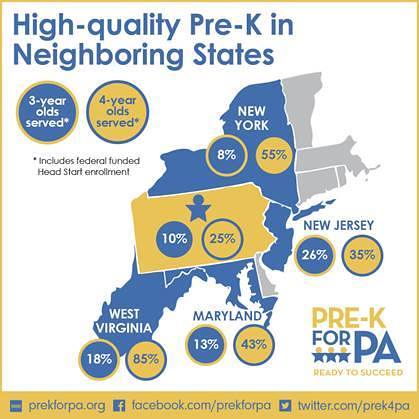
Shareable Graphic: Competing States
| Issue Brief: Competing States (Facebook)
Post by Pre-K for PA.
|
Issue Brief: PA Competitiveness (Twitter)
|
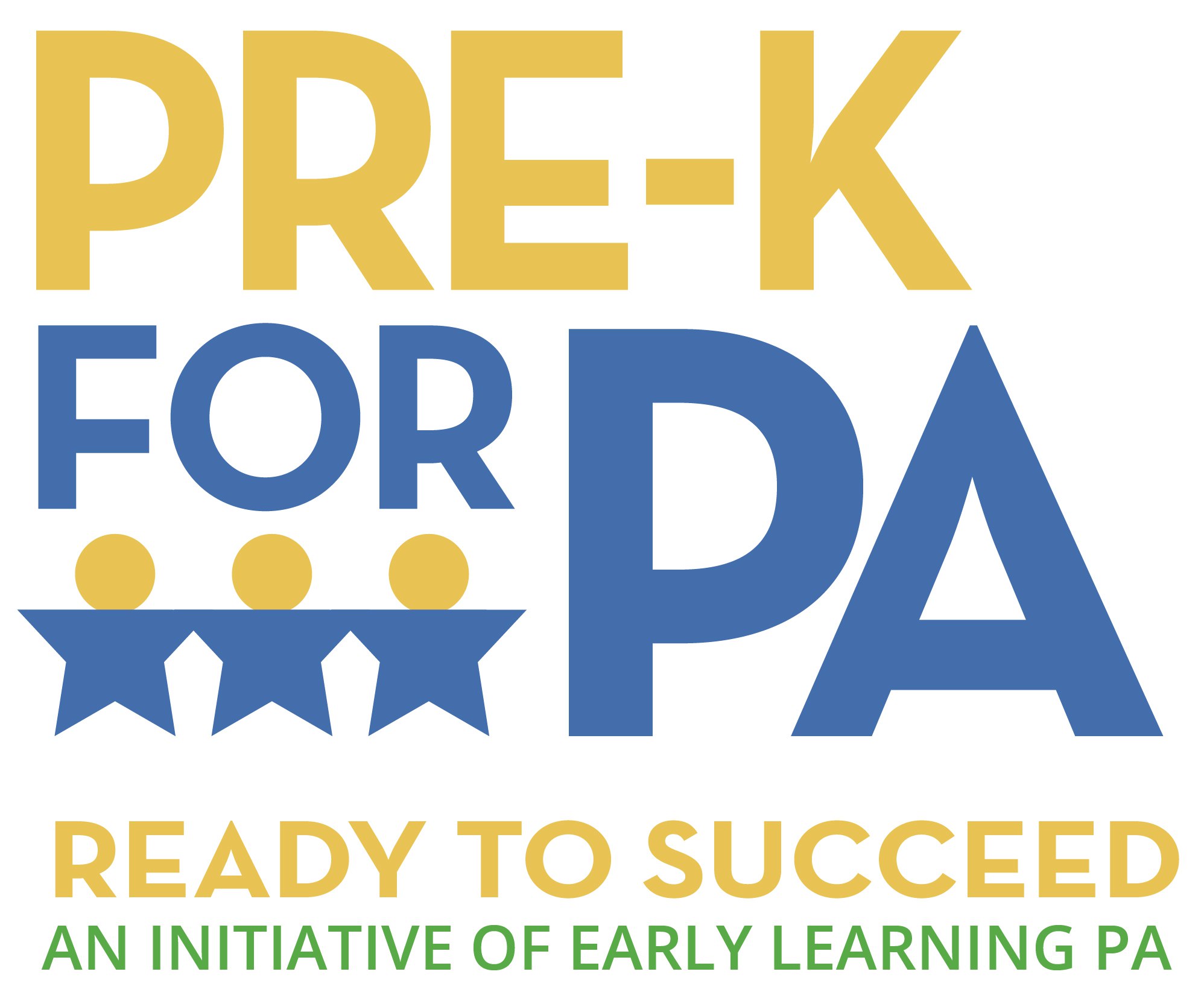
| Issue Brief: Competing States (Facebook)
Post by Pre-K for PA.
|
Issue Brief: PA Competitiveness (Twitter)
|
Pre-K for PA released a new issue brief: “The National Perspective: How Pre-K in PA Compares to Other Competing States, first in a series of three policy documents outlining the path to achieve our campaign vision in Pennsylvania.
Click here to download the new issue brief.
|
Issue Brief: Competing States (Facebook)
Post by Pre-K for PA.
|
Issue Brief: PA Competitiveness (Twitter)
|

Pre-K for PA has developed issue briefs for policy makers and candidates to consider when developing proposals to ensure access to high-quality pre-kindergarten for every 3- and 4-year-old child in Pennsylvania. Please click below to download each policy brief:
Why high-quality pre-k is a good investment
Access to high-quality pre-kindergarten gives young children the opportunity to make the most of a critical period in their academic, social, and emotional development. That is why the Pre-K for PA is working to expand access to high-quality pre-k to all 3- and 4-year-olds in Pennsylvania.
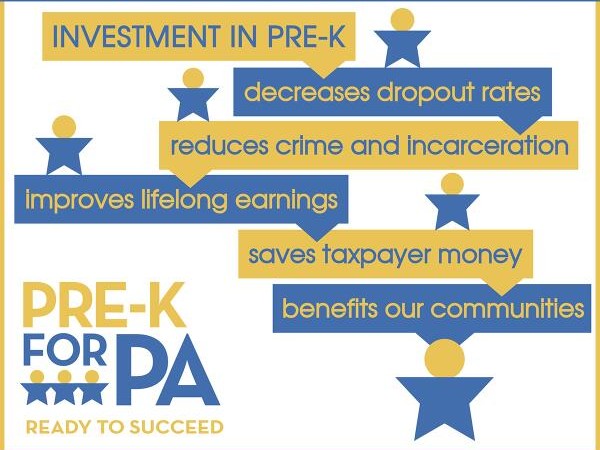
High-quality pre-k leads to reduced public spending on special education, social services, and incarceration and improves high school graduation rates, leading to increased earnings and tax revenues. Over the long-term, the return on investment (ROI) is between $7 and $17 for every $1 invested. In the short-term, expanded pre-k would create jobs and the sale of goods and services. In PA, the annual economic impact is estimated at $1.79 for every dollar spent on pre-k – a better ROI than investment in retail or manufacturing.[1]
How Pennsylvania fares on pre-k access
In PA, just 1 in 6 3- and 4-year-olds (53,000) have access to high-quality public pre-k, and more than 200,000 children lack access to high-quality pre-k, public or private. Many states, including most of our neighbors, are serving more children than PA.
| State | 3-year-olds | 4-year-olds |
| West Virginia | 18% | 85% |
| New Jersey | 26% | 35% |
| Oklahoma | 14% | 87% |
| Pennsylvania | 10% | 25% |
How the state can expand access to high-quality pre-k
Pre-K for PA is not advocating for a specific path to expanding access. Instead, the campaign is advocating for expansion guided by the following principles:
PA’s existing pre-k programs are high-quality based on standard measures, which include the use of comprehensive early learning standards, high teacher qualification requirements, and small class sizes. As the state expands access, we must maintain high-quality by continually monitoring programs to evaluate effectiveness, ensuring alignment with the k-12 system, and identifying opportunities for program improvements.
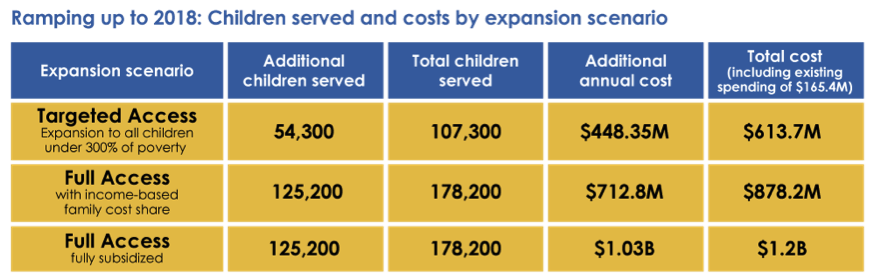
Currently, PA spends $165.4M on high-quality pre-k, representing 0.6% of the General Fund Budget, compared to the 1.7% to 3% invested by states that serve more than half of 3- and 4-year-olds. The following chart shows three potential expansion scenarios and the associated costs.[2]
The Pre-K for PA campaign is mindful of the fiscal challenges PA faces. While increasing access to high-quality pre-k will require additional resources, the proven, long-term benefits of high-quality pre-k will ease other areas of state spending. Options for funding include:
The bottom line
Moving forward, PA must ensure the state’s public pre-k programs are high-quality and widely available. Because of its proven benefits and return on investment for taxpayers, high-quality pre-k has earned broad, bipartisan support among Pennsylvania policymakers and voters. For more details on how the PA can help every child be ready to succeed, see our full policy option briefs at prekforpa.org/issuebriefs. Additional resources on pre-k quality, economic impact analysis, and information about how to get involved in the campaign is available on the website, prekforpa.org.
[1] ReadyNation report footnote
[2] Cost is calculated at $8,250/child based on current state spending and modest anticipated capacity building costs.
|
PA Budget (Facebook)
Post by Pre-K for PA.
|
PA Budget (Twitter)
|

Philadelphia, PA – While Pennsylvania’s high school seniors are proudly standing with their classmates and teachers this month as they accept their diplomas, superintendents and school boards across the commonwealth are expressing their support for Pre-K for PA’s goal of ensuring access to high-quality pre-k for every 3- and 4-year-old.
Since the campaign launched just a few months ago, more than two dozen of Pennsylvania’s school superintendents signed an open letter calling for investment in high-quality pre-k and seventeen school boards have passed resolutions sending the same message to policymakers in Harrisburg. This growing number of “Supers for Pre-K” are joining the more than340 supporting organizations and 5,500 Pennsylvanians that support Pre-K for PA – and is yet another example of the vast and diverse bipartisan support for this issue.
“Considering all of the benefits of quality early learning opportunities – particularly when it comes to preparation for school – ensuring access to high-quality pre-k for all children should be a state budget policy priority,” said Dr. Natalie Thomas, Superintendent of the School District of Cheltenham Township. “As I see day in and day out, if all children have the same chance to attend a quality early learning program, we can ensure they will be ready for kindergarten, future academic achievement and lifelong success.”
Superintendents see firsthand every day what decades of research supports –that a high-quality K-12 education starts with high-quality pre-k – which greatly increases the likelihood of high school graduation and college enrollment, in turn leading to stronger employment opportunities and increased lifetime earning potential. They also know that enrollment in quality pre-k can cut special education placements by nearly half through 2nd grade and reduce grade repetition by as much as a third through 8th grade – therefore significantly reducing the costs associated with remediation and special education for school districts.
Pre-K for PA is an issue campaign supported by individuals and organizations across Pennsylvania who believe that investing in our children is the right choice and an urgent necessity. Our vision is that every 3- and 4-year-old in Pennsylvania will have access to high-quality pre-k. We will not endorse nor oppose candidates, but rather we will advocate on behalf of this vision for Pennsylvania’s children, schools and communities.